Last Updated: July 27, 2026
Duffle bag sizes vary by purpose and construction, from compact 20–30L gym bags to 60–90L travel duffles. This guide compares standard dimensions in centimeters and inches, explains how to measure length, width and height, and helps you estimate capacity for carry-on or checked luggage.
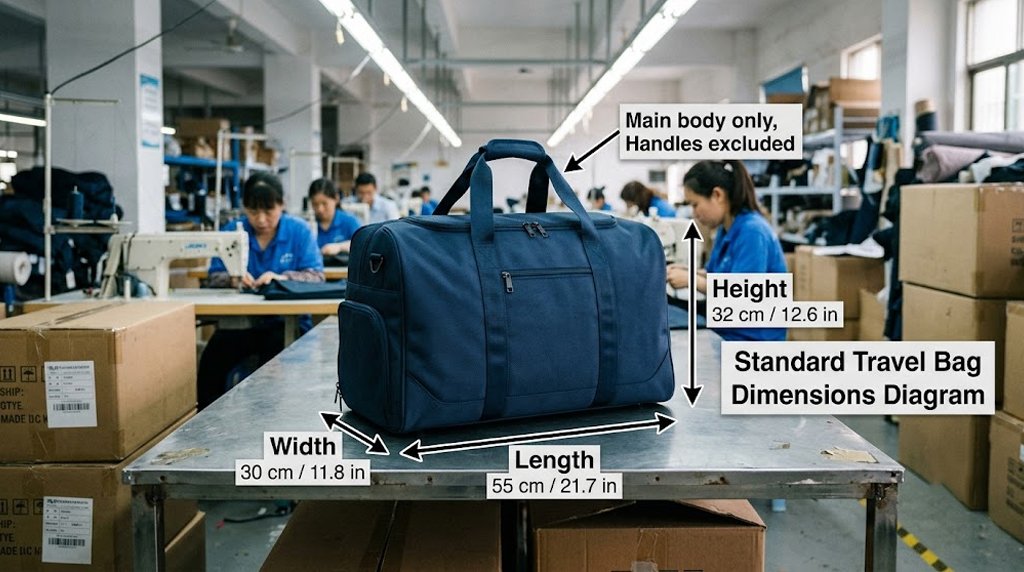
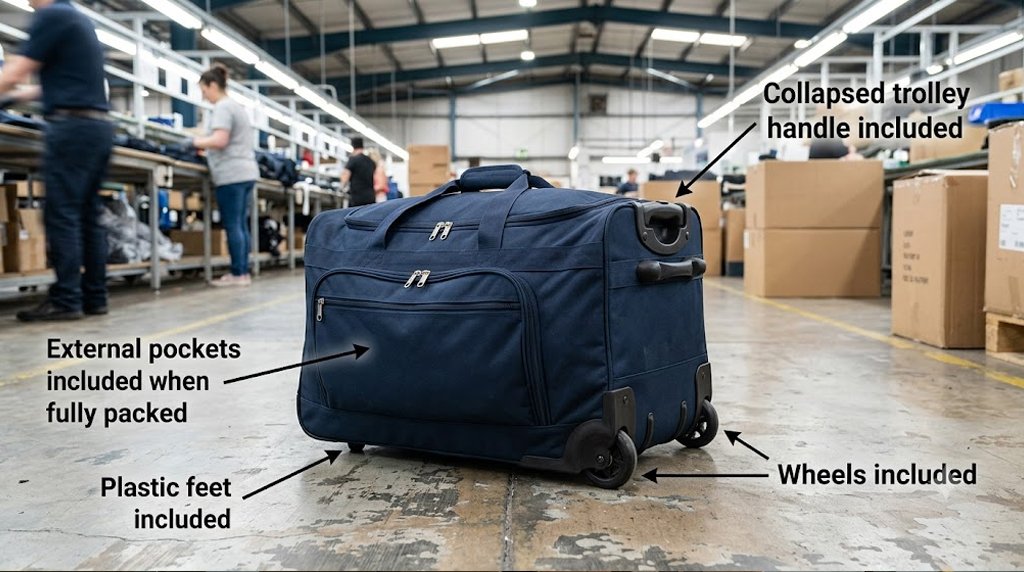
To measure a duffle bag, place it on a flat surface and expand it to its intended shape without overstuffing it. Measure the length from one end seam to the other, the width across the widest part of the base, and the height from the base to the top of the main body. Exclude flexible handles, but include wheels, rigid pockets and protruding hardware when checking airline size limits.
For brands and manufacturers, always specify whether dimensions refer to the empty body, the fully packed bag or the complete external size. This prevents inaccurate listings, sampling mistakes and bulk-production inconsistencies.
Understand Industry Size Classifications
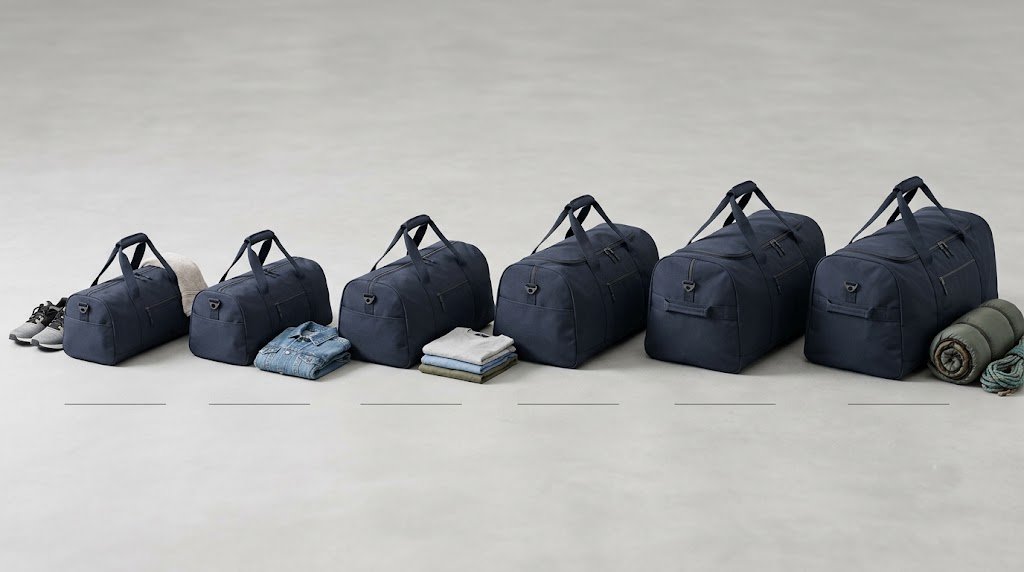
In the duffle-bag market, capacity is universally measured in liters, with each size category tailored to specific use cases. Recognizing these classifications helps customers quickly narrow their options to the bags that best suit their needs and aligns your content with how manufacturers and retailers present sizing.
Standard Capacity Ranges
-
Small (5–20 L)
Ideal for gym sessions, quick errands, or as a personal item on flights. -
Medium (21–35 L)
Perfect for day trips, outdoor excursions, or carry-on use with minimal packing. -
Large (36–50 L)
Suited to overnight stays, weekend getaways, and technical day trips. -
Extra-Large (51–65 L)
Designed for multi-day travel when you need space for extra layers or bulky gear. -
Extended Travel (66–74 L)
Accommodates week-long excursions and allows room for souvenirs. -
Expedition (75–100+ L)
Built for intensive, multi-week adventures or transporting heavy equipment.
How Volume Is Actually Measured in the Industry (ASTM vs. L×W×H)
Most brand owners assume volume is a simple L × W × H calculation. In reality, the professional industry uses two very different benchmarks.
1. The Marketing Method (L × W × H)
- How it works: Multiply external dimensions and convert to liters.
- The Flaw: It creates a “phantom volume.” Because duffles have curves, seams, and fabric thickness, this method overestimates capacity by 15–25%.
2. The Professional Standard (ASTM F2153)
- How it works: Used by brands like Patagonia and Osprey. The bag is filled with standardized polystyrene balls to measure true internal displacement.
- The Result: A more honest, lower number that reflects what a user can actually pack.
⚠️ Brand Owner Reality Check: > If you list a “50L” bag using the L×W×H method, but your product actually holds the same as a competitor’s “40L” ASTM-rated bag, you risk negative reviews for “running small.”
Comparison at a Glance
| Method | Calculation | Accuracy | Best For |
|---|---|---|---|
| Standard | Length × Width × Height (cm) ÷ 1000 | Low (+20% error) | Quick marketing specs |
| ASTM F2153 | Physical Fill Test | High | Technical/Premium brands |
| Pro Estimate | L×W×H × 0.75 / 1000) | Moderate | Honest product listings |
Osgoodway Recommendation: Use the “Pro Estimate.” Apply a 0.7–0.8 correction factor to your math and always label it as “Approximate Capacity.”
What Tools Do You Need to Measure a Duffle Bag Accurately?
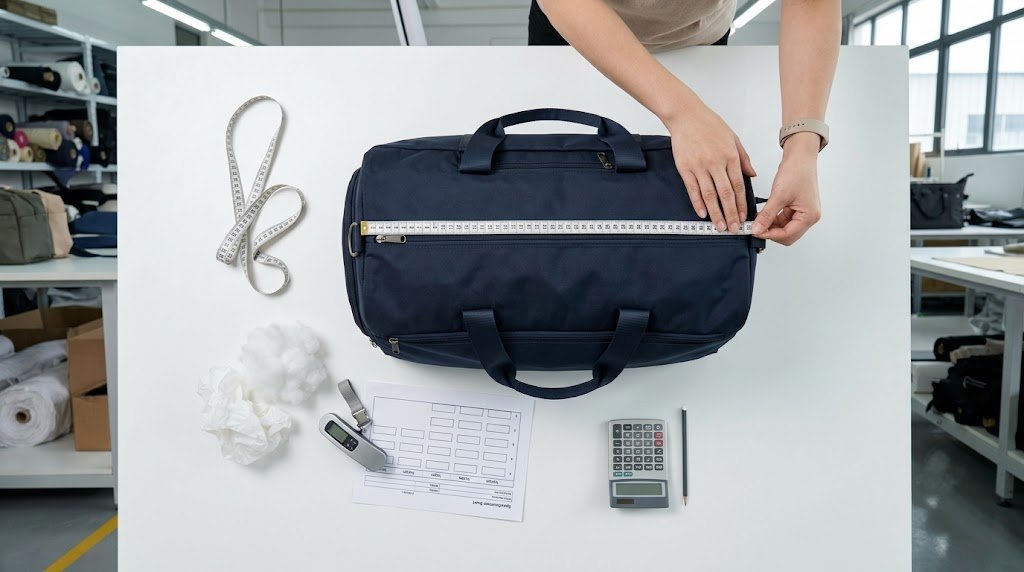
Using the wrong tools for measurement is just guessing. This leads to inconsistent product data, confused customers, and costly returns for your e-commerce store. I’ll show you the simple tools I use.
You’ll need a flexible tape measure (with both inches and centimeters), a flat surface, and maybe a rigid support like a book to keep the bag straight. For weight, a simple luggage scale is helpful. Make sure the bag is fully expanded but empty for the most accurate results.
Getting precise measurements starts with having the right tools on hand. It doesn’t require a fancy lab, just a few basic items. In my early days working with manufacturers, I learned that consistency is key, and that starts with your toolkit. You want every bag of the same SKU to have the same listed dimensions2.
The Essential Tape Measure
A flexible tailor’s tape measure is your best friend here. It needs to have both inches and centimeters, as you’ll use inches for airline compliance3 and centimeters for calculating volume. A rigid metal tape measure can be awkward to use on a soft bag.
Creating a Stable Measuring Environment
You need a large, flat surface like a floor or a big table. To get an accurate reading, the bag must be laid flat and fully expanded, as if it were full. Sometimes, I use a book or a small box inside to help the bag hold its shape, but make sure it doesn’t stretch the material.
Why a Scale is a Good Idea
While not for measuring size, a luggage scale is crucial for providing complete product information. Many travelers, especially those flying with budget airlines, are just as concerned about weight as they are about dimensions.
| Tool | Purpose | Pro Tip |
|---|---|---|
| Tape Measure | Measures length, width, height | Use a flexible one with both cm and inches. |
| Flat Surface | Ensures a stable, consistent base | A clean floor or large table works best. |
| Rigid Support | Helps the bag hold its shape | Use a book or box inside, but don’t overstuff. |
| Scale | Measures weight | Important for airline compliance and product specs. |
The Manufacturer’s Measurement Protocol
At Osgoodway, when we develop a new duffle bag for a client, we don’t just measure it once. Here’s the protocol we use to ensure every product listing is accurate:
- Measure 3 samples from the same production run — fabric stretching and sewing tolerances mean individual bags can vary by 0.5–1 cm.
- Measure each sample twice — once with the bag empty and shaped with a rigid insert, once lightly stuffed with tissue paper to simulate “packed” dimensions.
- Record the average — this gives the most representative dimension for marketing.
- Round down, not up — if a bag measures 56.5 cm long, we list it as 56 cm. It’s always better for a customer to find the bag slightly bigger than expected rather than smaller.
This process adds 10 minutes to the spec sheet workflow, but it prevents the kind of customer complaints that destroy Amazon ratings overnight.
How Do You Measure a Duffle Bag’s Length, Width, and Height?
Your bag’s dimensions seem to change every time you measure them. This inconsistency means you can’t guarantee airline compliance or give customers reliable information. Follow my simple process for accurate results.
First, lay the bag flat on a hard surface. Measure the length from one end cap to the other. Next, measure the width across the widest part of the base. Finally, measure the height from the base to the top seam or zipper line. Always pull the tape measure taut.
I once worked with a client whose “45L” bags were being returned constantly because they were too long for carry-on. The problem was simple: their team was measuring from the strap anchors, not from the bag’s actual end-to-end points. This small mistake had big consequences for their brand’s reputation. Let’s make sure that doesn’t happen to you.
Step 1: Measuring the Length
Lay the bag on its side. Identify the two furthest points on the main body of the bag, which are usually the seams of the end caps. Measure the distance between these two points. Do not include side handles or flimsy exterior pockets in this measurement.
Step 2: Measuring the Width
Place the bag on its base. Measure across the widest point of the bottom of the bag. For most duffles, this is a straightforward measurement from one side seam to the other.
Step 3: Measuring the Height (or Depth)
With the bag still on its base, measure from the flat surface up to the top line of the bag, typically where the main zipper is located. Don’t include the top handles in this measurement, as they are flexible.
| Measurement | Common Mistake | How to Do It Right |
|---|---|---|
| Length | Including strap anchors or handles | Measure from end cap seam to end cap seam. |
| Width | Measuring a compressed or empty bag | Ensure the bag is expanded to its full shape. |
| Height | Including the carry handles | Measure from the base to the top of the main body. |
The “Airline Gate Sizer” Rule: External Dimensions Include EVERYTHING
Here’s a critical distinction that many brand owners and travelers miss: your product listing dimensions and your airline compliance dimensions are NOT the same thing.
For your product listing, you measure the main body of the bag (excluding handles and straps). But when an airline gate agent puts your duffle into the metal sizing frame, everything counts — handles, straps, buckles, external pockets, and any hardware that protrudes.
This is especially important for wheeled duffles and duffles with rigid external shoe compartments. I’ve seen bags that are marketed as “carry-on compliant” based on body measurements, but once you add the 2-inch external shoe compartment, they exceed the limit.
My rule of thumb: When specifying dimensions for airline compliance on your product page, add 1–2 inches to the length and 0.5–1 inch to the height to account for external features. Better yet, test the packed bag in an actual airline sizer if you have access to one.
Developing a Duffle Bag? Check the Size Before Sampling
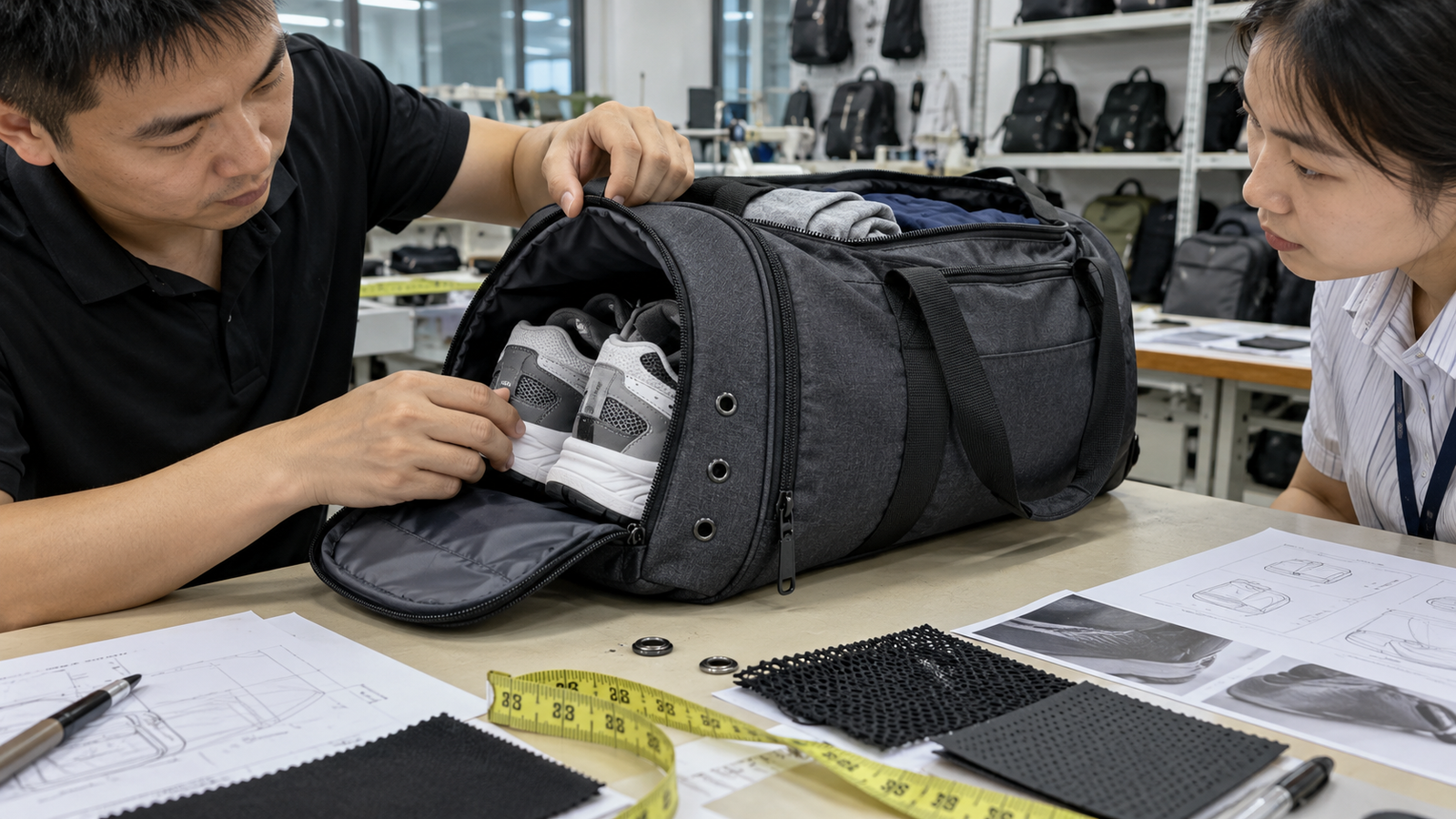
A target length, width and height are only the starting point for product development. The bag’s shape, padding, shoe compartment, wheels and external pockets can all affect its usable capacity and finished dimensions.
Before pattern development, confirm whether your measurements refer to the main body, the packed bag or the complete external size. The measurement method and acceptable tolerance should also be written into the tech pack to keep bulk production consistent.
Send us your target L × W × H, capacity, quantity and a reference image. We’ll identify obvious dimension, construction or airline-fit conflicts before sampling.
What Is the Formula for Calculating a Duffle Bag’s Volume in Liters?
You have the dimensions in inches or centimeters, but what do they really mean? Customers think in terms of capacity, and if your product page only lists dimensions, you’re missing a key selling point.
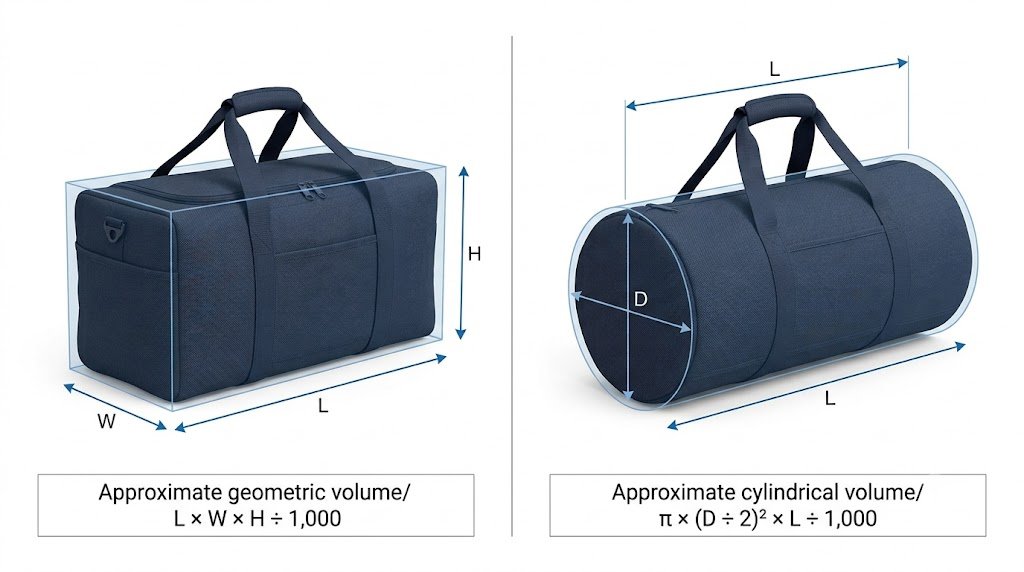
To calculate the volume in liters4, first ensure your measurements are in centimeters. Then, multiply the Length (cm) by the Width (cm) by the Height (cm). Finally, divide that total by 1000. This gives you the bag’s internal capacity in liters, a crucial metric for customers.
As a manufacturer, we use this calculation every day at Osgoodway. It’s the bridge between a physical design and how a customer understands a bag’s utility. For an e-commerce seller like Madison, communicating volume in liters is non-negotiable. It tells your customer if the bag is for a gym session or a week-long vacation.
The Formula for Volume
The industry-standard formula is simple and effective for estimating the capacity of a bag.Volume (Liters) = [Length (cm) × Width (cm) × Height (cm)] / 1000
Why Liters Matter to Customers
Liters are a universal unit of volume that helps customers compare different bags, even across different brands and styles. It’s a much more intuitive measure of “how much stuff fits” than dimensions alone.
A Practical Example
Let’s say you measured a bag and got these dimensions:
- Length: 55 cm
- Width: 35 cm
- Height: 23 cm
The calculation would be: (55 × 35 × 23) / 1000 = 44,275 / 1000 = 44.275 Liters. You would likely market this as a 44L or 45L bag.
| Dimensions (cm) | Calculation | Volume (Liters) | Common Use |
|---|---|---|---|
| 50 x 30 x 20 | (50x30x20)/1000 | 30 L | Gym / Day Trip |
| 55 x 35 x 25 | (55x35x25)/1000 | 48 L | Weekend Trip |
| 65 x 40 x 30 | (65x40x30)/1000 | 78 L | Week-Long Trip |
Volume Calculation for Cylindrical (Barrel) Duffle Bags
The L×W×H formula works well for rectangular duffles, but what about barrel-shaped bags? Many gym and sports duffles are cylindrical, and using the rectangular formula significantly overestimates their volume.
Here’s the correct approach:
Cylindrical Volume Formula:Volume (Liters) = π × (Diameter/2)² × Length / 1000
Practical example: A barrel duffle with a 30 cm diameter and 55 cm length:3.14159 × (15)² × 55 / 1000 = 3.14159 × 225 × 55 / 1000 = 38.9 Liters
If you used the rectangular L×W×H method on this same bag (55 × 30 × 30 / 1000), you’d get 49.5L — a 27% overestimate. This is why some customers feel misled when they receive a “50L” barrel duffle that seems to hold significantly less than a “50L” rectangular bag.
| Bag Shape | Correct Formula | Example (55cm long, 30cm across) | Realistic Volume |
|---|---|---|---|
| Rectangular | L × W × H / 1000 | 55 × 30 × 30 / 1000 | 49.5 L |
| Cylindrical | π × r² × L / 1000 | 3.14 × 15² × 55 / 1000 | 38.9 L |
| Tapered/Duffel-shaped | Use 0.70–0.85 × rectangular estimate | 49.5 × 0.78 | ~38.6 L |
Manufacturer’s tip: For oddly shaped duffles (tapered ends, curved body), we typically multiply the rectangular L×W×H result by a shape factor between 0.70 and 0.85 depending on how much the bag deviates from a box shape. This gives a much more honest capacity figure.
What Are the Best Duffle Bag Sizes for Different Activities?
A “large” duffle bag can mean anything to anyone. Selling the wrong size bag for your customer’s needs leads to frustration, returns, and a mismatch between product and purpose. To understand the full range of what a duffle bag is used for, it helps to match capacity to activity.
Match the bag’s volume (in liters) to the activity. A small bag (20–30L) is perfect for the gym. A medium bag (30–50L) works for weekend trips. For week-long travel or bulky gear, you’ll want a large or extra-large bag (50–75L+).
I once helped a brand reposition their 45L duffle. They were marketing it as a “large gym bag,” and sales were slow. We changed the product description to a “perfect weekend getaway bag,” and sales tripled. They were finally speaking the customer’s language. Using the right context is everything.
For Daily Use & Gym Sessions (20–35 Liters)
These bags are designed to carry the essentials for a few hours. Think a change of clothes, a pair of shoes, a water bottle, and toiletries. They are compact and easy to carry. For more on what makes a great gym duffle, check out our gym bag buying guide.
For Weekend Getaways (35–50 Liters)
This is the sweet spot for many travelers. A bag in this range can typically hold two to three outfits, a second pair of shoes, and a toiletry bag. Most bags under 45L are also carry-on compliant, but you must always check the dimensions. Our guide to versatile weekend duffel bags covers some excellent options in this category.
For Extended Travel & Expeditions (50–100L+)
Once you go beyond 50 liters, you’re in checked luggage territory. These bags are for week-long trips, family vacations, or adventures that require bulky gear like ski boots or camping equipment.
Large-capacity duffles also require more careful material selection because the fabric, base panel and seams must support a heavier packed load. Compare the main duffle bag fabric options before specifying a 50–100L travel or equipment bag.
| Capacity (Liters) | Trip Duration | Typical Contents |
|---|---|---|
| 20–35 L | Day Trip / Gym | Shoes, one outfit, water bottle, towel |
| 35–50 L | 2–4 Days | 2-3 outfits, toiletries, extra shoes |
| 50–75 L | 5–7 Days | Multiple outfits, layers, small souvenirs |
| 75–100 L+ | 1–2 Weeks+ | Bulky gear, extensive wardrobe, equipment |
The Visual Packing Test: What Actually Fits in Each Size?
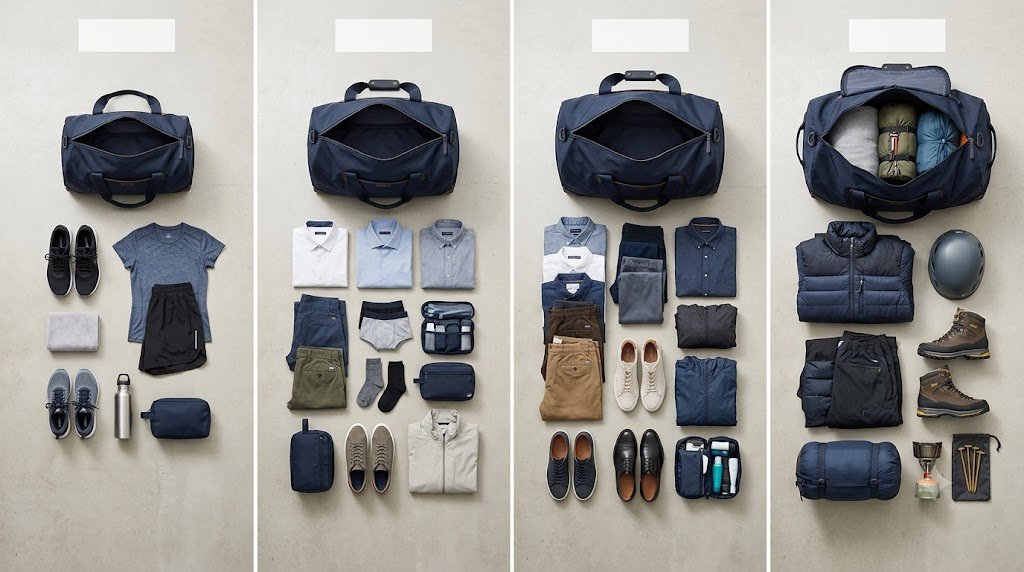
Numbers can be abstract. Here’s a practical “what fits” reference I’ve compiled from years of helping brands develop product descriptions that actually convert:
| Size | What Fits Inside (Real-World Contents) | Weight When Packed |
|---|---|---|
| 25L | 1 pair of gym shoes, 1 change of clothes, towel, water bottle, toiletry kit | 4–6 kg (9–13 lbs) |
| 40L | 3 shirts, 2 pants, underwear, socks, 1 pair of shoes, toiletry bag, light jacket | 7–10 kg (15–22 lbs) |
| 60L | 5 shirts, 3 pants, 2 pairs of shoes, toiletries, jacket, rain layer, small souvenirs | 12–16 kg (26–35 lbs) |
| 80L | Full week’s wardrobe, 2 pairs of shoes, coat, toiletries, laptop, travel pillow, souvenirs | 18–23 kg (40–50 lbs) |
| 100L+ | Above + bulky items (ski boots, camping gear, helmet), multiple-person packing | 23+ kg (50+ lbs) |
Brand owner tip: Photograph these real-world packing scenarios for your product images. Showing a flat-lay of “what fits” next to the bag is one of the highest-converting image types on Amazon and Shopify. We provide this kind of photography support as part of our OEM/ODM service for clients who want to launch with strong visual content.
Comparison Table: Different Types Of Duffle Bags
Duffle bags come in various sizes and styles, each designed for specific uses and activities. Here’s a comprehensive comparison table that outlines the different types of duffle bags, their capacities, dimensions, and ideal uses:
| Duffle Bag Type | Capacity (Liters) | Ideal For |
|---|---|---|
| Small Duffle Bag | 5-20 | Short outings, day trips, gym sessions |
| Medium Duffle Bag | 21-35 | Full-day adventures, weekend getaways |
| Large Duffle Bag | 36-50 | Overnight trips, technical day trips |
| Weekend Duffle Bag | 51-65 | Weekend travel, short vacations |
| Extra-Large Duffle Bag | 66-100 | Extended travel, camping trips |
| Wheeled Duffle Bag | 40-100 | Multisport travel, family trips, road trips |
| Carry-On Duffle Bag | Up to 40 | Short flights, personal items |
2026 Airline Carry-On Size Limits: Duffle Bag Compliance Chart
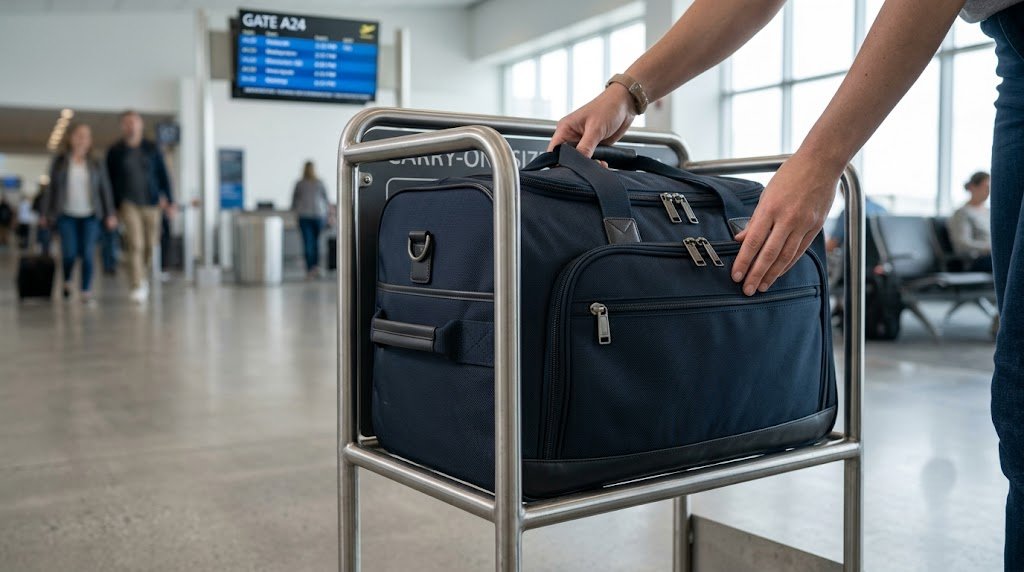
This is the section most people are really looking for when they search “how to measure a duffle bag.” They want to know: will my bag fit on the plane?
In 2026, airlines haven’t introduced a new universal standard, but enforcement has become noticeably stricter. Gate agents now use automated scanners and metal sizing frames more frequently. Bags that used to pass with a squeeze are now being gate-checked — and the fees range from $35 to $100+.
Here’s a quick-reference chart for the most commonly flown airlines. For a deeper dive, read our guide on whether your duffel bag can be a carry-on.
Carry-On Size Limits by Airline (2026)
| Airline | Max Carry-On Dimensions | Max Weight | Key Note |
|---|---|---|---|
| Delta | 22 × 14 × 9 in (56 × 36 × 23 cm) | No published limit | Rarely enforced on domestic; stricter on regional jets |
| United | 22 × 14 × 9 in (56 × 36 × 23 cm) | No published limit | Bin space determines; board early for overhead access |
| American | 22 × 14 × 9 in (56 × 36 × 23 cm) | No published limit | Removing gate sizers; agent discretion increasing |
| Southwest | 24 × 16 × 10 in (61 × 41 × 25 cm) | No published limit | Most generous US domestic limits |
| JetBlue | 22 × 14 × 9 in (56 × 36 × 23 cm) | No published limit | Blue Basic fares: personal item only |
| Spirit | 18 × 14 × 8 in (46 × 36 × 20 cm) | 40 lbs | Personal item only free; carry-on = $35–$99 |
| Frontier | 24 × 16 × 10 in (61 × 41 × 25 cm) | 35 lbs | Free personal item is 18 × 14 × 8 in |
| Ryanair | 21.7 × 15.7 × 7.8 in (55 × 40 × 20 cm) | 10 kg | Strictest depth limit; uses metal sizing cages |
| EasyJet | 17.7 × 13.8 × 7.9 in (45 × 36 × 20 cm) | No published limit | Small cabin bag only for base fares |
| British Airways | 22 × 17.7 × 9.8 in (56 × 45 × 25 cm) | 23 kg | One of the more generous international limits |
| Emirates | 21.7 × 15.7 × 9.8 in (55 × 38 × 20 cm) | 7 kg | Weight strictly enforced |
| ANA / JAL | 21.7 × 15.7 × 9.8 in (55 × 40 × 25 cm) | 10 kg (domestic: 7 kg) | Asian carriers enforce weight at check-in |
The duffle bag advantage: Soft-sided duffle bags have a significant edge over hard-shell luggage at the gate. If your duffle is 1–2 inches over the limit but not fully packed, it can compress to fit the sizer frame — something a rigid suitcase cannot do. This is one of the biggest practical benefits of choosing a duffle over a roller for carry-on travel.
For brand owners: If you’re developing a carry-on duffle, I recommend designing to a maximum of 21 × 13 × 8.5 inches body dimensions. This builds in enough margin for external features (handles, pockets) while ensuring compliance with 95% of major airlines. At Osgoodway, this is the default “safe zone” we use when a client requests a carry-on duffle design.
How Do Different Duffle Bag Styles Affect Their Measurements?
You might think all duffle bags are measured the same way. But a cylindrical duffle and a rectangular one have different shapes, which can throw off your calculations and customer expectations. For a full breakdown of all styles available, see our guide to the different types of duffle bags.
A classic rectangular duffle is measured with length, width, and height. For a cylindrical or “barrel” duffle, you measure the length and the diameter of the circular end. A wheeled duffle5‘s measurements must include the wheels and handle, as airlines count them.
The shape of a duffle bag directly impacts how you measure it and how its volume is calculated. As a designer and manufacturer, we have to be precise about this. When we design a wheeled duffle at Osgoodway, for example, the frame and wheels are a critical part of the dimension specs. For carry-on models, every millimeter counts to stay within airline limits.
The Classic Rectangular Duffle
This is the most common style. Its boxy shape makes it easy to measure using the standard Length x Width x Height method we’ve discussed. It’s efficient for packing folded clothes.
The Cylindrical (Barrel) Duffle
This style is popular for its simple, sporty look. To measure it, you take the length from end to end and the diameter of the circular end cap. The diameter acts as both the width and height. The volume calculation is different here (πr²h), but for marketing, a simple L x D x D / 1000 estimate is often used for consistency.
The Wheeled Duffle
This is a hybrid between a suitcase and a duffle. When measuring, you must include the wheels, plastic feet, and the collapsed handle in your overall dimensions. Airlines are strict about this—the bag has to fit entirely within their sizer.
| Duffle Style | How to Measure | Key Consideration |
|---|---|---|
| Rectangular | Length, Width, Height | Most common and straightforward. |
| Cylindrical | Length, Diameter | Volume calculation is technically different. |
| Wheeled | Overall Length, Width, Height | Must include wheels and handles. |
The Convertible Backpack-Duffle: Measuring for Dual Use
One of the fastest-growing categories in the bag industry is the convertible backpack-duffle — a bag that can be carried as a traditional duffle or worn as a backpack using stowable straps. These present a unique measurement challenge.
The issue: When carried as a duffle, the bag’s “length” is the horizontal dimension. When worn as a backpack, that same dimension becomes the “height.” Airlines measure based on how the bag presents when placed in the sizer, which is typically upright (backpack orientation).
How to measure for product listings:
- List both orientations: “Duffle mode: 22 × 13 × 11 in | Backpack mode: 22 (H) × 13 (W) × 11 (D) in”
- For airline compliance, measure in the configuration that produces the largest external dimensions (usually backpack mode, because the straps add depth)
- Always specify that stowable straps should be tucked away before placing in the airline sizer
At Osgoodway, convertible duffle-backpacks are one of our most requested custom designs. We’ve developed pattern templates specifically optimized for the carry-on sweet spot — bags that function as both a 40L duffle and a compliant backpack. If you’re interested in this product category, GET IN TOUCH WITH US for samples and spec sheets.
Conclusion
Mastering these measurement steps ensures your product listings are accurate, builds customer trust, and helps you choose the perfect bag. It’s a fundamental skill for any successful bag brand.
Whether you’re a consumer checking airline compliance or a brand owner developing your next product line, accurate measurement is the foundation of a good experience. The best practice is simple: measure consistently, calculate honestly, and always account for the real-world conditions your bag will face — from the overhead bin to the gym locker.
If you’re developing custom duffle bags for your brand, Osgoodway can help you nail the specs from the very first sample. With 12+ years of manufacturing experience and dedicated QC at every stage, we ensure your bags measure exactly as listed — every time.
Send us your target dimensions, quantity and reference image. Our team will identify obvious capacity, construction or airline-fit risks before sampling.
Start your custom project today.
frequently asked questions
For a standard weekend itinerary, a capacity of 40 to 50 liters is the industry benchmark. This volume provides sufficient space for three days of apparel, a secondary pair of footwear, and essential toiletries. Bags exceeding 60 liters often become too cumbersome for single-shoulder carry and may exceed “personal item” or “carry-on” weight thresholds when fully packed.
To ensure a duffel is accepted in an overhead compartment, it must generally adhere to the standard dimension of 22 x 14 x 9 inches (56 x 36 x 23 cm).
- Manufacturer Insight: Unlike hardside luggage, a duffel’s “soft-shell” nature allows it to be slightly over-dimensioned if the material is flexible enough to be compressed into the airline’s sizing sizer.
Yes. Soft-sided duffels offer a mechanical advantage in air travel: compressibility. Because they lack a rigid frame, they can often fit into tighter overhead bins or under-seat spaces that would reject a hardside spinner of the same volume. This flexibility makes them a favorite for regional jets with smaller storage configurations.
Absolutely, provided the construction meets high-stress specifications. For a duffel to withstand the rigors of automated baggage handling systems, it should feature:
- High-Denier Fabrics: Minimum 800D Nylon or 1000D Polyester.
- Reinforced Seams: Double-stitched or bound interior seams to prevent bursting under pressure.
- Stowable Straps: Loose straps are the primary cause of damage in transit; checked duffels should ideally have removable or tuck-away shoulder straps.
To achieve an accurate measurement for technical spec sheets or airline compliance, the “Full-Volume Simulation” method is used.
- Stuff the bag with lightweight, compressible material (such as poly-fill or tissue) until it reaches its intended silhouette without over-stressing the zippers.
- Measure the maximum points of the length, width, and height.
- Note: Avoid using rigid inserts like cardboard boxes, as they create artificial corners that do not represent the bag’s organic shape in a real-world use case.
Most domestic and international carriers restrict personal items to approximately 18 x 14 x 8 inches (45 x 35 x 20 cm).
- Capacity Range: Generally, a duffel between 20L and 25L will fit comfortably under most aircraft seats.
- Compliance Warning: Budget carriers (e.g., Ryanair, Spirit, Frontier) utilize strict “zero-tolerance” sizers at the gate; if the duffel is overstuffed and cannot slide into the sizer, it will likely be reclassified as a carry-on with associated fees.
This discrepancy usually stems from the calculation method used:
- Geometric Volume: A simple $L \times W \times H$ calculation. This often overstates capacity because it treats the bag as a perfect rectangle, ignoring rounded corners and tapered ends.
- ASTM F2153 Standard: This involves filling the bag with small 20mm plastic spheres and then measuring the volume of those spheres. This is the “true” capacity.When evaluating bags, look for “Packed Capacity” or “Usable Volume” to ensure the specifications align with the end-user’s needs.
References
- Choosing the right tape measure is crucial for accurate measurements, ensuring compliance with airline regulations. ↩
- Accurate dimensions are key to customer trust and satisfaction, preventing returns due to size issues. ↩
- Knowing airline regulations can help avoid travel issues and ensure your bag meets carry-on standards. ↩
- Calculating volume helps customers understand capacity, making it easier to choose the right bag for their needs. ↩
- Including wheels and handles in measurements is crucial for compliance with airline size restrictions. ↩