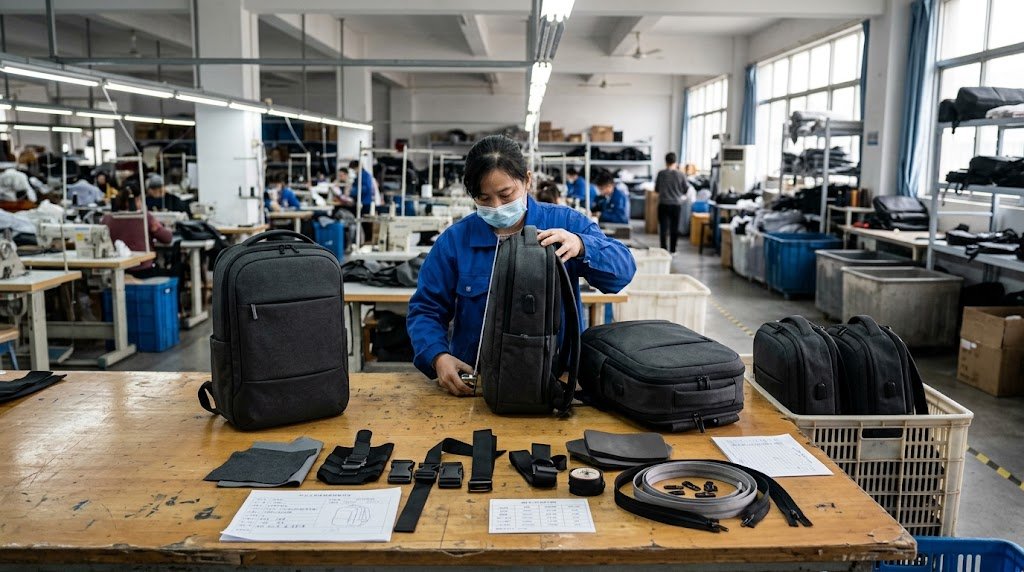
Last month, a a client I’d just started working with emailed me furious. He’d paid a 30% premium to upgrade his school bag line from polyester to nylon — because his consultant told him nylon was "the premium material." Six months after launch, he had a return rate problem. Pilling at the zipper edges. Seam splits at the strap anchors.
The nylon was fine. The coating was wrong and the bartacking was lazy. The fiber had nothing to do with it.
The direct answer: Nylon wins on abrasion resistance, tear strength, and tactile feel. Polyester wins on UV stability, natural water repellency, color retention, and cost — at a 2–3× lower price per meter. Neither wins overall – construction quality wins. Specifically coating type and seam construction — is the variable that determines whether your bag lasts 18 months or 8 years.
At Osgoodway, we produce custom backpacks for brands across the $15–$200 retail spectrum. We run both materials through our QC lab regularly. What I’m about to share isn’t pulled from a Wikipedia article — it’s from our production floor, our test reports, and a few expensive mistakes we made early on.
What This Guide Does That Others Don’t
Most "nylon vs polyester" guides are written by people who’ve never touched a fabric swatch in a factory setting. They recycle the same five talking points. Here’s what you’ll actually get in this article:
- Real factory cost data per meter — the number nobody publishes
- A use-case verdict table with no "it depends" cells
- The 3 scenarios where nylon genuinely earns its premium — and the rest where it doesn’t
- How to physically verify what your supplier actually shipped you
The Chemistry That Actually Matters – and the Part That Doesn’t

Here’s what actually matters for bag making:
Nylon (polyamide):
- Moisture absorption: 4–5%
- Stretches under load, recovers shape
- Higher tensile strength per denier
- Costs more to produce
Polyester (PET):
- Moisture absorption: 0.4% — nearly hydrophobic
- Holds shape rigidly under load
- UV-stable without treatment
- Takes dye easily and cheaply
That’s it. When a client sends me a sample and asks "nylon or polyester?" — my first question is always about the coating. Always. Because the fiber is step two.
Stop asking "which is better." Start asking "which is right for this bag, at this price point, for this end user."
How Each Fiber Actually Fails — Not Where You’d Expect
This is what the guides don’t tell you, because they’ve never seen a return pile.
Nylon’s real failure modes:
- UV degradation at exposed seams — loses ~50% tensile strength after 500hrs UV exposure (ISO 105-B02)
- Stretch-sag on heavy packs over time — the elasticity that makes it strong also causes the strap zone to deform under years of load
- Moisture weight gain in humid climates — a nylon bag can absorb enough water to feel noticeably heavier and softer after rain
Polyester’s real failure modes:
- Pilling at abrasion zones — zipper edges, bottom corners, strap attachment points
- Seam splitting at stress anchors when bartacking is under-specified
- Color bleed under cheap dye processes — I saw this firsthand on a 3,000-unit school bag run in 2019. Red dye wicked into grey panels on the first customer wash. We re-dyed the entire batch. Never again.
The Rule That Overrides Everything
A coated polyester outperforms an uncoated nylon. A welded seam beats a stitched seam regardless of fabric.
This is the argument that runs through this whole article.
The Spec Numbers — Sourced, Not Made Up

Peoples throw out numbers like "nylon withstands 100,000 Martindale cycles" with zero sourcing. That number is meaningless without specifying denier, weave structure, and coating.
Here’s what our factory’s QC data — cross-referenced against ASTM D4966 (the standard Martindale abrasion test protocol) — actually shows:
Martindale Abrasion: Nylon vs Polyester at Matched Denier
| Fabric | Martindale Cycles (to visible wear) | Tensile Strength | Tear Resistance |
|---|---|---|---|
| 500D Nylon (standard) | ~50,000 | High | High |
| 600D Polyester (standard) | ~42,000 | Medium | Medium |
| 1000D Polyester | ~60,000 | Medium-High | Medium-High |
| 1000D Cordura® Nylon | ~90,000+ | Very High | Very High |
Key finding that nobody talks about: 1000D polyester outperforms 500D nylon on Martindale cycles. Denier matters more than fiber type at the same price point. If your supplier quotes you "500D nylon" as a premium upgrade over "600D polyester" — run the math first.
UV Degradation: Where Nylon’s Real Weakness Lives
After 500 hours in a UV exposure chamber (per ISO 105-B02 standards):
- Nylon: ~50% loss in tensile strength
- Polyester: ~20% loss in tensile strength
This is the one data point I’ve never seen disputed. The practical implication: if your backpack will live in a car trunk, on a boat deck, or be used daily in outdoor UV environments — polyester is categorically better. No argument.
Factory Cost Per Meter — The Number Nobody Publishes
This is the most important table in this article for anyone placing a custom order:
| Material | Factory Cost Per Meter (FOB China, 2025) |
|---|---|
| 600D Polyester (standard PU) | $1.60 – $2.80 |
| 420D Nylon | $3.20 – $5.00 |
| 500D Nylon | $4.00 – $6.50 |
| 1000D Cordura® Nylon | $7.50 – $12.00 |
The 2–3× cost gap between polyester and nylon is the single most important number for anyone speccing a custom order. I’ve had buyers spec nylon "because it sounds premium" and then blow their entire margin buffer on material cost alone — leaving nothing for YKK zippers or proper bartacking. That’s a trade-off that visibly hurts the finished product.
Weight Per Meter: The Design Trick
At equivalent denier, nylon is 10–15% lighter than polyester due to higher fiber tenacity. This means a designer can spec a lower-denier nylon and achieve equivalent strength to a higher-denier polyester.
Example: 420D nylon ≈ strength performance of 600D polyester, at lower weight. That’s a real advantage for ultralight travel packs and premium carry-on bags where every gram matters.
Water Resistance: The Coating Overrides the Fiber. Full Stop.
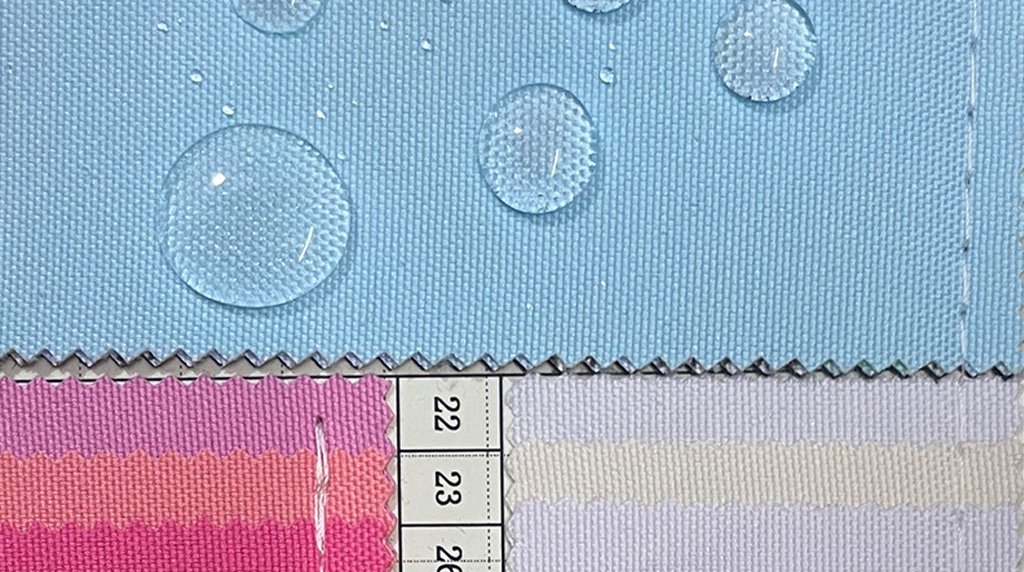
This is the most-searched sub-topic in the entire nylon vs polyester debate. And almost every guide gets it wrong.
The debate over which fiber is "more waterproof" is the wrong debate entirely. Neither fiber is waterproof without a coating. Here’s the actual performance hierarchy:
The Waterproofing Performance Hierarchy
| Rank | Configuration | Performance |
|---|---|---|
| 1 (worst) | Uncoated nylon | Absorbs 4–5% moisture; gets heavy in rain |
| 2 | Uncoated polyester | Hydrophobic baseline; repels light moisture |
| 3 | PU-coated nylon or polyester | DWR protection; degrades with washing |
| 4 | TPU-laminated nylon or polyester | 3× better retention than PU; lasts longer |
| 5 (best) | TPU laminate + ultrasonically welded seams | Near-waterproof; used in premium outdoor gear |
The fiber is the least important variable in this list.
Why Uncoated Polyester Beats Uncoated Nylon in Rain
Polyester absorbs 0.4% moisture. Nylon absorbs 4–5%. In a 30-minute rain shower with zero coating on either bag:
- Polyester backpack gains approximately 50g of weight
- Nylon backpack gains approximately 250g of weight
For school bags and commuter packs without premium waterproofing treatment: polyester is the answer. Categorically. I don’t care what anyone else says.
When Nylon Surpasses Polyester in Waterproofing
With TPU lamination, nylon’s higher mechanical strength means the laminate stays bonded longer under flex and abrasion. In a pack that gets dragged across rocks, stuffed into overhead bins daily, or used for multi-week trekking — TPU-nylon outlasts TPU-polyester over years of use.
The fiber matters again here. But only when coating quality is equal and high.
2026 Compliance Update: C0-DWR and EU REACH
If your supplier is still applying PFAS-based DWR (C6/C8 chemistry) to either nylon or polyester — that’s a problem. The EU is phasing out PFAS-based treatments under REACH regulation, with restrictions affecting textile imports tightening from 2026 onward.
C0-DWR (PFAS-free formulations) now performs at functional parity with legacy DWR for most backpack applications. We’ve been running C0-DWR on our standard production since early 2024. The performance difference is negligible. The compliance risk of staying on C6/C8 is not.
Ask your supplier directly: "What DWR chemistry are you using?" If they can’t answer, that’s your answer.
Sustainability: rPET vs Recycled Nylon — The Real Question in 2025/26
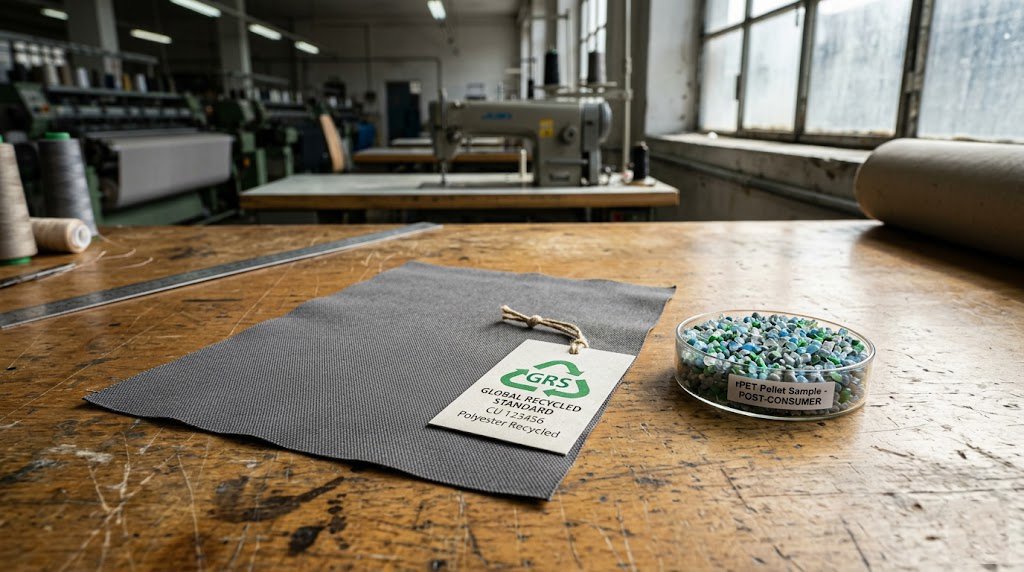
Most guides say "polyester is more recyclable." That’s technically true but commercially useless. Here’s what actually matters for a buyer writing a PO in 2026.
rPET Polyester: The Default Sustainable Choice for Most Orders
- Cost premium over virgin polyester: $0.30–$0.80/meter (down significantly from 20–30% in 2022 — the supply chain has matured)
- Performance delta: 2–5% lower tensile strength — negligible for backpack applications in the $25–$100 retail range
- GRS certification: Widely available from certified mills; adds approximately $0.10–$0.25 per unit in documentation overhead
For 80% of the branded backpack programs we see at Osgoodway — rPET polyester is the correct default. The cost premium is minimal, the certification is straightforward, and the ESG story is defensible.
Recycled Nylon (e.g., ECONYL®): Worth It Only in Specific Situations
ECONYL® and equivalent recycled nylon programs cost 15–25% more than recycled polyester. The supply chain is less mature — fewer GRS-certified mills, longer lead times, more quality variance between batches.
Justified for:
- Premium DTC brands with $150+ retail price points
- B-Corp certification positioning
- EU eco-label compliance requirements
Not justified for:
- School bags
- Corporate gifting and promotional packs
- Sports team orders under $60/unit
I’ll be direct: don’t let a sustainability consultant talk you into ECONYL for a $35 retail backpack. The cost structure doesn’t work, and your customer can’t see the difference.
Certification Decoder: GRS vs OEKO-TEX vs Bluesign
| Certification | What It Verifies | Applies To | Key Market Requirement | Factory Cost to Obtain |
|---|---|---|---|---|
| GRS (Global Recycled Standard) | Recycled content chain of custody | rPET, recycled nylon, both | EU, US, increasingly Asia | $500–$2,000/year |
| OEKO-TEX STANDARD 100 | Harmful substance limits in finished product | Both fibers | EU retail, mass market | $800–$3,000/year |
| Bluesign® | Chemical use + environmental impact at mill level | Both fibers | Premium outdoor brands, EU | Mill-level; harder to obtain |
This is the table B2B buyers actually need before writing a sustainability clause into a purchase order. Most buyers conflate these three — they serve different compliance functions.

The Verdict Matrix: Use-Case Decisions, No "It Depends" Cells
Every guide promises a clear recommendation and then hedges into uselessness. I’m not doing that.
The 3 Scenarios Where Nylon Genuinely Earns Its Premium
- Tactical, military, or serious hiking packs above $120 retail with daily rough-terrain use. The abrasion resistance advantage is real and measurable over a 3–5 year lifespan.
- Ultralight travel packs where the 10–15% weight saving at equivalent strength matters — carry-on bags, packable day packs, running vests.
- Luxury brand positioning where nylon’s higher sheen, softer hand feel, and premium market perception align with the brand tier. Gucci, Longchamp, and similar brands use coated nylon for exactly this reason.
Everything else: polyester wins on ROI.
8-Row Use-Case Verdict Table
| Use Case | Recommended Fiber | Minimum Denier | Coating Required | Why |
|---|---|---|---|---|
| School / daily pack | Polyester | 600D | PU standard | Cost efficiency; abrasion at textbook level is fine |
| Commuter / laptop bag | Polyester or 420D Nylon | 600D poly / 420D nylon | PU + DWR | Depends on price point; poly wins under $60 retail |
| Hiking / outdoor | Nylon | 500D+ | PU or TPU | UV + abrasion combo; terrain contact is real |
| Travel / carry-on | Nylon (preferred) | 420D–500D | TPU preferred | Weight savings + overhead bin abrasion |
| Sports / gym | Polyester | 600D–900D | DWR | Sweat resistance; rPET is ideal here |
| Team / corporate gifting | Polyester | 600D | PU standard | Full-color print required = polyester only |
| Tactical / military | Nylon (Cordura®) | 1000D | TPU or none | No compromise on abrasion; weight is secondary |
| Luxury / fashion | Nylon | 210D–420D | PU laminate | Hand feel and sheen are the product |
The 2025/26 Workhorse Spec for 70% of Orders
If you’re launching a branded backpack program at $25–$80 retail and you’re not sure where to start — here’s my direct recommendation:
900D rPET polyester + C0-DWR + YKK #5 main zipper + bartacked strap anchors.
That’s the spec. I’ll defend it with everything in sections 02 and 03. rPET gives you the sustainability story. C0-DWR gives you EU compliance headroom. YKK #5 handles 15,000+ open/close cycles before failure. Proper bartacking at strap anchors means your bag doesn’t come back.
The contrarian verdict:: for most branded backpack programs, polyester — properly specified — is the smarter material choice.
How to Verify What Your Factory Actually Shipped You — 5 Physical Checks
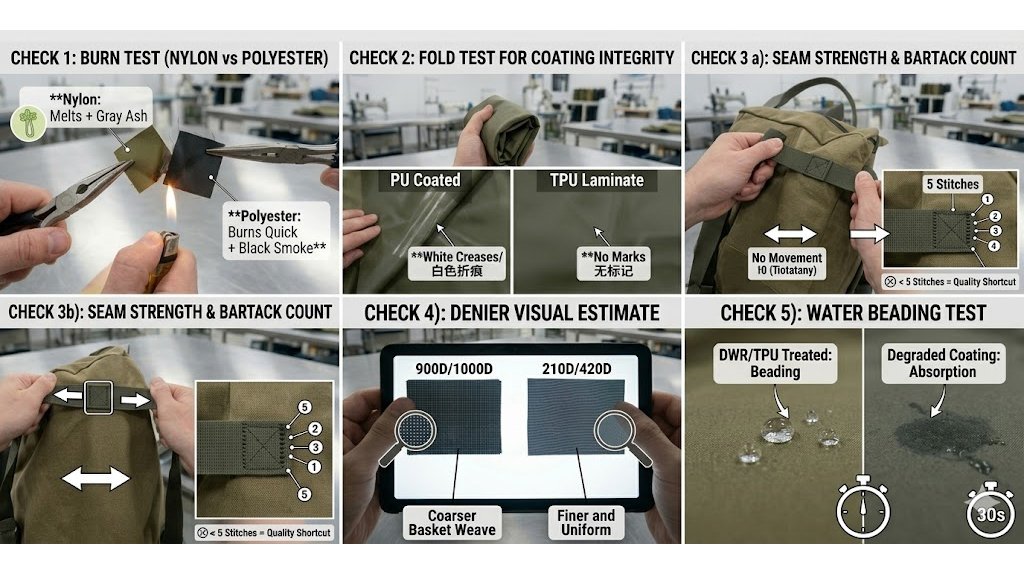
This section is for buyers who have samples in hand. These are the exact checks our QC team runs on incoming fabric before we cut a single panel.
Check 1: The Burn Test — Identify Nylon vs Polyester in 10 Seconds
Hold a small fabric scrap with pliers and apply a lighter flame:
| Result | Material |
|---|---|
| Melts + drips, self-extinguishes, gray ash, celery smell | Nylon |
| Melts + drips, burns slightly longer, black smoke, sweet chemical smell | Polyester |
This works in a showroom, at a trade show, or on your receiving dock. I’ve used it dozens of times to catch suppliers who substituted polyester for nylon mid-production.
Check 2: Coating Integrity — The Fold Test
Fold the fabric tightly on itself and hold for 10 seconds. Release and examine the fold line:
- PU coating: White crease marks appear — normal, indicates PU layer is present
- TPU laminate: No marks — TPU is more flexible and recovers cleanly
- DWR only (no coating): No crease marks, but water should bead on the surface rather than sheet off
This test works at any point in the supply chain before the bag is assembled.
Check 3: Seam Pull Test + Bartack Count
At the shoulder strap anchor point — the primary structural failure zone on any backpack — grab both sides of the anchor and pull hard with two hands. The seam should show no movement.
Then count the bartack stitches. Less than 5 bartacks at a strap anchor point is a quality shortcut. This is our factory’s actual rejection criterion. We’ve refused incoming samples from subcontractors for exactly this reason.
Check 4: Denier Visual Estimate
Hold the fabric up to a light source. Higher-denier fabrics (900D, 1000D) have a visibly coarser, more basket-weave appearance. Lower-denier fabrics (210D, 420D) appear finer and more uniform. If a supplier quotes you "600D" and the fabric looks finer than your reference 600D sample — push for a lab test.
Check 5: Water Bead Test
Drop 5–10 drops of water on the exterior face of the fabric. On properly DWR-treated or TPU-laminated fabric, the water should bead immediately and roll off. If the water soaks in within 30 seconds, the coating has either degraded, was applied too thin, or was never applied at all.
The Bottom Line
Osgoodway have built bags from $8 promotional giveaways to $180 premium outdoor packs. The material label — nylon or polyester — has never been the deciding factor in whether a bag succeeds or fails.
Coating. Seam construction. Hardware spec. Those are the decisions that matter.
Get those right, and 900D rPET polyester will outlast a sloppily-built nylon bag every time. Get those wrong, and no fiber in the world saves you from returns.
Ready to Spec Your Next Backpack Program?
At Osgoodway, we don’t just quote fabric — we help you build the right spec from the ground up.
- Free material sample kit (nylon + polyester, 5 common specs)
- Factory cost within 24 hours
- MOQ from 500 units
Request a Free Sample & Quote →
FAQ — 8 Questions, Direct Answers
Is nylon or polyester better for backpacks?
Neither is universally better. Nylon wins on abrasion resistance and tear strength. Polyester wins on UV stability, water repellency, color retention, and cost. For most branded packs at $25–$80 retail, polyester — properly coated — outperforms nylon on ROI. Nylon earns its premium only in tactical, ultralight travel, and luxury applications.
Is 600D polyester stronger than 500D nylon?
On Martindale abrasion cycles: no. 500D nylon outperforms 600D polyester in abrasion resistance. But 1000D polyester outperforms 500D nylon. Denier matters more than fiber type at equivalent price points. Don’t spec nylon just because a number sounds premium — run the actual denier comparison.
Which is more waterproof: nylon or polyester?
Without coating: polyester. It absorbs 0.4% moisture vs nylon’s 4–5%. In a 30-minute uncoated rain exposure, a nylon bag gains ~200g more weight than a polyester bag. With TPU lamination at equal quality: nylon, because its higher mechanical strength keeps the laminate bonded longer under abrasion.
Why do most mass-market backpacks use polyester?
Three reasons: it costs 2–3× less per meter than nylon, it holds color better under standard dye processes, and it’s the only fiber that accepts full-color sublimation printing. Nike, Adidas, and most $15–$50 backpack brands use 600D polyester not because it’s inferior — but because it’s optimized for their price-to-performance targets.
Can you print on nylon backpacks?
Yes, with limitations. Nylon cannot accept sublimation printing — the dye bonds only to polyester. Nylon can take screen printing, but requires a specialty bonding primer or the ink will peel within months. Embroidery is the most stable decoration method on nylon. Heat transfer is risky due to nylon’s lower melting point.
What is Cordura and is it nylon or polyester?
Cordura® is a registered brand of Invista — it refers to a family of high-tenacity nylon fabrics. 1000D Cordura nylon is the industry standard for tactical, military, and heavy-duty outdoor gear. It outperforms standard 1000D nylon on abrasion resistance by a significant margin. You pay for the brand and the certification. For serious gear: it’s worth it.
Which is more eco-friendly: nylon or polyester?
Neither is clean — both are petrochemical-based synthetic fibers. rPET polyester has a more mature recycling infrastructure and lower cost premium ($0.30–$0.80/m over virgin poly). Recycled nylon (e.g., ECONYL®) has a larger carbon reduction potential but costs 15–25% more than recycled polyester and has fewer certified supply chain options. For most programs: rPET polyester is the pragmatic sustainable choice.
How do I tell if my backpack is nylon or polyester without a label?
Run the burn test: hold a loose thread to a lighter. Nylon melts and drips with gray ash and a celery-like smell. Polyester melts and drips with black smoke and a sweet chemical smell. Alternatively: feel the fabric. Nylon has a slightly silkier, softer hand. Polyester feels crisper and slightly stiffer. Under direct light, nylon has more sheen; polyester looks more matte.