Updated October 2026 | Reviewed from a backpack manufacturing perspective
Most articles about bag coatings are written by people who’ve never touched a roll of coated fabric. They recycle the same three bullet points about "waterproofing" and call it a day.
For a sewn everyday backpack, PU-coated fabric can be a practical choice when it meets the required water resistance and durability. For a bag designed around welded seams, a suitable TPU-coated or TPU-laminated fabric may be a better starting point. Neither material name alone guarantees a waterproof or longer-lasting bag.
TPU is thermoplastic polyurethane—a type of PU. In bag sourcing, “PU coating” commonly means a liquid-applied polyurethane coating, while “TPU fabric” may mean a TPU film laminate or a melt-coated fabric. Compare the actual constructions, not just the labels.
Let’s get into it.
TPU vs PU Coating: What’s the Difference?

For most sewn backpacks and everyday bags, PU-coated fabric is usually the more cost-effective choice when the required water resistance and aging performance are clearly specified.
TPU-coated or TPU-laminated fabric becomes more attractive when the design requires compatible welded seams, repeated flexing, cold flexibility or stronger barrier performance.
The better option depends on the polyurethane chemistry, base fabric, coating or film construction, and how the finished bag is assembled.
The familiar “TPU vs PU” comparison is usually between two supplied fabric constructions rather than two unrelated material families. Both are polyurethane-based systems, but their chemistry and processing can differ significantly.
A conventional PU coating is applied to a textile and dried or cured according to its formulation. TPU can be supplied as a thermoplastic layer or as a pre-formed film laminated to the textile. Its thermoplastic behavior can allow heat or RF welding, but the specific material and seam design must be compatible.
| Buying consideration | Conventional PU-coated fabric | TPU-coated or laminated fabric |
|---|---|---|
| Construction | Polyurethane coating on a textile base | TPU layer applied directly or bonded as a film |
| Water resistance | Depends on formulation, coverage and finished construction | Depends on grade, layer integrity and finished construction |
| Humid-use durability | Depends on chemistry, stabilization and coating adhesion | Also depends on chemistry; TPU is not automatically immune to hydrolysis |
| Abrasion performance | Mainly depends on the face fabric; the coating is usually on the reverse side | Also depends mainly on the face fabric and exposed construction |
| Seam options | Commonly sewn; compatible seam sealing may be possible | May be sewn or welded, depending on the supplied material |
| Weight and hand feel | Vary with base fabric and coating weight | Vary with base fabric, film thickness, hardness and bonding layers |
| Relative material cost | Generally lower | Generally higher, especially for custom laminations |
| Common applications | Everyday backpacks, gym bags, travel bags and cost-sensitive sewn products | Waterproof cycling bags, welded dry bags and technical applications requiring compatible thermoplastic construction |
For both options, confirm which side carries the coating or film. An inner barrier and an exposed outer layer encounter different wear conditions.
A durable backing does not establish the abrasion resistance of the outer textile. If a cycling bag rubs against a frame, the contact surface and local reinforcement need their own review.
What Is TPU Coating on Fabric?
In bag manufacturing, TPU coating generally refers to a thermoplastic polyurethane layer applied to or laminated onto a textile such as nylon or polyester.
Supplier terminology is not always consistent. Some materials use a directly applied thermoplastic polyurethane layer, while others use a pre-formed TPU film laminated to the base fabric.
For sourcing, buyers should confirm the TPU chemistry, base fabric, layer or film thickness, adhesion performance, and whether the finished material is intended for sewing, seam sealing or welding.
TPU vs Nylon: Are They Alternative Backpack Materials?
Not exactly. Nylon is commonly used as the base textile of a backpack, while TPU is normally used as a coating, film or laminate on top of a textile.
For example, a technical waterproof bag may use a nylon fabric laminated with TPU. In this construction, nylon provides much of the textile strength while the TPU layer contributes barrier performance and may allow compatible welded construction.
So when comparing backpack materials, the more useful question is usually not “TPU or nylon?” but “which base fabric and TPU construction should be used together?”
Does "Waterproof" on a Bag Label Actually Mean Anything?

No. "Waterproof" with no test number attached is a marketing word, not a spec. The number that matters is Hydrostatic Head (HH), measured in millimeters under ISO 811:2018 or AATCC 127. It tells you how much water pressure a fabric can resist before it leaks.
When a buyer tells me "I want a waterproof hiking backpack," my first question is always: what HH are you targeting? Because 1,500 mm and 10,000 mm are both technically "waterproof" — and they are not the same product.
What Does Hydrostatic Head Tell You?
Hydrostatic head is useful for comparing the water-pressure resistance of coated or laminated fabrics, but it should not be treated as a direct waterproof rating for the finished bag.
The assembled product can still leak through sewn seams, zipper openings, closures and attachment points. A high hydrostatic-head fabric therefore does not automatically create a waterproof backpack.
For sourcing, specify both the required fabric test result and the finished-product water-resistance test.
How PU and TPU compare on HH — what the TDS sheets actually show:
| Coating Type | Typical HH Range | Test Method |
|---|---|---|
| Single-pass PU | 1,000–2,000 mm | ISO 811 |
| Double-pass PU | 3,000–5,000 mm | ISO 811 |
| TPU single-side lamination | 10,000–15,000 mm | ISO 811 |
| TPU double-side lamination | 15,000–20,000+ mm | ISO 811 |
| TPU + RF-welded seams | Up to 100,000 mm* | ISO 811 |
*Published by Ortlieb for their fully-welded TPU construction — the ceiling of what’s commercially achievable.
Factory tip: If a supplier gives you a fabric spec sheet with "waterproof" but no HH number or test standard, send it back. That spec sheet is useless for sourcing decisions.
Why Do PU and TPU Coatings Fail in Heat and Humidity?
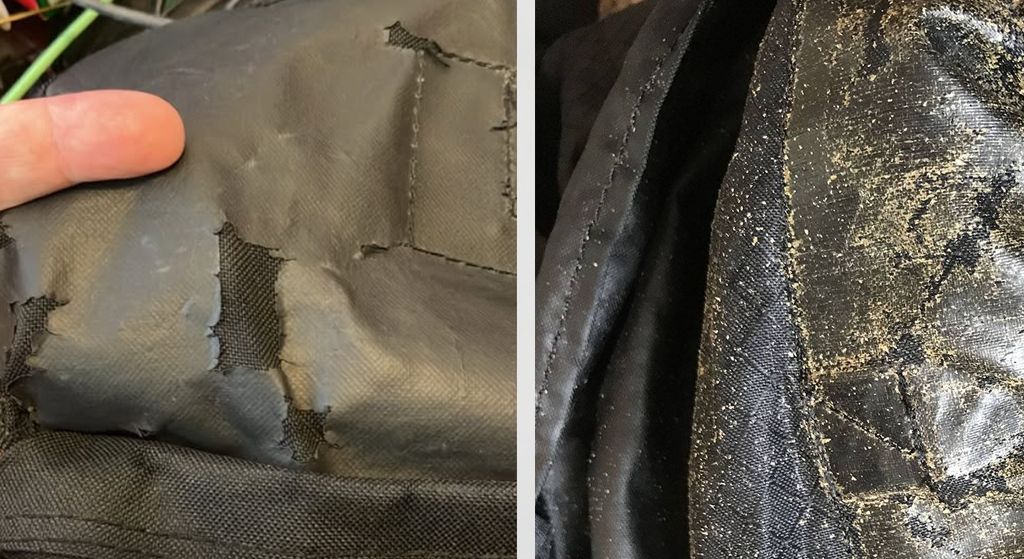
PU coating fails through hydrolysis: water molecules chemically attack the polymer backbone and break it apart. The result is that sticky, peeling, foul-smelling lining you’ve seen on older backpacks.
Hydrolysis resistance depends heavily on polyurethane chemistry.
Polyester-based polyurethane systems, including some TPU grades, can degrade after prolonged exposure to heat and moisture. Polyether-based polyurethane systems generally provide better resistance to hydrolytic degradation.
This is why buyers should not specify only “PU” or “TPU.” The polymer chemistry, coating or film construction, adhesion system and required aging performance should also be confirmed.
The chemistry in plain English
Standard PU coatings are built on ester linkages in the polymer chain. Water attacks those bonds over time — faster in heat and humidity. The bag doesn’t need to get wet. A warehouse in Florida, a shipping container on a 35-day sea freight, or a closet in Guangzhou is enough.
Ether-based polyurethane and polyether-TPU don’t have those vulnerable ester bonds. They’re hydrolysis-resistant by design. That’s why I always ask clients: where is your end customer? Tropical market or dry climate? The answer changes the spec.
| Chemistry | Relative Hydrolysis Resistance | Sourcing Consideration |
|---|---|---|
| Polyester-based PU | Lower to moderate | Aging performance should be checked for hot and humid markets |
| Polyether-based PU | Generally better | Useful where improved humidity resistance is required |
| Polyester-based TPU | Grade-dependent | Do not assume all TPU is highly hydrolysis-resistant |
| Polyether-based TPU | Generally high | Strong candidate for humid or wet-use applications |
Already have a bag with a peeling, sticky lining? That’s PU hydrolysis in action — we broke down exactly why it happens in this article.
What Is TPU Laminated Fabric — and Is It the Same as TPU Coating?

Not necessarily.
TPU laminated fabrics normally uses a pre-formed TPU film bonded to a textile substrate. A directly applied TPU layer uses a different manufacturing process to build the thermoplastic polyurethane layer on the textile.
In everyday sourcing language, however, suppliers do not always use “TPU coated” and “TPU laminated” consistently. A buyer should therefore confirm the actual cross-section of the material rather than relying on the product name alone.
Direct-Applied TPU vs TPU Film Lamination
| Construction | How It Is Made | Key Sourcing Check |
|---|---|---|
| Direct-applied TPU layer | TPU is applied directly to the textile through a suitable coating process | Layer uniformity, adhesion, thickness and processing compatibility |
| TPU film laminate | A pre-formed TPU film is bonded to the textile | Film grade, thickness, bonding strength and welding compatibility |
How Should Buyers Specify TPU Film Thickness?
There is no single TPU film thickness that defines “bag grade.”
The required thickness depends on the TPU grade, base fabric, bonding system, welding method, flexibility target and finished-product construction.
In our development work, we compare the supplier’s TDS and trial samples rather than approving a material from film thickness alone. For custom projects, film thickness should therefore be treated as one part of the material specification, not as a stand-alone quality grade.
Factory secret: If a supplier tells you a bag is "TPU laminated" but the film is thinner than 100 µm, what you actually have is an apparel-grade laminate — not bag-grade construction. Ask for the TDS and cross-check the film weight (g/m²) or thickness (µm). Don’t let them hand-wave it.
TPU vs PU Coating: Which One Does Your Bag Actually Need?
The answer depends on three things: where the bag is used, how long it needs to last, and what the end customer will pay. Not every bag needs TPU — but certain use cases absolutely cannot survive on PU.
Here’s how I think about coating selection across the bag types we make most:
Use-case decision matrix
| Bag application | Starting point to evaluate | Main question before approval |
|---|---|---|
| Commuter backpack or urban crossbody | A suitable PU-coated fabric for a sewn construction | Does the assembled bag meet the intended rain exposure and wear requirements? |
| Gym bag | Coated shell or selected protective compartment material | Is the priority rain resistance, wipe-clean performance or containing damp items? |
| Hiking backpack | PU-coated or TPU-based options matched to weight and exposure | Do coating durability, seam protection and the carrying structure work together? |
| Cycling or bikepacking bag | Weld-compatible TPU material where a welded body is intended | Are joints, closures and frame-contact areas adequately developed? |
| Travel duffel | Compare coating or laminate options against handling and packing needs | How does the material behave after folding, rubbing and loaded handling? |
| Dry bag or waterproof duffel | A complete barrier, seam and closure system | Does the finished product pass the specified water-exposure test? |
What Does TPU vs PU Actually Cost?
The cost difference between PU-coated and TPU-laminated fabrics can be meaningful, but there is no fixed “TPU surcharge” that applies to every bag.
The final material cost depends on the base fabric, PU or TPU chemistry, coating weight or film thickness, color, MOQ, mill, bonding method and order volume. For this reason, we normally compare actual approved fabric constructions rather than estimating the bag price from the material name alone.
Indicative Material Cost Ranges From Recent Sourcing
| Material Construction | Indicative Added Cost / Linear Meter | Typical Sourcing Consideration |
|---|---|---|
| Single-pass PU coating | $0.50–$1.50 | Common for cost-sensitive sewn bags |
| Heavier or multi-pass PU coating | $1.20–$2.00 | Used where greater coating weight or barrier performance is required |
| TPU single-side lamination | $1.50–$3.00 | Common in technical waterproof constructions |
| TPU double-side lamination | $3.00–$4.50 | Used for selected dry bags, cycling bags and welded products |
| Polyether-based TPU | Usually higher than comparable polyester-based TPU | Often evaluated for hot, humid or wet-use applications |
These figures are indicative ranges from recent sourcing and can change significantly with the mill, MOQ, base textile, coating weight, TPU grade, film thickness and market conditions.
How Does the Material Premium Affect the Finished Bag?
A medium-sized backpack may use roughly 1.2–1.5 linear meters of main body fabric, but the actual consumption varies with bag size, panel layout, reinforcement and cutting efficiency.
Because of this, switching from a conventional PU-coated fabric to a TPU-laminated construction may add only a few dollars to the finished bag, or considerably more if the project also requires:
- custom TPU film or color
- higher material MOQ
- welded-seam construction
- additional material testing
- specialized bonding or welding equipment
- longer development and sampling time
The correct comparison is therefore not simply PU price vs. TPU price. Buyers should compare the complete approved construction against the performance required for the product.
When Is the Higher TPU Cost Justified?
TPU may be worth the additional cost when the project requires:
- compatible welded seams
- stronger barrier performance
- repeated flexing
- good cold-temperature flexibility
- improved resistance to prolonged humid conditions
- a technical waterproof construction that cannot be achieved reliably with a conventional sewn PU-coated fabric
For a standard sewn commuter backpack, gym bag or general travel bag, a well-specified PU-coated fabric may still provide the better cost-performance balance.
From a sourcing perspective, the goal is not to specify TPU because it sounds more premium. The goal is to choose the lowest-cost material construction that can reliably meet the required performance, aging and manufacturing conditions.
How Should TPU and PU Coated Fabrics Be Tested?
The test requirements should be selected according to the actual fabric construction, intended bag use and buyer specification rather than applying one fixed test package to every PU- or TPU-coated material.
| Performance to Check | Possible Test Reference | What Buyers Should Specify |
|---|---|---|
| Hydrostatic pressure | ISO 811 / AATCC 127 | Required water-pressure result for the intended use |
| Accelerated ageing | ISO 1419 | Aging condition and agreed pass/fail criteria |
| Coating adhesion | ISO 2411 | Minimum adhesion performance before and/or after conditioning where required |
| Finished-bag water resistance | Project-specific test | Exposure method, duration and acceptance criteria |
Fabric test results should not be treated as a direct guarantee of finished-bag performance. Seams, zippers, closures and attachment points can all affect water resistance, so technical waterproof bags should also be evaluated as a finished product.
Test values such as abrasion cycles, flex cycles, UV exposure time or minimum adhesion strength should be agreed for the specific project rather than using one universal requirement for all PU and TPU materials.

Factory Reality: What Changes When You Switch from PU to TPU?
Changing from a conventional PU-coated fabric to a TPU-coated or TPU-laminated construction can affect more than material cost. It may also change sourcing, sampling, cutting, welding, lead time and production planning.
The exact impact depends on the base fabric, TPU grade, film thickness, color, MOQ, supplier and finished-bag construction.
Material Sourcing and MOQ
MOQ and lead time vary significantly by mill, color, base fabric and TPU specification.
In our current supplier network, custom TPU laminations generally require higher material MOQs and longer development lead times than stock PU-coated fabrics. Stock PU-coated polyester or nylon is usually easier to source in smaller quantities, while custom TPU constructions may require a dedicated lamination run.
For custom projects, buyers should confirm:
- base fabric specification
- TPU chemistry and film construction
- film or coating thickness
- color requirement
- supplier MOQ
- available stock options
- production lead time
Cutting and Sewing
TPU-laminated fabrics can behave differently from conventional PU-coated fabrics during cutting and sewing.
Depending on the material construction, the fabric may be:
- stiffer or more slippery
- more sensitive to heat or pressure
- more difficult to fold around tight curves
- more prone to visible needle holes
- less suitable for repeated seam correction
For sewn bags, the sample stage should confirm whether the material works with the planned needle, thread, seam allowance, binding and reinforcement construction.
Welding and Seam Construction
One reason buyers choose TPU is the possibility of welded construction.
However, not every TPU-laminated fabric is automatically suitable for RF, HF or heat welding. Compatibility depends on the TPU formulation, laminate structure, film thickness and welding process.
If welded seams are required, the factory should confirm the actual material on the intended equipment before bulk production.
This may require additional development time for:
- welding temperature or power settings
- seam width
- overlap design
- corner construction
- attachment points
- leak testing
Sampling and Lead Time
TPU projects can take longer to develop when the material is customized or when welded construction is involved.
In our experience, the additional lead time usually comes from material sourcing, lamination trials, welding tests and sample adjustment, rather than from TPU itself.
For this reason, buyers should allow enough time for material approval and construction testing before confirming the bulk production schedule.
Cost Impact Beyond the Fabric
The material premium is only one part of the cost difference.
Depending on the project, TPU may also affect:
- material MOQ
- sample development
- cutting efficiency
- welding or seam-sealing operations
- testing requirements
- production speed
- rejection risk during development
For quotation, we therefore evaluate the complete bag construction rather than applying one fixed TPU surcharge to every style.
From a factory perspective, switching from PU to TPU is not simply a material substitution. The material, seam method and production process need to be evaluated together.
Before Choosing PU or TPU for Your Bag
Choose the material that supports the intended construction and passes the agreed checks. PU-coated fabric can be suitable for a well-developed sewn bag; a suitable TPU construction can support different joining and barrier requirements. Neither choice removes the need to validate seams, closures and aging behavior.
For a planned OEM/ODM bag order, send Osgoodway your project specifications, including reference photos or drawings, intended use, water-protection requirements, quantity per color, target FOB price and delivery date. Include any existing material specification so the options can be reviewed against the actual project.
FAQ: TPU vs PU Coating for Bags
Is TPU coating better than PU for bags?
For outdoor, cycling, and premium bags: yes, clearly. TPU lasts 2–3× longer in humid conditions, achieves higher waterproof ratings, and enables fully-welded seams. For urban commuter bags or gym bags, standard PU is often good enough and meaningfully cheaper.
What does "TPU laminated fabric" mean?
A pre-formed TPU film is thermally bonded to a base fabric (nylon or polyester) under heat and pressure. The result is a uniform, structural waterproof layer — different from a liquid PU coating, which is applied wet and cured. Lamination is what enables heat welding and higher hydrostatic head ratings.
How long does PU coating last on a bag?
Standard polyester-PU in a humid climate: 2–4 years before visible degradation. Polyether-PU: 5–8 years. This is independent of use — a stored bag in a humid environment degrades at the same rate as an actively used one.
What is the hydrostatic head for a waterproof bag?
For a hiking backpack: minimum 3,000 mm, tested to ISO 811. For cycling bags: 10,000 mm+. For dry bags or submersion-grade gear: 20,000 mm and above. Any number below 1,500 mm is water-resistant, not waterproof.
Does TPU make bags stiffer?
Thicker films (200+ µm) add noticeable stiffness. At 100–150 µm — our standard bag spec — the hand-feel is close to a well-coated PU fabric. The difference is manageable and most end users don’t notice.
Can you recycle TPU bags?
TPU is thermoplastic — it can be remelted and recycled in principle. In practice, bags bonded to nylon or polyester base fabrics are difficult to separate at end-of-life. TPU is cleaner than PVC (no plasticizers, no halogens), but it’s not truly "eco-friendly." Don’t let a supplier sell you on the green story without caveats.
Is TPU better than nylon for a backpack?
TPU and nylon normally serve different functions rather than replacing each other. Nylon is commonly the structural textile, while TPU may be used as a coating or laminate to add barrier performance and support compatible welded construction.
Many technical bags therefore use TPU-laminated nylon rather than choosing TPU instead of nylon.