Choosing the right fabric can make or break your product line. You need durability, but weight and cost are always a concern. How do you find the perfect balance for your brand?
Ripstop nylon is a lightweight woven fabric that uses a special reinforcing technique to make it resistant to tearing and ripping. During weaving, thicker reinforcement yarns are interwoven at regular intervals in a crosshatch pattern, which stops small tears from spreading into large gashes.
I know the pressure of sourcing materials that meet high standards for both performance and brand image. You need to understand not just what a fabric is, but why it’s the right choice for a specific product.
Ripstop nylon is one of the most common materials in the bag industry, but its variations and trade-offs are often misunderstood.
Let’s dive deep into what makes this fabric a workhorse, where it shines, and, most importantly, where it falls short. This guide will give you the expert insights you need to specify the perfect fabric for your next collection.
[claim claim=”Ripstop was originally developed for parachutes during World War II.” istrue=”true” explanation=”The U.S. military needed a lightweight, strong, and tear-resistant material for parachutes as a replacement for silk, leading to the invention of ripstop nylon.”]
[claim claim=”All ripstop fabrics are completely waterproof.” istrue=”false” explanation=”The ripstop weave provides tear resistance, but the fabric itself is only water-resistant. Waterproofing is achieved through coatings like PU or silicone, which can wear off over time.”]
What is Ripstop Nylon Fabric and How is It Made?
Struggling to find a fabric that’s both lightweight and strong? A tear in a sample can mean a failed product, costing you time and money. It’s a constant balancing act.
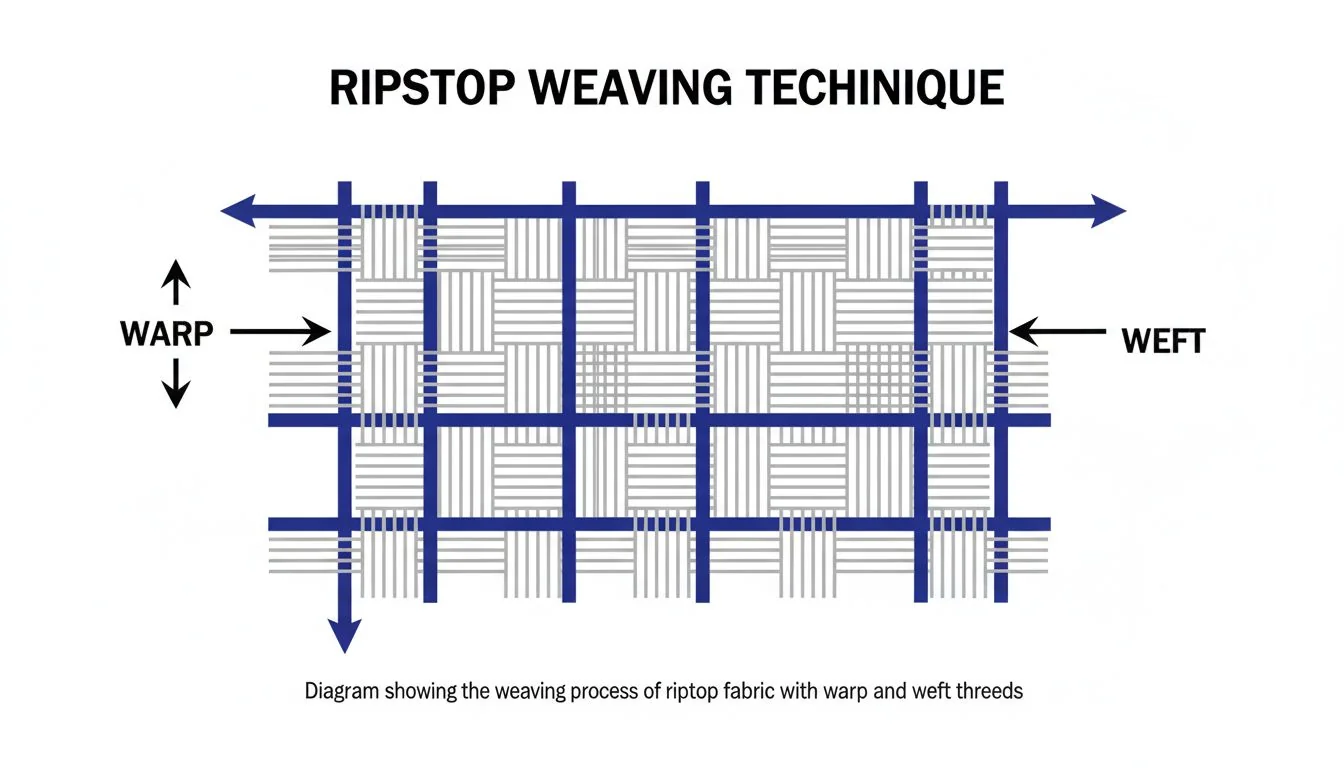
Ripstop nylon is a weaving technique, not a specific material. It involves weaving a thicker, stronger reinforcement yarn into the main fabric at regular intervals. This creates a grid that stops any potential tear from spreading, containing the damage to a small, manageable area.
When I first started in this industry, I thought "nylon was nylon." I quickly learned the magic is in the construction. The name "rip-stop" is its core function. Think of it as a built-in safety net within the fabric itself.
The Weaving Process: A Closer Look
The process happens on a loom, just like any other fabric. The key difference is the introduction of a special, high-tensile yarn.
- Warp and Weft: Standard weaving involves vertical threads (warp) and horizontal threads (weft).
- Reinforcement Grid: Every 5 to 8 millimeters, a thicker reinforcement yarn is woven into both the warp and weft directions. This creates the signature crosshatch or diamond pattern you can see and feel.
This grid is the fabric’s superpower. If a sharp object punctures one of the small squares, the tear can’t travel. It hits the thick reinforcement thread and stops dead in its tracks. This prevents a minor snag from becoming a catastrophic failure, which is critical for gear you depend on.
[claim claim=”The grid pattern in ripstop fabric is purely for aesthetic purposes.” istrue=”false” explanation=”The grid is functional. It’s formed by thicker, stronger reinforcement threads that are specifically designed to stop tears from propagating across the fabric.”]
[claim claim=”You can easily identify ripstop fabric by its visible square or diamond grid pattern.” istrue=”true” explanation=”Holding the fabric up to a light source makes the reinforcement grid clearly visible, which is the defining characteristic of the ripstop weave.”]
What Are the Different Types of Ripstop Nylon?
You see terms like "70D" or "420D" on spec sheets, but what do they mean for your product’s durability and feel? Choosing the wrong spec can lead to a bag that’s too heavy or not tough enough.
Ripstop nylon types are defined by their specifications, primarily Denier1 (D), which measures fiber thickness, and the type of waterproof coating applied. A lower Denier means a lighter fabric, while a higher Denier means a heavier, more robust fabric. Coatings add water resistance.

When you’re sourcing for a new bag line, you won’t ask for "Type A" or "Type B" ripstop. Instead, you’ll specify the Denier and coating you need. I’ve learned that understanding these two factors is the key to getting the exact performance you want.
By Denier (Fiber Thickness)
Denier (D) is a unit of weight, not a direct measure of strength. It tells you the mass in grams of a single 9,000-meter strand of fiber. However, a thicker, heavier fiber is generally stronger and more abrasion-resistant.
| Denier Range | Category | Common Uses |
|---|---|---|
| 30D – 70D | Ultralight | Packable jackets, stuff sacks, ultralight tents |
| 210D – 420D | All-Purpose | The "sweet spot" for hiking backpacks, daypacks |
| 600D – 1000D+ | Heavy-Duty | Backpack bottoms, luggage, military gear |
By Coating (Waterproofing)
The nylon fabric itself only resists water. True waterproofing comes from a coating applied to the fabric.
- PU Coated (Polyurethane): This is the industry standard for backpacks. A waterproof film is applied to the inside of the fabric. It’s effective and cost-efficient.
- Silnylon (Silicone-Impregnated): More common for tents and tarps. Silicone soaks into the fibers, making the fabric lighter, more flexible, and naturally water-repellent.
[claim claim=”Denier (D) is a direct measurement of a fabric’s strength.” istrue=”false” explanation=”Denier measures the linear mass density of fibers (weight), not strength. While higher denier fabrics are generally stronger and more durable, it is not a direct unit of strength.”]
[claim claim=”A PU coating is applied to ripstop nylon to make it waterproof.” istrue=”true” explanation=”Polyurethane (PU) coating is a common method used to create a waterproof barrier on the surface of nylon fabrics, which are otherwise only water-resistant.”]
Nylon Ripstop vs. Polyester Ripstop: Which Is Better for Your Gear?
Your design calls for a durable, lightweight fabric, but should you choose nylon or polyester? Making the wrong choice could mean a backpack that sags in the rain or a tent that degrades quickly in the sun.
Nylon ripstop is better for gear needing high abrasion resistance2 and tear strength, like backpacks. Polyester ripstop is better for gear needing UV resistance and water stability (no sagging when wet), like tent rainflys and tarps. Neither is universally "better"; they excel at different jobs.
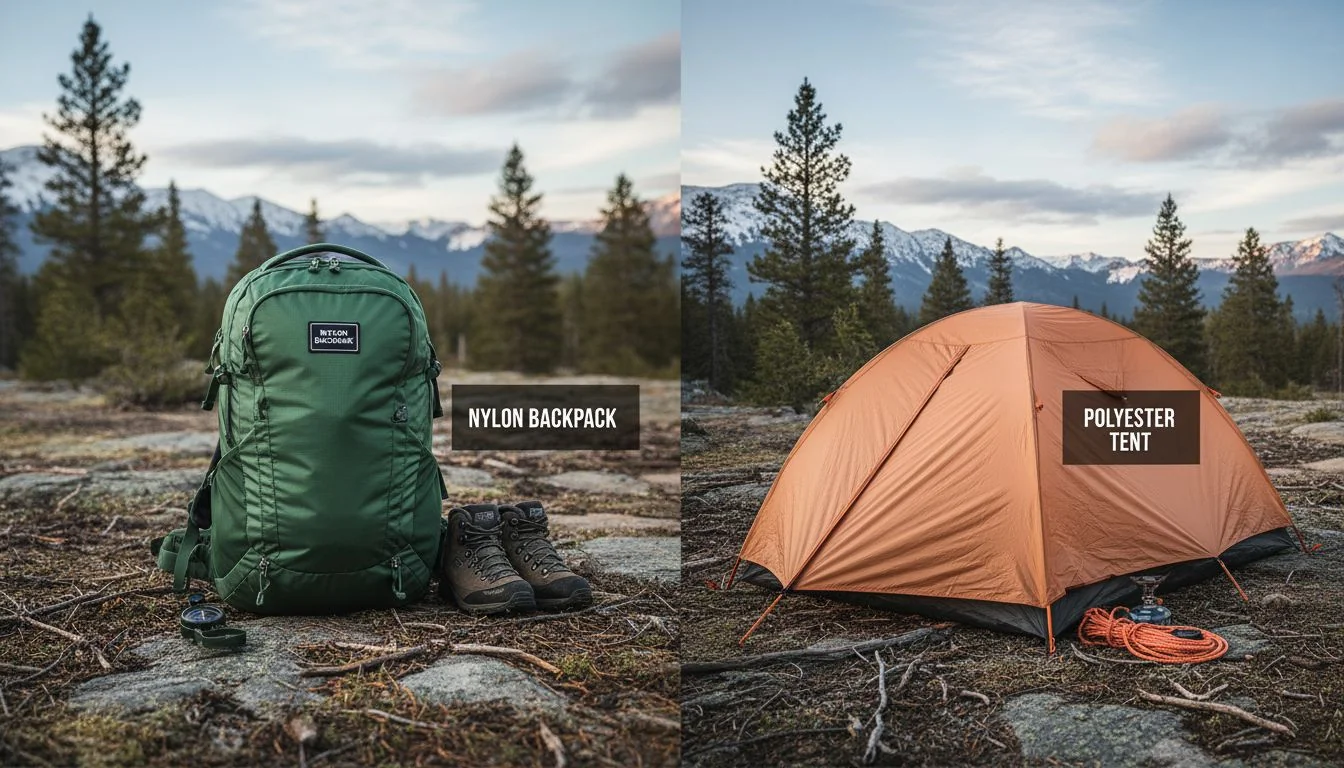
This is a classic manufacturing trade-off I discuss with clients all the time. The choice between nylon and polyester ripstop3 comes down to the product’s primary function. You have to prioritize what matters most: brute strength or weather stability.
Nylon Ripstop (The Durability Champion)
When I’m developing a backpack that I know will be scraped against rocks and trees, I always lean towards nylon.
- Pros: It has fantastic abrasion resistance and tear strength. It also has a slight natural stretch or "give," which helps it resist tearing under stress.
- Cons: It absorbs a small amount of water (about 3-5% of its weight). This can cause it to sag slightly when it gets soaked. It’s also more susceptible to damage from UV radiation over long periods.
Polyester Ripstop (The Stability Champion)
For products that live outside, like a tent rainfly, polyester is the clear winner.
- Pros: It’s hydrophobic, meaning it absorbs almost no water. It won’t sag or get heavy in a downpour. It also has much better UV resistance than nylon, so it won’t weaken after days in the sun.
- Cons: It simply isn’t as tough as nylon of the same denier. It has lower abrasion resistance and tear strength.
My Verdict: For any bag that will be carried, dragged, and stuffed, nylon ripstop is the superior choice. For stationary items exposed to sun and rain, go with polyester ripstop.
[claim claim=”Polyester ripstop is stronger and more abrasion-resistant than nylon ripstop.” istrue=”false” explanation=”Nylon ripstop generally has superior tear strength and abrasion resistance compared to polyester ripstop of a similar denier, making it the preferred choice for high-wear items like backpacks.”]
[claim claim=”Nylon ripstop absorbs more water and can sag when wet compared to polyester ripstop.” istrue=”true” explanation=”Nylon is hydrophilic and can absorb water, causing it to stretch and sag. Polyester is hydrophobic, absorbing very little water, which is why it’s ideal for tent rainflys.”]
How Does Ripstop Nylon Compare to Cordura and Ballistic for Backpacks?
You want to build the most durable backpack, but the material options are confusing. Is standard ripstop enough, or do you need something tougher like Cordura4 or Ballistic nylon?
Ripstop nylon offers the best strength-to-weight ratio, excelling at stopping tears. Cordura offers superior abrasion resistance, making it ideal for high-wear areas. Ballistic nylon provides the ultimate puncture and abrasion resistance but is very heavy. It’s a trade-off between weight and ruggedness.

I like to think of these three fabrics as "good, better, best" for pure abrasion resistance, but that’s too simple. As a product developer, you have to consider weight. The real choice is about balancing weight against a specific type of durability.
The Fabric Hierarchy
Let’s break down where each one fits in a backpack’s design.
| Fabric Type | Main Strength | Weakness | Common Use | Verdict |
|---|---|---|---|---|
| Ripstop Nylon | tear resistance5 | Less resistant to abrasion than Cordura and Ballistic | Main body of a pack where light weight is essential | Best strength-to-weight ratio. Ideal for lightweight packs. |
| Cordura | Extreme abrasion resistance (air-textured nylon fabric) | Heavier than Ripstop nylon | Premium backpacks, typically used on bottoms and high-wear areas | Best for high-abrasion areas but heavier than Ripstop. |
| Ballistic Nylon | Exceptional puncture and abrasion resistance (840D to 1680D) | The heaviest of the three, "overkill" for hiking | High-end luggage, heavy-duty duffels, tool belts | Best for heavy-duty use, but too heavy for hiking backpacks. |

- Cordura is actually a brand name for a type of air-textured nylon fabric. It feels much rougher and tougher than standard ripstop and has a matte, almost fuzzy appearance. Many premium brands use a hybrid approach: a lighter ripstop for the main body and a heavy-duty Cordura panel on the bottom.
- Ballistic Nylon was originally designed for flak jackets to protect against shrapnel. It’s an incredibly thick, smooth, and heavy fabric (often 840D or higher). For most hiking or travel bags, it’s complete overkill and adds unnecessary weight.
My Verdict: Use ripstop nylon for the best all-around performance with a focus on low weight. Add Cordura to high-wear areas for premium durability. Save Ballistic nylon for specialized, extreme-use gear.
[claim claim=”Cordura is just another name for ripstop nylon.” istrue=”false” explanation=”Cordura is a brand name for a specific type of air-textured nylon fabric known for its exceptional abrasion resistance, which is different from the ripstop weaving technique.”]
[claim claim=”Ballistic nylon is the lightest and most flexible of the three fabrics.” istrue=”false” explanation=”Ballistic nylon is the heaviest and stiffest of the three, prized for its extreme puncture and abrasion resistance, not its light weight or flexibility.”]
The Good: Why Is Ripstop Used in Almost Everything? (The Pros)
You see ripstop fabric everywhere, from kites to military uniforms. What makes this one fabric so popular and versatile across so many different industries and products?
Ripstop’s popularity comes from its unique combination of three key benefits: an excellent strength-to-weight ratio, superior tear resistance, and its versatility as a cost-effective base fabric that is easy to work with and coat for waterproofing.

It’s rare to find a material that hits the "sweet spot" on so many performance metrics. Ripstop isn’t just good at one thing; it’s the combination of its strengths that makes it such a go-to choice for designers and manufacturers, including myself.
1. Excellent Strength-to-Weight Ratio
This is its #1 benefit. It’s incredibly strong for how light it is. This allows manufacturers to build durable gear that doesn’t add unnecessary weight to your load.
2. Superior Tear Resistance
This is its namesake. The grid-like weave ensures that a small puncture from a branch or rock doesn’t become a 12-inch gash, making the gear far more reliable and repairable in the field.
3. Versatility & Cost-Effectiveness
From a manufacturing standpoint, ripstop nylon is a dream to work with. It’s easy to produce in massive quantities, it takes dye very well for custom colors, and it’s easy to sew. Most importantly, it provides a perfect surface for applying waterproof coatings like PU, allowing us to easily turn a simple fabric into a high-performance, weather-resistant material.
[claim claim=”Ripstop’s main benefit is its luxurious, soft feel.” istrue=”false” explanation=”While it can be made soft, ripstop’s primary benefits are functional: its high strength-to-weight ratio and its resistance to tearing, not its texture.”]
[claim claim=”The grid weave of ripstop makes field repairs easier by containing damage to a small area.” istrue=”true” explanation=”By stopping a tear from spreading, the grid makes it possible to patch a small hole with tape or a needle and thread, which is much more manageable than repairing a long rip.”]
The Bad: What Are Ripstop’s Weaknesses? (The Cons & Environmental Cost)
Before you specify ripstop nylon for your entire product line, what are the hidden downsides? No fabric is perfect, and understanding the weaknesses is crucial for managing customer expectations and making sustainable choices.
Ripstop nylon’s main weaknesses are that its waterproofing can fail over time as the coating degrades, it can be damaged by prolonged UV exposure, and it is a petroleum-based plastic that is not biodegradable, posing a significant environmental challenge.

This is the "Don’t Buy Before Reading" part of our conversation. I once stored an old favorite backpack in a damp shed for a few years. When I pulled it out, the inside was sticky and the waterproof coating6 was flaking off like dandruff. This is hydrolysis, and it’s a key weakness of coated nylon.
Performance Cons
- Waterproofing Isn’t Permanent: The nylon weave isn’t waterproof; the PU coating is. Over time, this coating can break down, crack, and peel, especially if stored improperly. Your waterproof bag will eventually become just a water-resistant one.
- UV degradation7: Standard nylon doesn’t like the sun. If you leave a backpack or gear in direct sunlight for months on end, the UV rays will slowly weaken the fibers and cause the colors to fade.
- Limited Abrasion Resistance: While it’s strong for its weight, it’s not invincible. Dragging it repeatedly across sharp, abrasive surfaces like granite will eventually wear through the fabric. This is why we often add tougher Cordura panels.
The Environmental Cost
This is the biggest "con" for any brand focused on sustainability, like yours.
- Fossil Fuel Based: Ripstop nylon is a plastic derived from petroleum. Its production is energy-intensive and contributes to carbon emissions.
- Not Biodegradable: Like other plastics, it will sit in a landfill for hundreds of years without breaking down.
- The Solution: The best path forward is using recycled ripstop nylon8. This material is made from post-consumer waste like discarded fishing nets and old carpets. It offers nearly identical performance to virgin nylon but with a much smaller environmental footprint. Many top brands are making this switch, and it’s a key factor for conscious consumers.
[claim claim=”Ripstop nylon is a natural, biodegradable fiber.” istrue=”false” explanation=”Ripstop nylon is a synthetic polymer derived from petroleum. It is a type of plastic and is not biodegradable.”]
[claim claim=”Recycled ripstop nylon offers a more sustainable alternative with similar performance to virgin nylon.” istrue=”true” explanation=”Recycled nylon, often made from industrial and post-consumer waste, reduces reliance on fossil fuels and diverts waste from landfills while maintaining the strength and durability required for high-performance gear.”]
What Are Common Uses of Ripstop Nylon?
Now that you know the pros and cons, where does this fabric actually get used? Seeing its wide range of applications helps illustrate just how versatile and reliable it truly is.
Ripstop nylon is used in countless applications, from outdoor gear like backpacks, tents, and sleeping bags to aviation equipment like parachutes and hot air balloons. It’s also found in military uniforms, sails, kites, and everyday items like luggage and reusable bags.

The applications for ripstop are incredibly diverse, which speaks to its amazing balance of properties. I’ve worked on projects across many of these categories, and the fundamental reasons for choosing ripstop remain the same: strength, light weight, and reliability.
Outdoor & Adventure (The Obvious)
This is where most people encounter ripstop. Its strength-to-weight ratio is perfect for gear that you have to carry.
- Backpacks and stuff sacks
- Tent rainflys and footprints
- Sleeping bag and insulated jacket shells
- Hammocks and tarps
Aviation & Recreation (Its Origin)
This is where it all started. The need for a lightweight, tear-proof material for parachutes drove its invention.
- Parachutes, parasails, and hang gliders
- Hot air balloon envelopes
- Kites
- Boat sails
Military & Service
The military requires gear that is both lightweight for soldiers to carry and tough enough for battlefield conditions.
- Battle Dress Uniforms (BDUs)
- Field tarps and equipment pouches
- Webbing and load-bearing equipment
Everyday Items
The properties that make ripstop great for extreme sports also make it great for durable consumer goods.
- Luggage and duffel bags
- Reusable shopping bags
- Flags and banners
[claim claim=”Ripstop nylon is only used for making backpacks and tents.” istrue=”false” explanation=”While common in outdoor gear, ripstop nylon’s applications are vast, including parachutes, sails, military uniforms, hot air balloons, and everyday luggage.”]
[claim claim=”The original use for ripstop nylon was in aviation, specifically for parachutes.” istrue=”true” explanation=”Ripstop nylon was developed during WWII as a durable, lightweight, and tear-resistant replacement for silk in the manufacturing of parachutes.”]
Conclusion
Ripstop nylon is a versatile, high-performance fabric defined by its strength-to-weight ratio. Understanding its specifications, alternatives, and environmental impact is key to making the best choice for your product line.
Common Questions Related to Ripstop Nylon Fabric:
Is ripstop nylon strong?
Yes, it has an incredibly high strength-to-weight ratio. It’s not necessarily stronger than a very heavy canvas, but for its light weight, it is exceptionally strong and, most importantly, resistant to tearing.
Is Ripstop Nylon Waterproof?
Ripstop nylon is water-resistant but not entirely waterproof. Some variants are coated with waterproof layers to provide better water resistance.
What makes ripstop nylon different from regular nylon?
Ripstop nylon features a grid pattern of thicker threads woven into the fabric, which makes it more tear-resistant compared to regular nylon.
Can you repair ripstop nylon?
Absolutely. It’s one of the easiest fabrics to repair in the field. A small puncture or tear can be permanently fixed with a peel-and-stick ripstop repair patch (like Tenacious Tape). The ripstop grid will prevent the tear from growing before you can patch it.
Is ripstop nylon fabric breathable?
Ripstop nylon is moderately breathable, though not as much as other fabrics like cotton. For breathable outdoor gear, additional ventilation features may be added.
How do you care for ripstop nylon fabric?
Ripstop nylon should be washed in cold water and air-dried to prevent damage. It should also be stored away from sharp objects to maintain its integrity.
References
-
Understand the significance of Denier in fabric selection and how it affects performance. ↩
-
Find out how abrasion resistance impacts the longevity of fabrics in high-wear applications. ↩
-
Compare polyester ripstop to nylon and see which is better for specific applications. ↩
-
Explore the differences between Cordura and ripstop fabrics for various uses. ↩
-
Learn about the mechanics of tear resistance in fabrics and why it’s crucial for durability. ↩
-
Discover the various waterproof coatings available and their effectiveness in fabric protection. ↩
-
Understand the impact of UV rays on nylon fabrics and how to mitigate damage. ↩
-
Learn about the environmental advantages of recycled ripstop nylon and its performance. ↩