You are likely here because your sourcing agent threw two options at you—600D and 1680D—and the price gap is making you hesitate. Or maybe you just want to know if "higher number" means "better bag."
The primary difference between 600D and 1680D polyester is yarn thickness and weave structure. 600D is a versatile, medium-weight standard fabric (approx. 220gsm) used for school bags and promo bags. 1680D is a heavy-duty,for heavy-duty luggage and tactical gear, dual-strand "ballistic" style weave (approx. 380gsm+) that offers superior abrasion resistance and a premium sheen but costs roughly 30-50% more per yard.
I’m going to break down the 600D vs. 1680D debate based on what I see on my production floor—not what a Wikipedia article tells you.
What Exactly is the Difference Between 600D and 1680D?

"D" stands for Denier, a unit of measure for the linear mass density of fibers. Specifically, it is the weight in grams of 9,000 meters of the yarn.
Technically, 1680D is often a "double strand" twist (two 840D yarns twisted together), which creates that signature chunky, basket-weave look originally designed to mimic ballistic nylon. 600D is a simpler plain weave. In our warehouse, you can identify them blindfolded: 600D feels like a canvas canvas, while 1680D feels slippery, thick, and cold due to the heavy coating.
The weight difference is massive. A standard roll of PU-coated 600D weighs about 200-230 grams per square meter (gsm). A roll of 1680D with a PVC backing often hits 380-450 gsm. I’ve seen shipping costs double just because a client switched to 1680D without realizing how much heavier the final cartons would be.
What defines 1680D Polyester’s performance?
1680D features a heavy-duty "basket weave" structure, offering superior abrasion resistance1 and a shiny, rugged look ideal for high-wear gear.
- Weave Style2 Double (2×2) Basket Weave, creating a chunky texture.
- Abrasion: Withstands 2,000+ cycles on our Taber test before coating failure.
- Aesthetics: High sheen and prominent grain; looks "technical."
- Primary Use: Tool bags, soft-sided luggage, and tactical gear bottoms.
How does 600D compare in technical specs?
600D uses a standard plain weave that is lightweight and pliable, providing a smooth matte surface that holds detailed screen printing ink perfectly.
| Feature | 600D Polyester | 1680D Polyester |
|---|---|---|
| Yarn Weight (9km) | 600g per 9000m | 1680g per 9000m |
| Fabric Weight (GSM) | Lightweight (~200-250 gsm) | Heavy (~380-450+ gsm) |
| Weave Type | Smooth, fine plain weave (1×1) | Coarse, chunky basket weave (2×2) |
| Hand Feel | Pliable, Canvas-like | Stiff, Rigid, Chunky |
| Cost Index3 | Economical ($) | Premium / Expensive ($$ – approx +40%) |
| Common Uses | School bags, tote bags,lightweight luggage, outdoor covers | Tool bags, military gear, checked luggage, bag bases |
Actionable Tip: If your bag design has complex folded corners or piping, avoid 1680D. It is too stiff to fold cleanly and will cause needle breakage on the assembly line.
Also read: 600D Polyester Fabric: The Ultimate Guide to Properties, Uses & Care
Is 1680D Polyester Always Stronger than 600D?

Yes, 1680D is significantly stronger in terms of abrasion resistance and tear strength, primarily due to its coarser weave and higher tensile mass.
However, "stronger" is relative. While 1680D is superior for dragging across concrete (abrasion), 600D has sufficient tensile strength (pulling force) for 95% of consumer backpacks. The failure point in most bags is rarely the fabric ripping in the middle; it’s the stitching blowing out. A 600D bag with reinforced bar-tack stitching will outlast a 1680D bag with single stitching.
Strength comparison matrix
| Stress Test | 600D Performance | 1680D Performance |
|---|---|---|
| Abrasion (Rubbing) | ~500 – 800 cycles,Good (Standard daily use) | Excellent (Extreme heavy use)1,500+ cycles |
| Tear Strength | Moderate | High |
| Puncture Resistance | Low | High |
| Stiffness | Flexible, drapes well | Stiff, holds shape |
Don’t Over-Spec: If you are making a foldable or packable bag, DO NOT use 1680D. It is too stiff to fold down small and will crack the coating if creased repeatedly.
How Do the Textures and Visual Finish Differ?
This is where your design team needs to pay attention. The look is totally different.
600D has a smooth, uniform, canvas-like finish that is ideal for detailed screen printing, whereas 1680D has a large, prominent grain structure that looks rugged and reflects light.
The 1680D has a distinct "shine" to it because the larger yarns reflect more light. It looks "techy" and tactical. 600D is flatter and matte. I once had a client insist on screen printing a fine-line geometric logo on 1680D. It was a disaster. The ink pooled in the deep valleys of the weave, and the edges looked jagged. We had to scrap 500 panels.
Best aesthetic applications
- 600D: School bags, tote bags, complex color prints, sublimation.
- 1680D: Tool bags, luggage, laptop bag bottoms, tactical gear.
Actionable Tip: If you must use 1680D but need a logo, do not print. Use a rubber patch (PVC label) or heavy embroidery. Ink does not sit well on the basket weave.

How Much More Does 1680D Cost Compared to 600D?
I deal with margins every day. Here is the math.
1680D Polyester generally costs 30% to 50% more per yard than standard 600D, impacting the final FOB price by $1.50 to $3.00 depending on bag size.
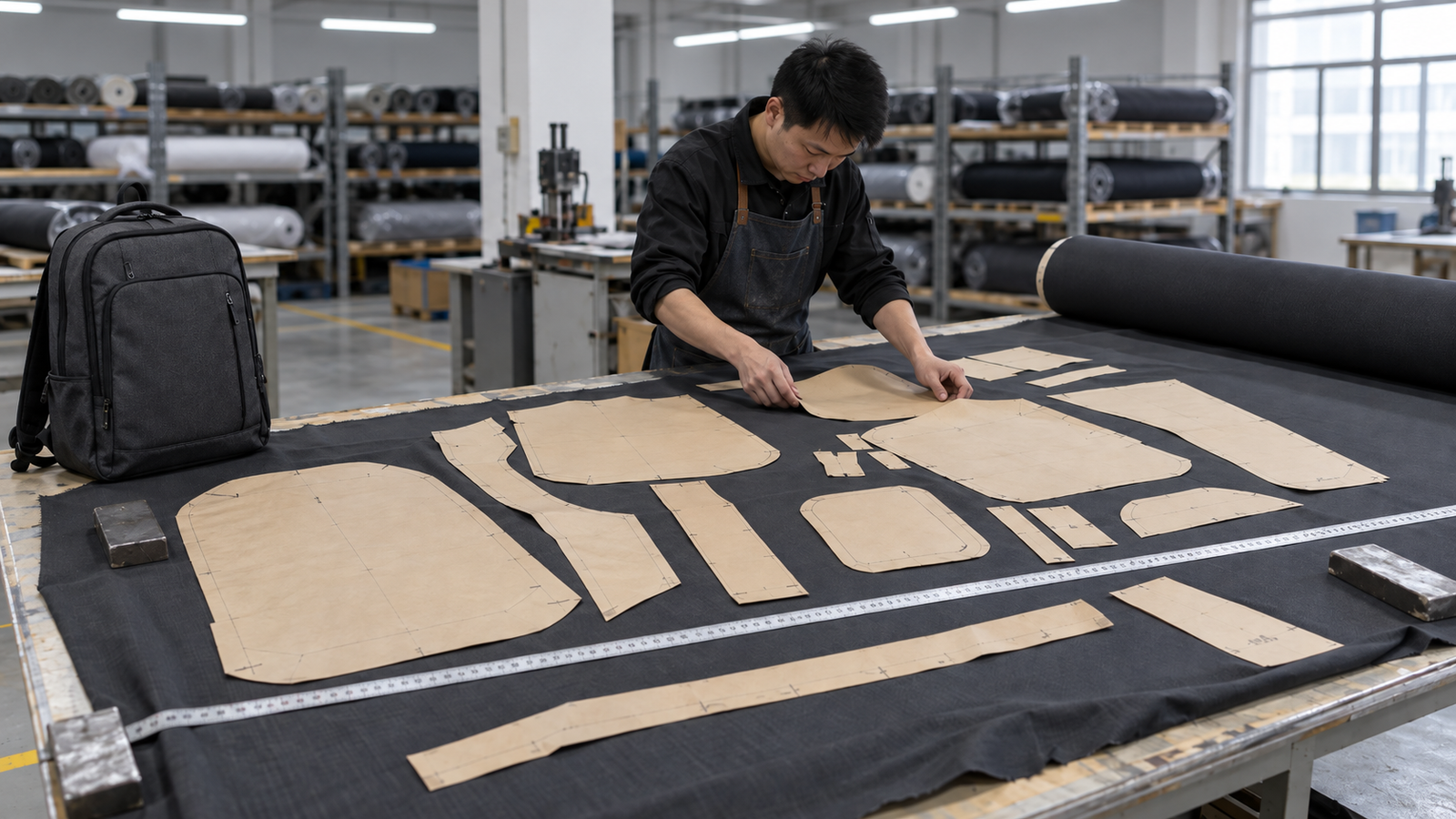
It’s not just the material cost. 1680D is harder to cut (our blades dull twice as fast) and slower to sew (we have to slow down the RPMs to prevent needle heat). That labor cost gets passed to you.
I remember a startup client dealing with a budget crunch on a travel backpack. We switched the main body from 1680D to a high-density 900D (a middle ground), and kept 1680D only on the bottom panel. They saved $1.80 per unit, and the bag still looked premium.
Price vs. Value Decision Matrix
| Project Budget | Recommended Strategy |
|---|---|
| Low / Promotional | 100% 600D (PVC backed for structure). |
| Mid-Range | 600D Body + 1680D Bottom Panel. |
| Premium / Industrial | 100% 1680D (or consider Nylon). |
Don’t waste money using 1680D on the inside or low-wear areas of a bag. Use "Strategic Material Mapping"—put the expensive stuff only where the bag touches the ground.
Can You Print Logos Easily on Both Fabrics?

600D provides a smoother surface ideal for screen printing intricate logos, whereas 1680D’s coarse texture often causes ink breakup on fine details.
This is the "hidden" production risk. 1680D has deep "hills and valleys" in the weave. If your client’s logo has 8pt text or thin serif fonts, the ink will fall into the valleys, making the text look broken or jagged. 600D is flat enough to hold a clean edge.
I remember a disaster order for a tech company where we tried to screen print a QR code on 1680D. The weave texture distorted the code so badly it wouldn’t scan. We had to scrap 500 panels and switch to a heat-transfer patch.
| Feature | Printing on 600D | Printing on 1680D |
|---|---|---|
| Silk Screen | Excellent. Sharp edges. | Poor. Saw-toothed edges. |
| Heat Transfer | Good, but watch for dye migration. | Good, adheres to high points. |
| Embroidery | Good, requires stabilizer. | Best. Fabric supports stitches well. |
Logo Rule: If you MUST use 1680D and have a complex logo, do not screen print. Use a Rubber Patch (PVC label) or a Woven Label sewn onto the bag. It looks more expensive and solves the texture issue.
Should You Choose 600D or 1680D for Your Next Project?
Choose 600D for promotional totes or school bags. Upgrade to 1680D for professional camera bags, checked luggage,tool bag, or any gear where failure is not an option for the user.
In our workshop, we follow a simple rule: If the product is meant to be "disposable" or used once a week for the gym, 600D is the king of value. If the product is a "tool of the trade" (like a photographer’s bag), 1680D is the baseline.
Quick decision checklist
- Load capacity < 8kg? Use 600D.
- Daily professional use? Use 1680D.
- Budget under $10/unit? Stick to 600D.
- Selling on Amazon for $80+? You better use 1680D or Cordura.
The Bottom Line: Don’t overthink the numbers. I’ve seen cheap 1680D fall apart in a month and premium 600D last for years. It’s about the backing and the weave quality.
Need a second opinion on your tech pack? Stop guessing. Contact Osgoodway Today ! and I’ll send you a swatch card so you can feel the difference yourself.

FAQ: Insider Answers from the Factory Floor
1. Is 1680D the same as "Ballistic Nylon"?
Absolutely not. This is the biggest lie in marketing. "Ballistic" refers to the weave style (2×2 basket weave), but 1680D is usually Polyester, which is weaker than Nylon. True Ballistic Nylon (1050D) is military-grade. 1680D Poly is the "budget lookalike."
2. Can I sublimate print on 1680D?
You can, but it looks terrible. Sublimation requires a smooth surface for sharp details. 1680D is too textured; the image will look broken and grainy. Stick to 600D for sublimation.
3. Which one is more eco-friendly?
Neither, unless you specify rPET (Recycled Polyester). However, 600D uses less plastic mass per yard than 1680D, so technically, 600D has a smaller carbon footprint during production.
4. Will 1680D make my bag too heavy?
It might. A full 1680D backpack can weigh 1.5kg empty. If you are targeting the "ultralight travel" niche, 1680D is a bad choice. Use 600D or Ripstop instead.
5. Is 600D waterproof?
No fabric is "waterproof" forever. 600D is water-resistant because of the PU/PVC backing. Once that backing wears off or the water hits the seams (which have holes from the needles), the bag leaks. Always specify "taped seams" if you actually want it waterproof.
FOOTNOTES
-
Understand the importance of abrasion resistance in fabric selection, especially for bags subjected to heavy use. ↩
-
Learn about various weave styles, including plain and basket weaves, and how they affect fabric performance and appearance. ↩
-
Investigate the factors that affect the cost of polyester fabrics, including material quality and manufacturing complexity. ↩