Last Updated: April 10, 2026
I’ve watching millions of yards of fabric turn into backpacks, duffels, and coolers. If there is one “King of the Hill” in our industry, it’s 600D Polyester. It’s the workhorse. It’s the budget-saver.
600D Polyester is a medium-weight, durable synthetic fabric1 used in over 70% of general-purpose bags, featuring 600-denier yarn in a plain or Oxford weave, typically coated with PU or PVC for water resistance. It weighs 200–230 GSM, costs $1.20–$2.80 per meter at factory level, and offers the best balance of durability, print-ability, and cost for school bags, promotional items, and travel gear.
Key facts at a glance:
| Attribute | Specification |
|---|---|
| Full name | 600 Denier Polyester |
| Weight (GSM) | 200–230 grams per square meter |
| Standard width | 58″ / 60″ (147–152 cm) |
| Weave types | Plain weave / Oxford weave |
| Common backings | PU, PVC, TPE, TPU |
| Factory price range (2026) | $0.8 – $2.80 USD per meter |
| Abrasion resistance | 7/10 (good for daily use) |
| Best for | School bags, promo bags, duffels, travel luggage |
| Not suitable for | Military gear, heavy tactical use, extreme abrasion |
It isn’t the strongest fabric on earth—that’s Nylon’s job—but for 90% of daily-use products, it is the most economically viable choice that doesn’t sacrifice perceived quality.
In this guide, I’m going to cut through the spec-sheet noise and tell you exactly what we see in the lab and on the production line—flaws included.
What Exactly Is 600D Polyester? (The Basics of Denier)
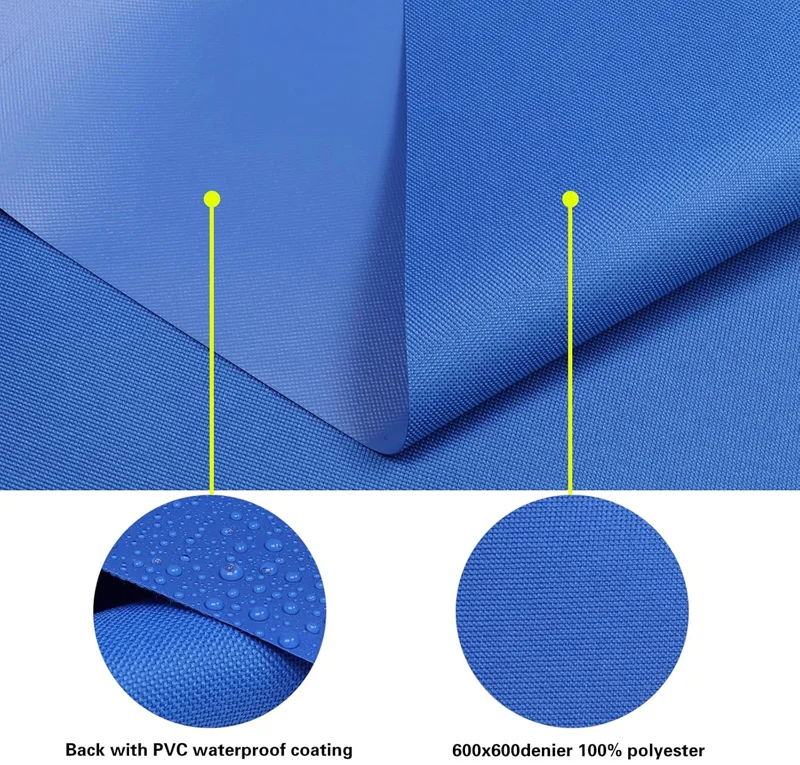
600D refers to the linear mass density of the fiber, where ‘D’ stands for Denier. Specifically, 9,000 meters of the yarn used in this fabric weighs exactly 600 grams.
Technically, the “D” (Denier) only tells you the weight of the yarn, not the quality of the weave. A high-quality 600D Oxford weave uses a 600×600 construction (warp and weft), creating a dense, ballistic-like face. Cheaper versions use 600×300, which saves weight but halves the structural integrity.
What are the standard specifications we use?
- Composition: 100% Polyester Filament
- Standard Weight: 200-230 gsm (grams per square meter)
- Weave Type: Plain / Oxford
- Backing: PVC, PU, or TPE.
- Width: Standard 58/60″.
- Standard Weight: Approx. 200-230 gsm (grams per square meter)
How to Spot Cheap 600D vs Real 600D (Weave Construction Matters)
| Construction | Warp × Weft | Typical Weight | Factory Cost | Real-World Performance |
|---|---|---|---|---|
| Premium 600D Oxford | 600D × 600D | 210–230 GSM | $2.20–$2.80/m | Full abrasion resistance, dense hand-feel |
| Standard 600D | 600D × 300D | 180–200 GSM | $1.00–$1.20/m | Acceptable for school/promo bags |
| Cheap 600D (trap) | 600D × 150D or lower | 150–170 GSM | $0.6–$0.8/m | Fails after 6–12 months of daily use |
🚨 Factory Warning: Many overseas suppliers market their 300D-weft fabric as “600D polyester” because technically the warp yarn IS 600D. They’re not lying — but they’re not telling you the whole story. Always ask for the full warp × weft specification (e.g., “600D × 600D”) on your Purchase Order, not just “600D.”
Also read: What Does “Denier” (600D vs 1000D) Actually Mean for Backpack Durability?
Why is 600D the Industry Standard? Key Properties & Performance
600D Polyester is the industry standard because it provides the optimal ratio of durability to cost. It is tough enough for daily use (school bags, gym bags[^2]), holds dye and prints exceptionally well, and costs roughly 30-40% less than comparable Nylon fabrics.
I call this the “Toyota Camry” of bag fabrics. It isn’t bulletproof like Cordura, but it rarely fails under normal use. Unlike Nylon, which is notoriously hard to print on, Polyester loves ink. If you want vibrant, complex patterns or sublimation printing2, 600D is your only real choice.
Performance data breakdown
| Property | Rating (1-10) | Notes |
|---|---|---|
| Abrasion Resistance | 7/10 | Good for daily use; bad for concrete drag. |
| Color Fastness | 9/10 | Resists UV fading better than Nylon. |
| Cost Efficiency | 10/10 | The best bang for your buck. |
What are the specific advantages for manufacturing?
- Superior Dyeability: Unlike polypropylene, 600D polyester holds vibrant colors and complex sublimation prints without bleeding, making it ideal for branded merch.
- Production Efficiency:It is stable under the cutting knife and doesn’t fray easily, which speeds up our sewing lines and reduces defect rates compared to slippery nylon.
- Thermal Stability: It shrinks less than 1% during heat transfer logo application, ensuring your branding stays sharp.
- Rot Resistance: Being synthetic, it is naturally resistant to mold and mildew, unlike natural canvas fibers.
- Inventory: It is always in stock in hundreds of colors.
If your target audience is “Average Consumer,” 600D is perfect. If your audience is “Military/Tactical,” skip this and go to 1000D Nylon. Do not cut corners on the wrong demographic.
Also read: What Is the Difference Between 600D and 1680D Polyester?
Is 600D Polyester Actually Waterproof? (Understanding Water Resistance)
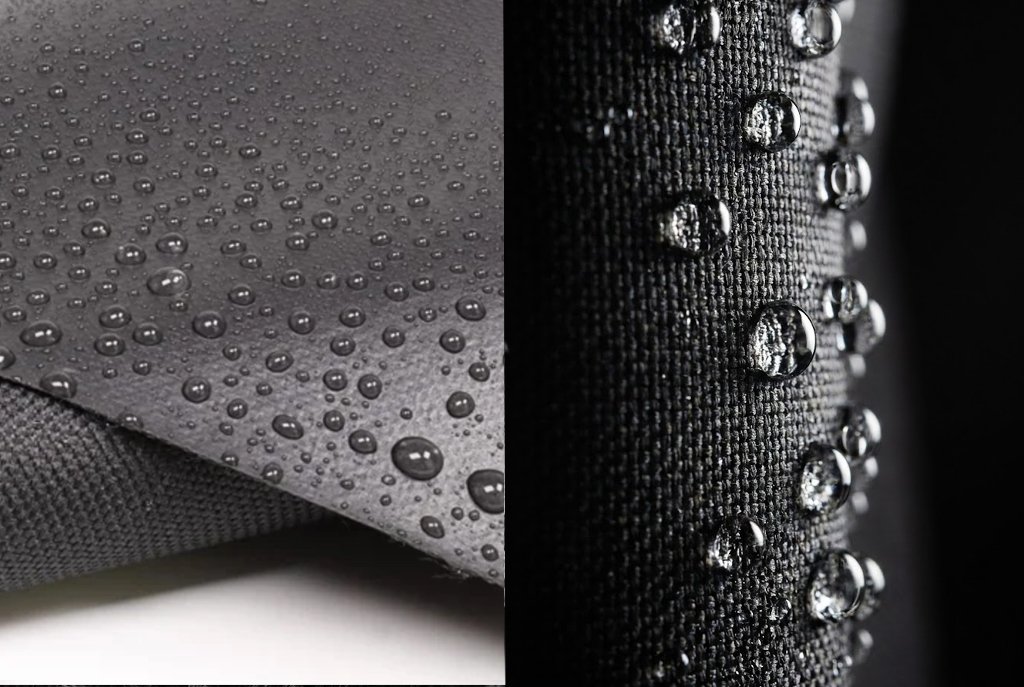
Let’s be clear because this is the #1 misconception I see in client emails.
No, raw 600D polyester is porous and will soak up water like a sponge. The ‘waterproof’ label you see comes entirely from the PVC, PU, or TPE backing coating and DWR finish3 applied at the factory, not the fabric itself.
We apply a chemical backing—usually PU (Polyurethane) or PVC (Polyvinyl Chloride)—to the backside of the fabric. Without this coating, the fabric has zero water resistance. With it, it can handle rain, but it will never be “submersible” waterproof unless you tape the seams, which is rare for this price point.
Which backing provides the best waterproofing?
PVC backing offers the highest water resistance because it creates a thick, rubber-like barrier, but it is heavy and contains toxic phthalates.
- Pros: Cheap, 100% waterproof barrier, gives the bag “structure” (stiffness).
- Cons: Cracks in cold weather, illegal in many EU markets (REACH compliance issues).
How do different coatings perform against water?
| Coating Type | Water Column Rating | Real-World Performance | Best Use Case |
|---|---|---|---|
| Raw 600D (Uncoated) | 0mm | Zero Protection. Water passes through instantly. | Laundry bags, cheap promotional totes. |
| 600D + 2x PU Coating | 800mm – 1,500mm | Rain Proof. Standard for backpacks. Good for rain showers. | School backpacks, gym bags (Standard). |
| 600D + PVC Coating | > 2000 mm | Waterproof Material. The fabric won’t leak, but water will enter through seams/zippers. | Heavy-duty gear, industrial tool bags. |
| TPE (Thermoplastic) | 3,000mm+ | Waterproof & Eco-friendly | Premium outdoor gear (The modern PVC alternative). |
Pro Tip for your Tech Pack: Never just write “Waterproof” in your material specs—it’s too vague. If you want standard rain protection, specify: “600D Polyester with 2x PU Backing and C0 DWR Finish.” If you need absolute waterproofing (like a dry bag), sewing isn’t enough; you will need HF welding capabilities.
600D PU vs. PVC Coating: How to Choose the Right Backing
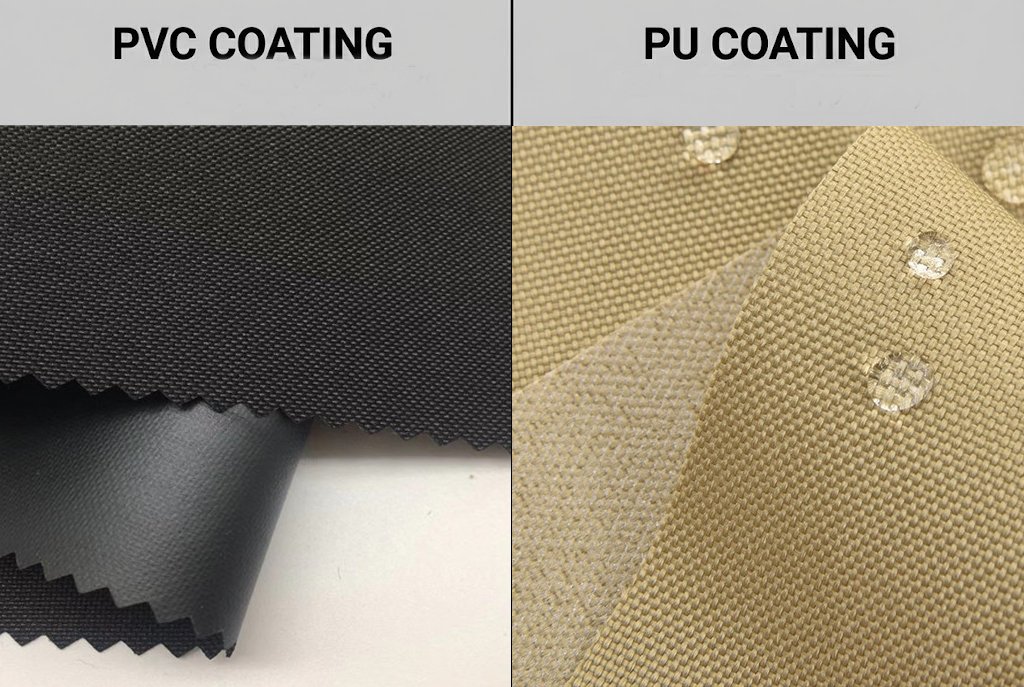
PU (Polyurethane) coating is eco-friendly, soft, and cold-resistant, while PVC (Polyvinyl Chloride) is cheaper, stiffer, and more waterproof but contains toxic phthalates. For US/EU markets, PU is strongly recommended to avoid Prop 65 and REACH compliance issues.
I recall a disaster where a client ordered PVC-backed bags for a Canadian winter promo. The PVC froze at -10°C and cracked when the bags were opened. It was a total loss. PVC smells like a shower curtain and feels cheap. PU feels like fabric and has no smell.
PU is the modern standard for quality; PVC is the old-school standard for cheapness and rigidity.
PU vs PVC vs TPU Coating: Complete Decision Matrix
| Coating | Flexibility | Cold Resistance | Cost Impact | Eco Rating | Best For |
|---|---|---|---|---|---|
| PVC | Stiff | Cracks below 0°C | +$0.20/m | ❌ Contains phthalates | Standing bags, rigid luggage |
| PU (Polyurethane) | Flexible | Good to -20°C | +$0.35/m | 🟡 Medium | Outdoor gear, winter bags |
| TPU | Very flexible | Excellent to -30°C | +$0.60/m | ✅ Phthalate-free | Premium outdoor, children’s bags |
| TPE | Flexible | Good | +$0.45/m | ✅ Fully recyclable | Eco-friendly lines (EU market) |
Which backing should you specify?
- Select PU: For retail brands, kids’ products, high-end backpacks, outdoor gear and anything sold in Europe/USA to avoid chemical compliance lawsuits..
- Select PVC: For cheap promotional giveaways or items that need rigid structure.
600D Polyester vs. Nylon: Which One Should You Buy?
Nylon is the “Ferrari” of fibers, but 600D Polyester is the “Toyota Camry.” It gets the job done for 90% of people at a much better price point.If budget is your #1 constraint, buy Polyester. If abrasion resistance is your #1 constraint, buy Nylon.
Nylon is chemically stronger—it’s a harder fiber. 500D Nylon will outlast 600D Polyester by years in a tumble test4 However, Polyester takes dye better (brighter colors) and resists UV fading much longer than untreated Nylon. For a school backpack? Polyester wins on price. For a military ruck? Nylon is mandatory.
How do the specs compare?
While Nylon is stronger pound-for-pound, Polyester offers superior UV resistance and holds dye colors longer, making it better for outdoor gear that sits in the sun.
| Feature | 600D Polyester | 420D/500D/1000D Nylon |
|---|---|---|
| Cost | $ Low | $$$ High |
| Feel | Crisp, Dry | Smooth, Silky |
| UV Resistance | Excellent | Moderate |
| Tensile Strength | Good | Excellent |
When to switch to Nylon?
- Choose 600D Polyester: School bags, tote bags, gym duffels, cooler bags.
- Choose Nylon: Tactical vests, luggage bottoms, mountain climbing packs.

How Much Does 600D Polyester Cost in 2026? (Real Factory Prices)

One question every brand owner asks me: “What should I actually be paying for 600D polyester?” Here are the real 2026 factory gate prices we see in Quanzhou and Guangzhou fabric markets:
Base Fabric Pricing (FOB China, per linear meter, 58″ width)
| Spec | Construction | Coating | Price Range (USD/m) | MOQ for this price |
|---|---|---|---|---|
| Cheap 600D (trap) | 600×150 Plain | PVC | $0.60 – $0.80 | 1,000m |
| Economy 600D | 600×300 Plain | PVC | $1.00 – $1.20 | 1,000m |
| Premium 600D Oxford | 600×600 Oxford | PU | $1.20 – $1.80 | 1,000m |
| Flame-retardant 600D | 600×600 | PU + FR | $1.60 – $2.60 | 1,000m |
| Recycled rPET 600D | 600×600 | PU | $2.20 – $2.80 | 1,000m |
| Anti-bacterial 600D | 600×600 | PU + AB | $1.60 – $2.60 | 1,000m |
Price fluctuation note: Polyester raw material prices track crude oil. Between Q1 2024 and Q1 2026, we’ve seen swings of ±18% on base 600D. For long-term contracts, lock in quarterly, not annually.
What Does This Mean for Your Bag Cost?
A typical 25L backpack uses approximately 1.2–1.5 meters of main fabric. At premium 600D prices:
- Fabric cost per bag: $2.64 – $3.90
- As % of total bag factory cost: 15–22%
- Retail markup factor: ×5 to ×8
If a supplier quotes you 600D fabric below $1.00/m, it’s not 600D — it’s likely 420D or 300D relabeled.
📘 Related: For a complete breakdown of all bag manufacturing costs (labor, hardware, QC, shipping), see our factory cost guide.
Common Applications: From Daily Backpacks to Tactical Gear
Due to its versatility, 600D Polyester is the primary fabric for school backpacks, laptop cases, gym duffels, and soft-sided cooler bags. It is generally not recommended for the bottom panels of heavy-duty hiking packs or luggage that will be dragged on concrete.
In our factory, 7 out of 10 lines are running 600D right now. It is the backbone of the “Soft Goods” industry.
Primary Industry Uses:
- Education: School backpacks (High printability).
- Travel: Packing cubes and toiletry kits.
- Outdoor: Camping chair skins and tent carry bags.
- Medical: First aid kits (Red 600D is standard).
Where should you NOT use it?
- Avoid: Drag bags.
- Avoid: Motorcycle protective gear (melts on sliding).
- Avoid: Submersible dry bags.
Actionable Tip: If you are making a backpack, use 600D for the main body, but use 1680D Polyester or Tarpaulin for the bottom panel. This adds durability where it touches the ground without increasing the total cost significantly.
600D vs 420D vs 1680D: Choosing the Right Denier for Your Use Case
600D doesn’t exist in a vacuum. Here’s how it compares to the two most common alternatives in our factory:
| Spec | 420D Polyester | 600D Polyester | 1680D Polyester |
|---|---|---|---|
| Weight (GSM) | 140–160 | 200–230 | 440–520 |
| Price/meter (2026) | $0.90–$1.30 | $1.00–$2.20 | 2.00–$3.20 |
| Abrasion | 5/10 | 7/10 | 10/10 |
| Tear strength | 180 N | 280 N | 600+ N |
| Typical use | Lunch bags, kids bags, promo | Backpacks, duffels, school bags | Luggage, tool bags, military |
| Bag lifespan (daily use) | 1–2 years | 3–5 years | 8–15 years |
The 600D sweet spot: For 80% of brand owners, 600D hits the perfect cost-to-durability ratio. Step down to 420D only for ultra-budget promo items; step up to 1680D only when buyers explicitly need “buy-it-for-life” durability.
Expert Insight: Why Do Some 600D Bags Fail While Others Last?
“I found 600D for $0.20 cheaper per yard!” That’s the most dangerous sentence in procurement. In our factory, we call this “Ghost 600D.” It looks right, but it’s a disaster waiting for your brand.
Most failures in 600D bags are rarely caused by the fiber itself. Instead, they are primarily due to low-density weaves (reduced pick count)—which force the plastic coating to bear the load rather than the yarn—or poor UV stabilization during the dyeing process.
There is “Good 600D” and “Bad 600D.” Unethical mills use recycled, short-fiber yarns that look fine initially but fuzz up (pilling) after a week of use. Or, they lower the density—for example, using a 64T or 58T weave instead of a standard 72T—to save yarn. It looks the same to the naked eye, but the tensile strength is cut by 15%.
Quality checklist for buyers:**
- Check Density: Ask for a 72T spec, not 58T or 64T.
- UV Treatment: Did they add UV inhibitors? (Crucial for outdoor gear).
- Backing Thickness: Is the PU coating visible, or does it look like a mist?
How to Test 600D Quality Without Professional Equipment?
While a lab test (ISO 13937) is the gold standard, these “guerrilla” tests will expose 90% of low-quality polyester instantly.
-
The Flashlight Test: Hold the fabric up to a bright light or your phone’s flash. If you see “stars” or pinpricks of light shining through the weave, the density is too low (likely a 58T or 64T) and will leak water.
-
The White Crease Test: Fold the fabric and pinch the crease hard between your thumb and forefinger, then drag your nail across the fold. If a permanent white scar or “chalk mark” appears, the backing is brittle and filled with cheap calcium carbonate that will peel within months.
-
The Water Bead Test: Pour a small amount of water on the face (the “pretty” side) of the fabric. If the water soaks in or “wicks” across the surface rather than rolling off like mercury, the DWR (Durable Water Repellent) treatment was skipped to save costs.
-
The Friction Test: Rub two pieces of the fabric face-to-face together vigorously for 30 seconds. If the surface becomes “fuzzy” or develops tiny balls (pilling), the mill used cheap, short-staple recycled fibers that won’t survive daily wear.
-
The Sniff Test: Take a deep breath of the fabric roll or a large sample. A strong, acrid, or “mothball” chemical smell indicates low-grade recycled PVC or high VOCs, which usually correlates with poor UV resistance and fast fading in the sun.
Summary Comparison: Good vs. Bad 600D
| Feature | Premium 600D (72T) | “Ghost” 600D (58T-64T) |
|---|---|---|
| Visual | Tight, uniform “basket” weave | Gaps between threads under light |
| Feel | Crisp, slightly “stiff” but flexible | Waxy, overly soft, or “crunchy” |
| The Scratch | No mark left | Coating flakes off like dandruff |
| The Pull | Seams stay tight | Threads “slide” (Comb-out effect) |
| Longevity | 3–5 years of heavy use | 3–6 months before peeling |
Pro-Tip for the Contract: When you add these to your guide, remind your readers that “Density is King.” You can have the best coating in the world, but if the “T” (Thread Count) is low, the bag will eventually fail at the stress points.
Conclusion: Is 600D Right for Your Project?
If you are building a product that needs to be affordable, colorful, and reliable, 600D Polyester is the correct choice. It is not the strongest fabric on earth, but it is the smartest choice for 90% of consumer goods.
However, if you are building gear for soldiers or mountaineers, look elsewhere.
Are you unsure if your design needs 600D or a heavy-duty Nylon?
We have a warehouse full of swatches. Contact Osgoodway Today !
, and I will send you a comparison kit so you can feel the difference yourself before you commit to a 5,000-unit order.
Related Fabric Guides from Our Factory Floor
600D polyester is just one fabric in the bag-making universe. If you’re evaluating materials for a new product line, these companion guides go deeper on alternatives:
- Complete Guide to 12 Common Backpack Materials — Side-by-side comparison of every major bag fabric
- Best Nylon Fabrics for High-Quality Backpacks — 420D to 1680D nylon deep dive
- Top 11 Fabrics for Making Bags — Industry-wide fabric overview
- Backpack Manufacturing Cost Breakdown — How fabric choice impacts total production cost
- Bag QC & Inspection Guide — How to verify fabric quality before accepting a shipment
Expert FAQ: 600D Polyester — No Fluff, Just Answers
“Oxford” refers to the weave pattern, not the denier. A 600D Oxford uses a basket-style interlacing that creates a more textured, dense surface than a plain 600D weave. Oxford typically has 5–10% higher abrasion resistance and a slightly heavier hand-feel, but costs about $0.20–$0.40 more per meter.
No. They share the same denier number (yarn weight) but behave very differently. Polyester holds color better, costs 30–40% less, and prints beautifully. Nylon is ~25% stronger in tensile tests but stains easily and costs more. For 90% of consumer bags, 600D polyester is the smarter choice.
Properly heat-set 600D polyester has less than 1% shrinkage across its lifetime under normal use. Cheap versions skip the heat-setting step and can shrink 3–5% after washing, causing seam puckering and distortion.
Yes, provided the coating is phthalate-free (avoid PVC, prefer PU or TPE) and the fabric passes CPSIA, EN 71, or California Proposition 65 testing. All Osgoodway 600D used for kids’ bags is PU or TPE coated and tested for compliance.
Virgin 600D polyester is theoretically recyclable but rarely accepted by standard PET recycling streams because of the coatings. rPET 600D (made from recycled plastic bottles) is the eco alternative — same specs, 20–30% higher cost, and GRS-certified for EU market compliance.
For stock colors: 500 meters (roughly 330 bags). For custom PMS-matched colors: typically 1,500–3,000 meters (dye lot minimum). Custom print or sublimation patterns usually require 2,000+ meters.
Three checks: (1) Request a GSM test — real 600D is 200–230 GSM, cheap fakes are 150–180 GSM. (2) Inspect the weave count on your PO — demand “600×600” not just “600D”. (3) Ask for a third-party lab report from SGS or Intertek confirming the warp/weft denier.
References
- Explore what is synthetic fabric? — “Industrial Revolution” for textile fabrics ↩
- Explanation of the printing process where heat transfers dye onto materials, ideal for synthetic fabrics. ↩
- Guide to how Durable Water Repellent finishes work to keep outer fabrics dry. ↩
- Industry standard testing method for determining the abrasion resistance and pilling of fabrics. ↩