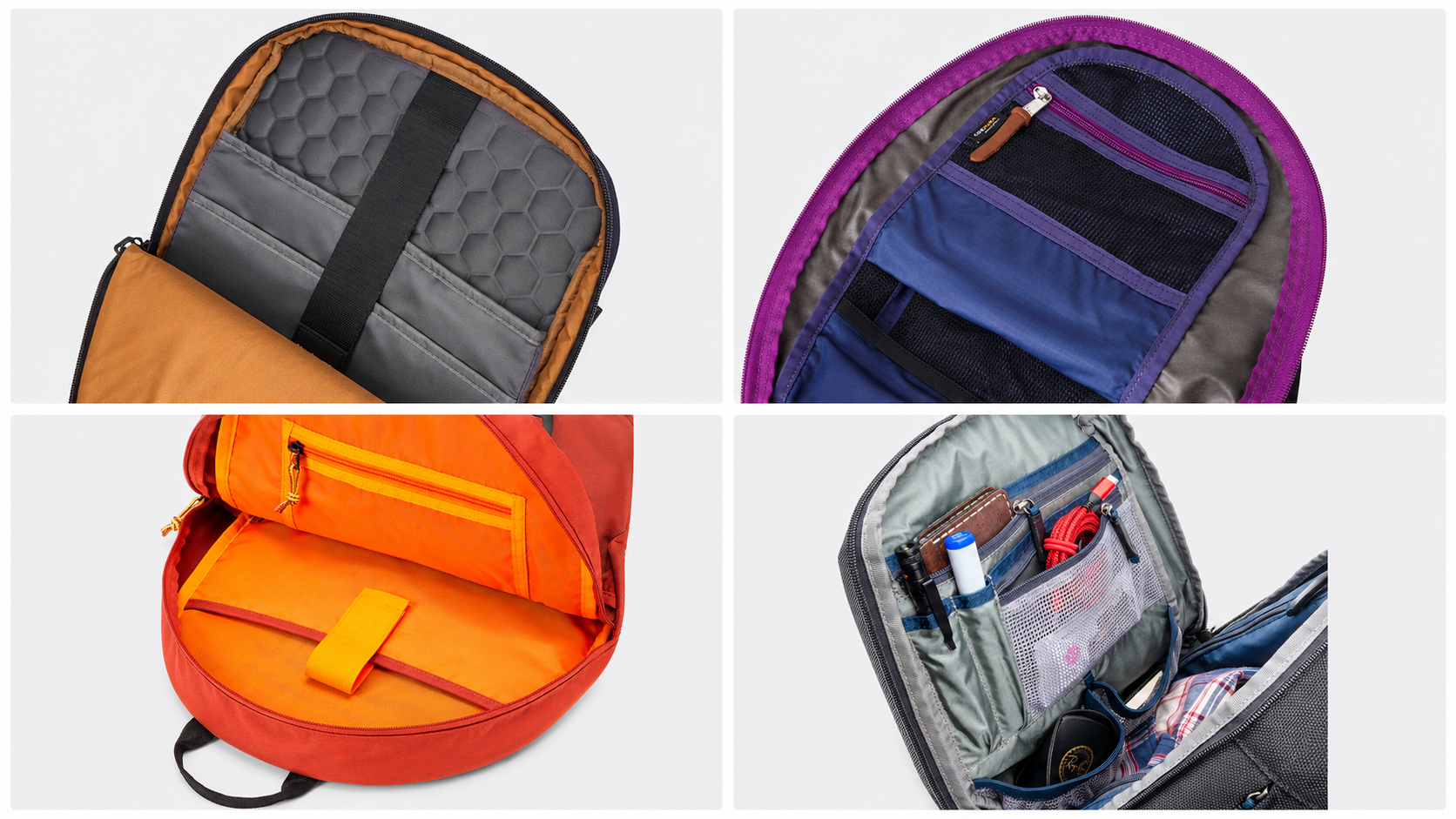
When developing a bag, the lining is not always made from one type of fabric throughout the interior. The main compartment, organizer pockets, laptop sleeve and other functional areas may all require different materials.
In our bag development work, we usually consider what each compartment needs to do before choosing the lining. Some areas need a lightweight fabric, while others require better abrasion resistance, a softer surface or additional cushioning.
The right lining is not necessarily the thickest or most expensive one. It is the one that meets the requirements of each area without adding unnecessary weight or cost.
In this guide, we’ll look at common bag lining materials, their practical applications and what buyers should consider when specifying them for production.
Quick Answer
- Polyester Taffeta: A common choice for general-purpose bag lining because it is lightweight, smooth and economical.
- Polyester Oxford and Nylon: Suitable options for internal areas requiring more substantial construction and durability.
- Mesh and Tricot: Mesh works well for organizer pockets, visibility and airflow where the design allows it, while Tricot provides a softer contact surface.
- Foam-Laminated Fabrics: Used where additional cushioning and structure are needed.
- RPET Polyester: Provides a recycled-material option across different fabric constructions.
- TPU, PVC and PEVA: Used for specialized moisture-containment compartments rather than ordinary textile lining.
How Are Bag Lining Materials Classified?
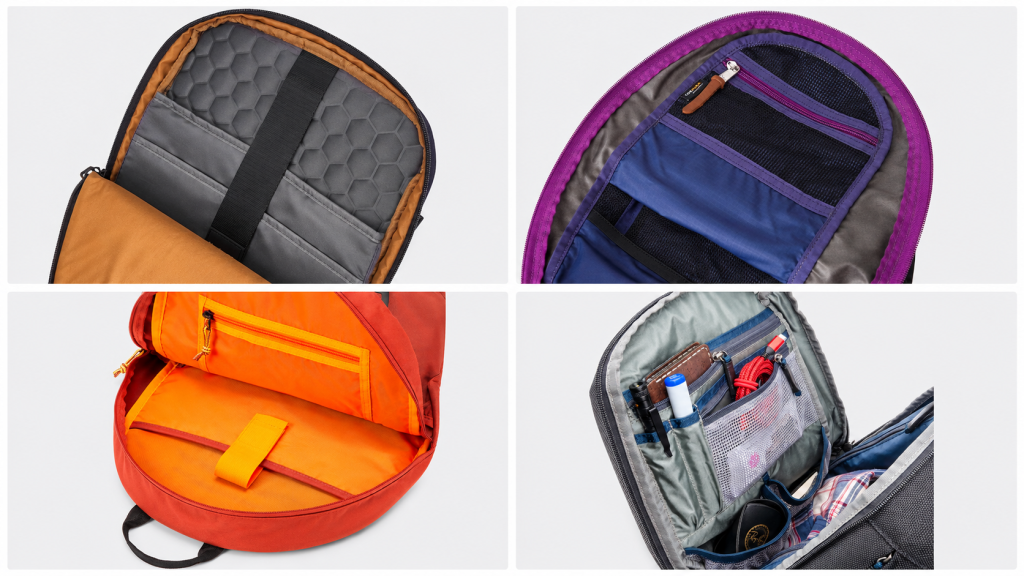
Before comparing different lining fabrics, it helps to understand how they are classified. In the bag industry, material names do not always describe the same thing. Some refer to the fiber itself, others describe how the fabric is constructed, while some refer to a coating or finishing process.
For example, polyester is a fiber type, Oxford is a fabric construction, and PU coating is a surface treatment. A single lining fabric can combine all three.
We usually look at these details together rather than choosing a material based on its name alone.
Fiber and Material Types
Polyester and nylon are common fibers for bag linings. Polyester is widely used across lightweight and heavier constructions, while nylon is another option where low weight and mechanical performance matter.
RPET is recycled polyester. It describes the source of the raw material, not a separate fabric structure or performance grade.
Fabric Construction
Taffeta and Oxford describe woven fabric constructions, while ripstop refers to a reinforced grid-like weave. Mesh has an open structure for pockets and dividers, and Tricot is a warp-knit fabric often used where a smooth or soft surface is preferred.
The same fiber can be made into different constructions, each with different characteristics.
Surface Finishing and Lamination
Finishing changes the fabric surface or adds another layer. PU coating can improve moisture resistance; brushing creates a softer surface; and foam lamination adds padding and bulk.
These treatments are not interchangeable, and a PU-coated lining should not automatically be described as waterproof.
What Do 190T, 210T, 210D and GSM Mean?
| Specification | What It Describes |
|---|---|
| 190T / 210T | Common market designations for lightweight woven fabrics; confirm the supplier’s counting convention |
| 210D / 300D | Yarn linear density (denier) |
| GSM | Fabric weight per square meter |
190T and 210D are not directly comparable: they describe different specifications. GSM also does not tell us thickness or durability on its own.
When sourcing, we check the full specification and an actual swatch rather than choosing by one number.
What Are the Most Common Types of Bag Lining Materials?
Several fabrics are commonly used for bag linings, but they serve different purposes. Some are designed for lightweight interior coverage, while others are better suited to pockets, high-friction areas or compartments that need a softer surface.
Here are seven options we commonly consider during bag development.
1. Polyester Taffeta (190T / 210T)
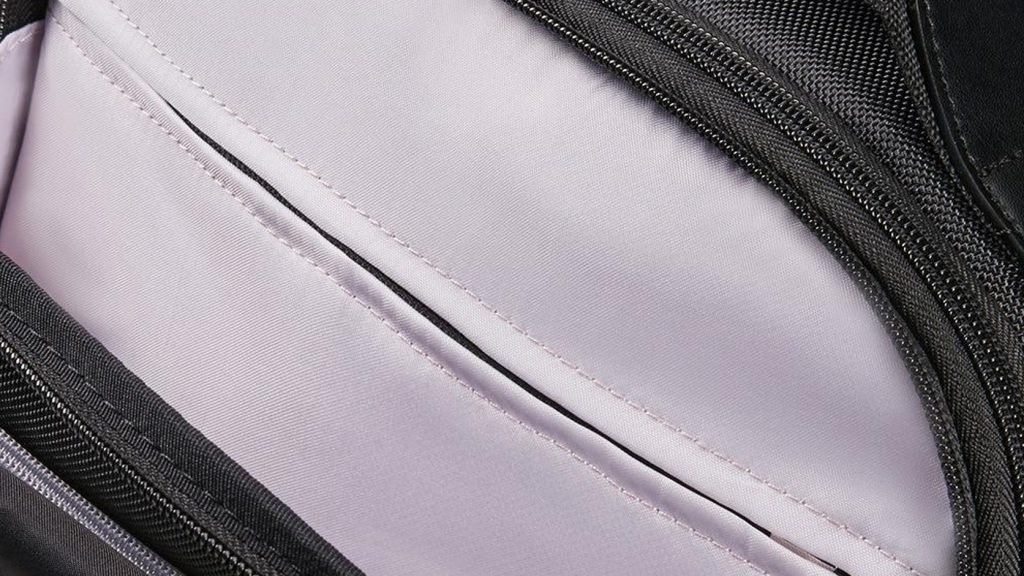
Polyester Taffeta is one of the most common choices for general-purpose bag lining. It has a relatively smooth surface, lightweight construction and competitive cost, making it suitable for everyday backpacks, travel bags, promotional bags and lightweight internal pockets.
Its main advantages are:
- Lightweight and flexible.
- Smooth surface and relatively easy to sew.
- Available in a wide range of colors.
- Economical for larger production quantities.
However, very lightweight Taffeta may have limited tear resistance. We also pay attention to areas around zipper openings and pocket edges, where thin fabric can be more vulnerable to repeated pulling.
For a standard backpack main compartment used mainly for clothing and everyday items, a suitable lightweight Taffeta may already be sufficient. There is not always a reason to upgrade to a heavier lining.
2. Polyester Oxford (210D / 300D)

When an internal area needs a more substantial fabric construction, Polyester Oxford is worth considering. It is commonly used in daily backpacks, tool bags, travel organizers and compartments exposed to more friction.
Compared with lightweight Taffeta, an appropriate Oxford construction can provide a firmer and more substantial feel. However, actual performance still depends on yarn quality, weave construction, fabric density, weight and finishing.
Denier alone does not define fabric construction. If you’re considering 210D polyester as a lining option, see our guide to Is 210D Polyester the Best Fabric for Bag Lining? for a closer look at its advantages, limitations and applications.
I would not automatically recommend using heavier Oxford throughout the entire bag just because certain areas need better durability. For example, if a tool organizer has compartments that regularly hold metal tools, reinforcing those specific areas may be more practical than increasing the lining weight everywhere.
Selective reinforcement can be a more practical solution than upgrading the entire interior.
3. Nylon and Nylon Ripstop
Nylon is another common option for lightweight and performance-oriented bags, particularly outdoor backpacks and travel products.
Depending on its construction, nylon can offer good strength-to-weight performance and abrasion resistance. Nylon Ripstop incorporates a reinforced grid structure designed to help limit the spread of small tears.
However, ripstop does not mean tear-proof. A sharp object can still puncture the fabric, and its actual performance depends on the base fiber, yarn specification and weave.
Nylon is also not automatically better than polyester for every lining application. We still consider material cost, availability, construction and the product’s actual requirements.
For lightweight products where durability and weight both matter, nylon ripstop can be worth evaluating.
4. Recycled Polyester (RPET): A Material Source Across Different Fabric Constructions

RPET is made from recycled polyester raw materials. It is increasingly used in bag development when brands want to incorporate recycled content into their products.
One important distinction is that RPET is not a separate fabric construction or performance grade. It can be made into different fabrics, including:
- RPET Taffeta
- RPET Oxford
- RPET Ripstop
Each construction can have different weight, hand feel and durability.
When sourcing RPET lining, we look beyond the recycled-material claim. Buyers should also confirm recycled-content documentation, material availability, color options, MOQ and whether the fabric meets the required performance.
If a brand wants to use recycled materials throughout the entire bag, the lining, mesh, webbing and other components should also be reviewed. Confirming that only the main shell fabric is recycled does not mean the whole bag meets the same recycled-content requirement.
For a broader look at recycled materials across different bag components, see our guide to How to Choose Eco-Friendly Materials for Kids Bags.
5. Mesh Fabrics

Mesh is commonly used in internal zipper pockets, water bottle pockets, elastic organizer pockets and storage dividers.
Its open structure allows users to see stored items and can provide airflow when the pocket design and surrounding construction allow it. It is also useful when a pocket needs some flexibility rather than a fully enclosed woven fabric construction.
But mesh selection depends heavily on what will be stored inside.
For example, a fine mesh may work well for small accessories, while a pocket designed for keys, tools or other items with sharp edges needs greater attention to snag resistance and durability.
During development, we normally check:
- Mesh opening size.
- Stretch and recovery.
- Snag resistance.
- Edge fraying.
- Seam durability.
Mesh is not automatically suitable for every internal pocket. The opening size and construction should match the contents and intended use.
6. Tricot and Other Soft-Touch Linings

Some internal pockets need a softer surface rather than a heavier woven fabric.
Brushed Tricot is often used for small accessory pockets, eyewear compartments, delicate-item storage and selected electronics contact surfaces.
Its soft hand feel helps reduce direct scratching from rougher woven surfaces. This makes it useful when the contents may come into frequent contact with the lining.
However, a soft lining should not be confused with protective padding.
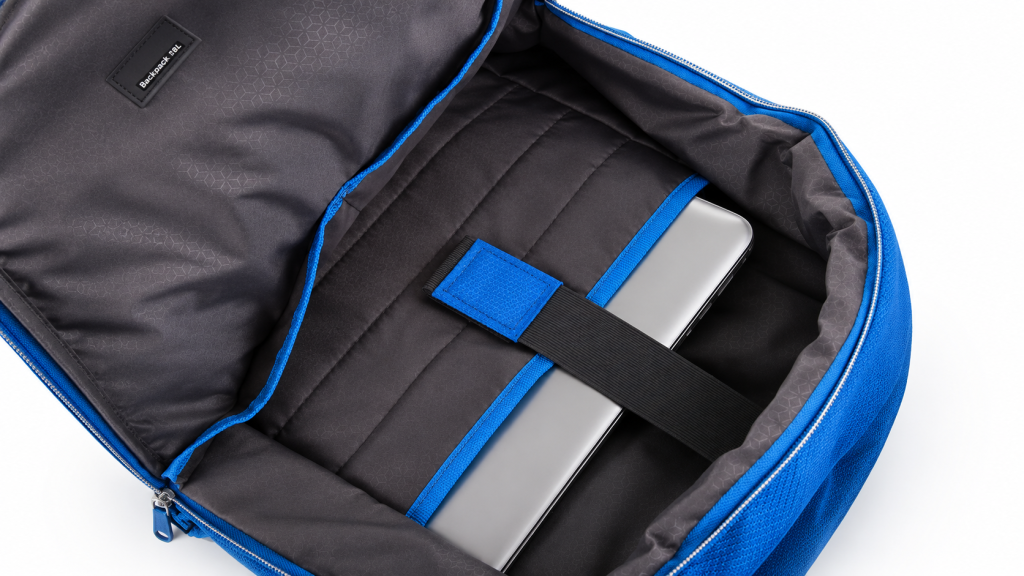
For example, a laptop compartment may use Tricot as its contact surface, but actual cushioning depends on the foam, compartment structure and other protective features.
We treat the surface material and the cushioning construction as two separate decisions.
For more on how fabric and padding work together in laptop bags, see our guide to Materials for Durable Laptop Backpacks.
7. Foam-Laminated Lining

Foam-laminated lining is a composite construction rather than a single fabric type. It typically combines a face fabric, a foam layer and a backing fabric or lining surface.
It is commonly considered for laptop compartments, camera bags, protective equipment bags and other padded internal panels.
The foam adds thickness and cushioning, while the face and backing materials provide the required surface and construction.
When developing this type of lining, we pay attention to more than the face fabric. Foam thickness, density, overall construction and bonding quality all matter.
If the lamination is unstable, the layers may eventually separate or form bubbles during use. Additional thickness can also make cutting, folding and sewing more difficult.
A good foam-laminated lining depends on the complete composite construction, not simply on how soft the surface feels.
How Should You Choose Lining Materials for Different Bag Compartments?
Choosing a lining material based only on the type of bag is not always the best approach. A backpack, for example, may contain a large main compartment, several organizer pockets, a padded laptop sleeve and smaller pockets for personal accessories.
Each area has different requirements, so using the same lining throughout the entire bag may not be the most practical solution.
Here is how we typically approach lining selection during product development.
| Internal Area | Common Material Choices | Main Consideration |
|---|---|---|
| Main compartment | Polyester Taffeta / Polyester Oxford | Weight, durability and cost |
| Organizer pockets | Polyester Taffeta / Mesh | Flexibility and visibility |
| High-friction areas | Heavier woven Polyester / Nylon | Abrasion and tear resistance |
| Small accessory pockets | Brushed Tricot / Soft Polyester | Smooth contact surface |
| Laptop and padded compartments | Tricot + Foam-laminated construction | Surface protection and cushioning |
| Wet compartments | TPU / PVC / PEVA or suitable coated materials | Moisture containment and easy cleaning |
Main Compartments: Balance Weight and Durability
For a standard backpack or travel bag, the main compartment usually does not need an especially heavy lining.
Lightweight Polyester Taffeta is often sufficient for storing clothing, books and everyday personal items. If the compartment is expected to carry heavier equipment or experience more friction, a more substantial Polyester Oxford construction may be worth considering.
The key is to match the lining to the expected load and usage rather than automatically choosing the thickest option.
Organizer Pockets: Consider Flexibility and Visibility
Internal organizer pockets often store smaller items such as chargers, cables, keys, wallets and stationery.
Polyester Taffeta works well for conventional pockets because it is lightweight and flexible. Mesh is another option when users need to see the contents or when airflow is useful.
However, mesh opening size and snag resistance should be considered if the pocket will hold keys, tools or other objects with sharp edges.
High-Friction Areas: Reinforce Where It Matters
Some internal areas experience more wear than others, including pocket bottoms that carry heavy accessories, areas around zipper openings, internal dividers and compartments used for tools or equipment.
In these locations, a heavier woven Polyester or Nylon construction may provide a more suitable solution.
Rather than upgrading every lining panel, we often recommend reinforcing only the areas that experience higher stress. This helps control material consumption, weight and overall production cost.
Laptop and Small Accessory Compartments: Separate Softness from Protection
For pockets holding glasses, phones or other delicate accessories, Brushed Tricot or another soft-touch fabric can provide a smoother contact surface and help reduce direct scratching.
Laptop compartments require a different approach. A soft inner lining improves the contact surface, while foam provides cushioning and structure.
These are two separate functions. A soft lining alone cannot provide sufficient impact protection.
The complete construction should be evaluated according to the device, foam specification and compartment design.
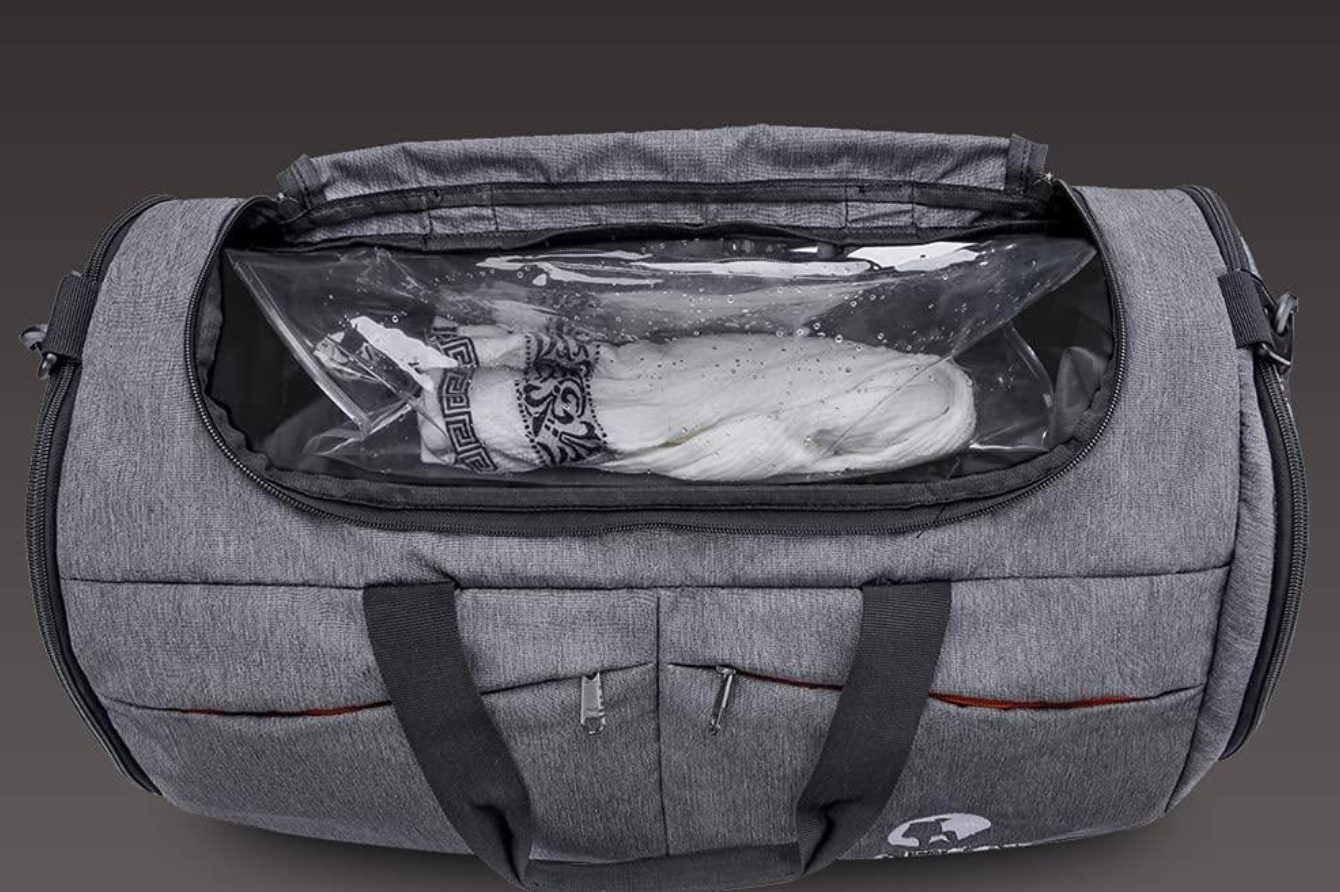
Wet Compartments: Use a Dedicated Moisture-Resistant Construction
Wet compartments in gym bags, swimming bags and travel products have different requirements from conventional textile-lined compartments.
They may use TPU, PVC, PEVA or other suitable coated materials, depending on the design and required performance.
However, choosing a waterproof material does not automatically make the finished compartment leakproof. Seams, zipper construction and material joining methods also need to be considered.
For a more detailed comparison, see our guide: Wet Pocket Materials for Gym Bags: TPU vs PVC vs PEVA.
Different compartments should be designed around their actual functions. A well-planned combination of lightweight, durable, soft and moisture-resistant materials is often more practical than using one expensive lining throughout the entire bag.
What Performance Factors Should You Consider When Choosing Bag Lining?
Choosing a lining is not just about fabric type or weight. Two fabrics with similar specifications can perform differently once they are cut, sewn and used inside a finished bag.
When reviewing lining materials, we usually look at several practical factors beyond the fabric name.
Abrasion Resistance and Tear Strength
The lining needs to withstand repeated contact with the items stored inside the bag. However, abrasion resistance and tear strength are not the same thing.
Abrasion resistance matters when contents repeatedly rub against the fabric, while tear strength becomes important around pocket openings, corners and seams.
If the compartment carries sharp or pointed objects, puncture resistance may also need to be considered. A fabric that performs well in one area does not automatically perform well in the others.
Weight, Thickness and Fabric Bulk
Heavier lining is not necessarily better. Adding unnecessary fabric weight can increase the finished bag’s overall weight, material consumption and shipping cost.
We consider GSM, actual thickness and how the material behaves when folded or sewn. For padded or laminated linings, the combined thickness can also affect usable compartment space.
Hand Feel and Cleanability
The lining is part of the user’s everyday experience. A smooth surface may make items easier to slide in and out, while a softer finish can be more suitable for delicate accessories.
For gym bags, travel organizers and everyday backpacks, it is also worth considering whether the lining can be wiped clean and whether dirt is easily visible.
Colorfastness and Color Selection
Lining color is sometimes overlooked during development, but it can affect both appearance and usability.
Light-colored linings make small items easier to find, while darker colors tend to hide everyday dirt better. We also check colorfastness to reduce the risk of color transfer caused by rubbing or moisture.
Coating and Moisture Resistance
A PU-coated lining may provide additional moisture resistance and make wipe cleaning easier, depending on the coating and fabric construction. However, coating can also change the fabric’s hand feel, flexibility and sewing behavior.
A coated lining does not automatically make the finished compartment waterproof. Seams, zippers and construction details still need to be evaluated.
Sewing Performance and Construction
Finally, a lining must work well during actual production.
We pay particular attention to zipper openings, pocket corners, seam allowances and attachment points. Even when the fabric itself is suitable, poor construction or insufficient reinforcement in these areas can lead to tearing during use.
The best lining specification is therefore one that performs well not only as a fabric sample, but also as part of the finished bag.
Does a Bag Need Full Lining or Partial Lining?
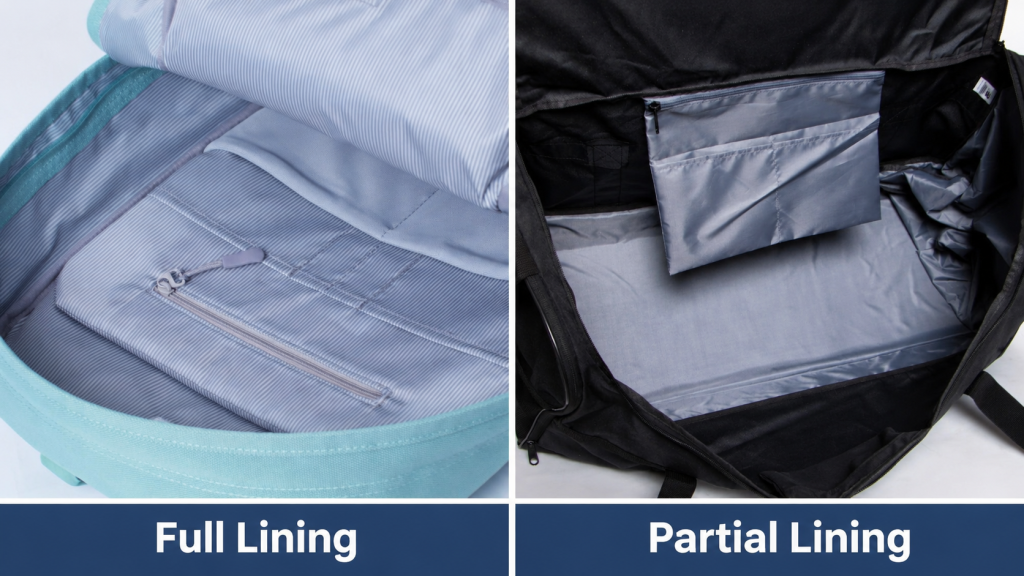
A fully lined backpack may look more finished inside, but that does not mean every bag needs the same construction.
For example, a structured travel backpack with several internal pockets usually benefits from a complete lining. A simple drawstring bag or lightweight promotional bag may only need selected areas lined, or no separate lining at all.
The decision should come from the product’s intended use and construction, not simply from appearance.
When Full Lining Makes Sense
Full lining is commonly used in backpacks, travel bags and structured bags where a clean interior finish is important.
It can cover raw seams, provide a consistent interior appearance and create a suitable base for attaching internal pockets and organizers.
When Partial or Unlined Construction Is Better
For simpler products, adding a complete lining may bring little practical benefit.
| Construction | Typical Applications | Main Consideration |
|---|---|---|
| Full lining | Structured backpacks, travel bags | Clean finish and internal organization |
| Partial lining | Lightweight outdoor bags, selected compartments | Finish only where needed |
| Unlined | Drawstring bags, simple promotional bags | Lower weight and simpler construction |
An unlined design still needs proper seam finishing. Exposed fabric edges should not be left unfinished simply to reduce material consumption.
How Lining Affects Weight, Cost and Usable Space
From the factory’s perspective, a full lining means additional fabric consumption, cutting and sewing operations. Multiple internal layers can also reduce usable space, particularly in compact bags with several pockets.
When reviewing a design, we consider three practical questions:
- Does the lining improve the product’s appearance or functionality?
- Are all internal areas actually required to have a lining?
- Could selected panels achieve the same result with less material?
Sometimes, lining only the main compartment or specific functional areas is enough to achieve the required finish.
The goal is not to use less lining everywhere, but to avoid adding construction that does not serve a clear purpose.
What Should Buyers Specify When Ordering Bag Lining?
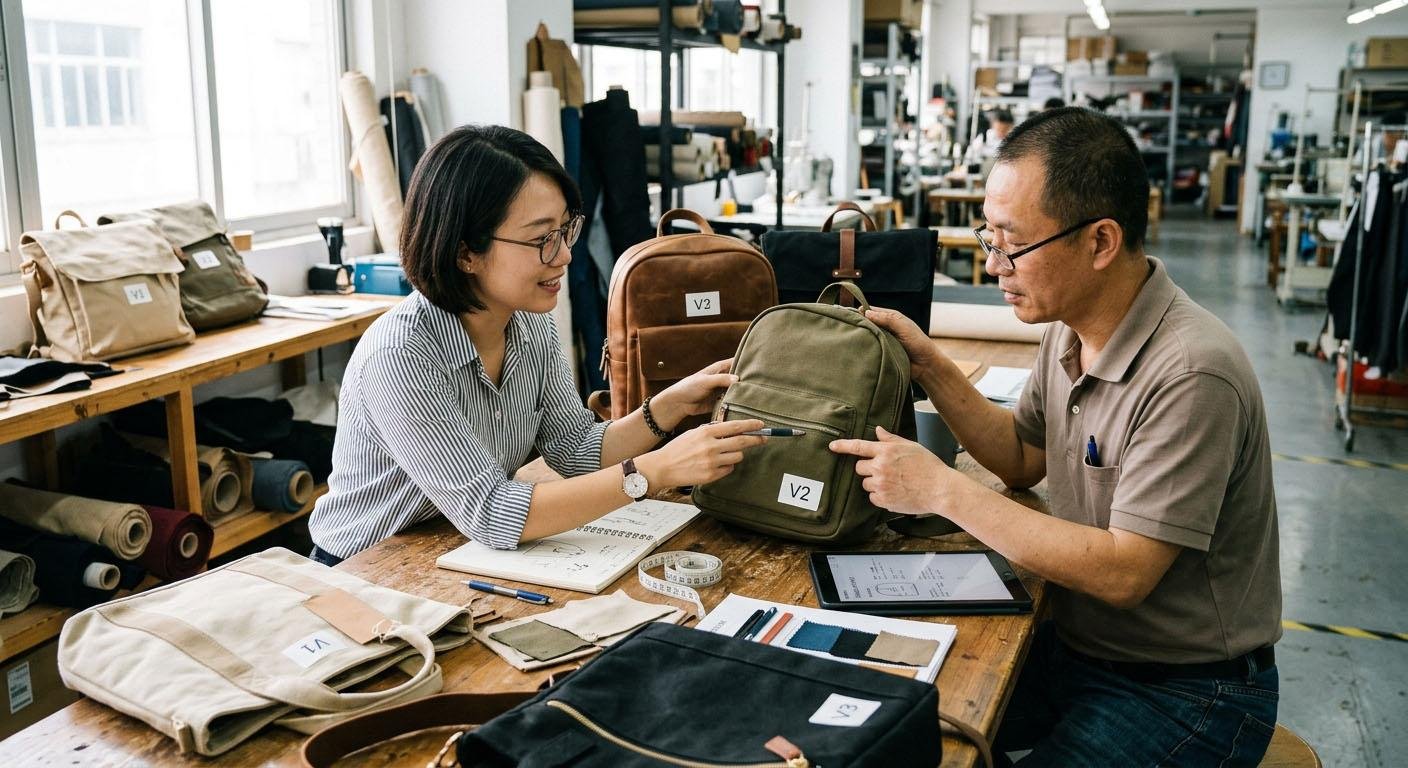
When requesting a quotation, some buyers simply write "polyester lining" in their tech pack or product specification. From a factory’s perspective, this leaves too much room for interpretation.
Polyester lining can vary in denier, fabric construction, weight, coating, hand feel and colorfastness. If these details are not confirmed, the material selected for sampling may not be the same as the buyer expects for bulk production.
Don’t Specify Only "Polyester Lining"
A material name is only a starting point. Before sampling or bulk production, we recommend confirming the following details.
What Should Be Included in the BOM?
| Specification | What to Confirm |
|---|---|
| Fiber composition | Polyester, Nylon or recycled Polyester |
| Fabric construction | Taffeta, Oxford, Ripstop, Mesh or Tricot |
| Yarn denier | 210D / 300D, where applicable |
| Fabric density designation | 190T / 210T, according to the supplier’s specification |
| GSM | Fabric weight per square meter |
| Color | Pantone reference or approved color swatch |
| Coating / Finishing | PU coating, brushing or other treatments |
| Recycled content | Required percentage and supporting documentation, if applicable |
| Physical reference | Approved material swatch |
| Material identification | Supplier reference or material code |
For more complicated constructions, such as foam-laminated lining, the foam thickness and complete layer structure should also be documented.
We also recommend keeping an approved physical swatch for comparison during material purchasing and incoming inspection. This helps avoid misunderstandings caused by written descriptions alone.
Check Recycled Content and Compliance
If recycled lining is required, buyers should confirm the recycled-content percentage, supporting documentation and relevant supply-chain requirements.
The Global Recycled Standard (GRS) and Recycled Claim Standard (RCS) provide third-party certification for recycled materials and chain-of-custody requirements. GRS also includes additional social, environmental and chemical-related requirements within its applicable scope.
Textile Exchange is transitioning its standards system toward Materials Matter, so buyers should confirm the applicable standard version, certification scope and claim requirements when sourcing.
OEKO-TEX STANDARD 100 serves a different purpose. It tests textile products and components for harmful substances rather than verifying recycled content.
Depending on the destination market and buyer requirements, applicable chemical compliance requirements, including EU REACH and the brand’s Restricted Substances List (RSL), may also need to be considered.
Why the Cheapest Lining May Not Have the Lowest Actual Cost
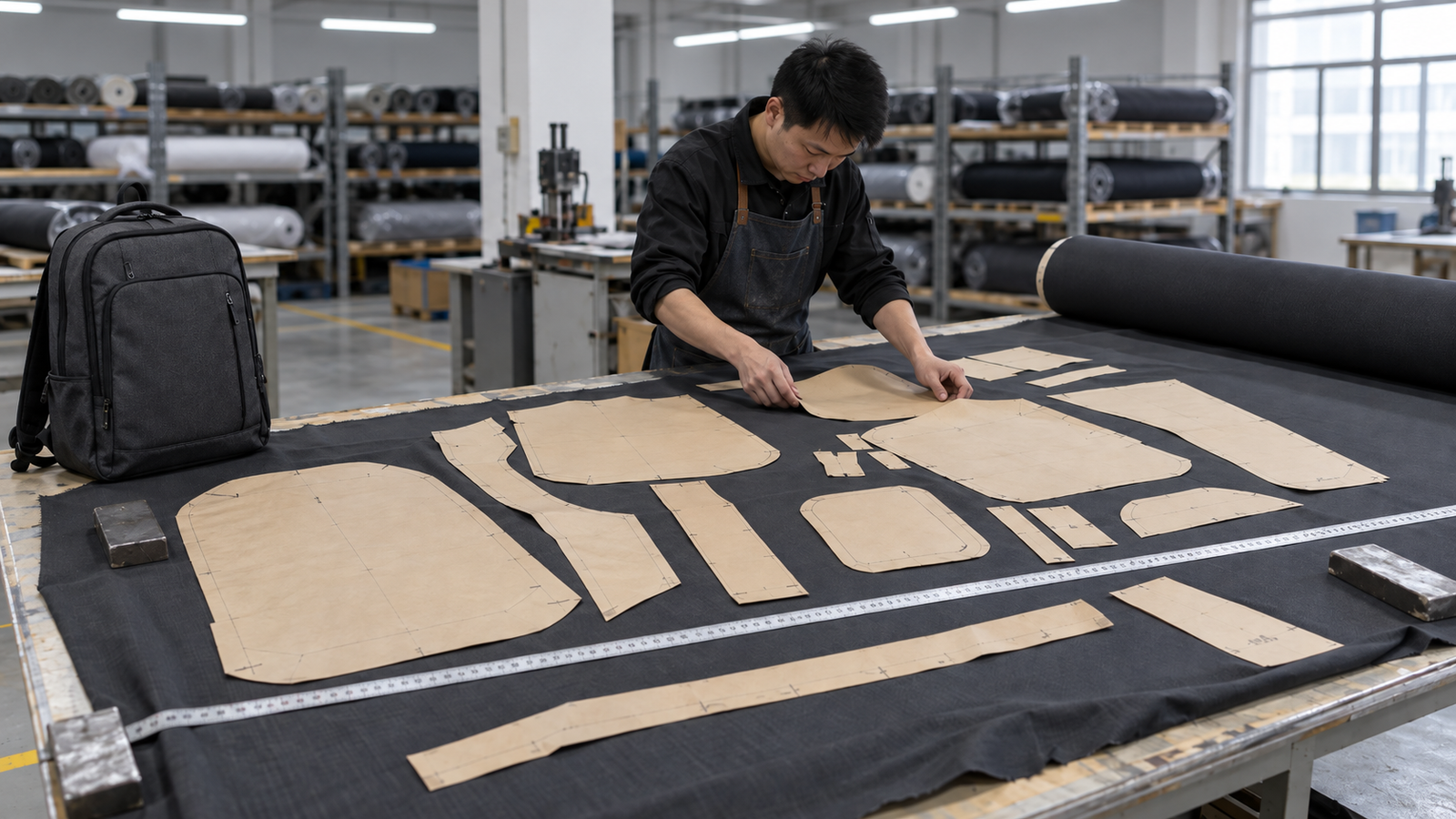
The price per meter does not tell the whole story. When calculating lining costs, we also consider:
- Fabric width and GSM.
- Actual consumption per bag.
- Cutting waste and pattern layout.
- Color MOQ and stock availability.
- Special coating or finishing requirements.
A lower-priced fabric may require more material because of its width or create higher cutting losses. In some cases, a readily available standard fabric can be more economical for the complete order.
For a closer look at how factories calculate material usage from patterns, usable fabric width and cutting loss, see our guide to How Bag Factories Calculate Fabric Consumption.
The best quotation should therefore be based on the actual material specification and consumption, not just the fabric’s unit price.
Frequently Asked Questions
1. What is the best material for bag lining?
Polyester Taffeta is a practical choice for many everyday bags because it is lightweight and economical. For areas requiring greater durability, Nylon or Polyester Oxford may be more suitable.
2. Is polyester or nylon better for bag lining?
Neither is automatically better. Both can offer good performance, but the result depends on yarn quality, fabric construction, weight and finishing.
3. Is 210D lining better than 190T?
Not necessarily. 210D refers to yarn denier, while 190T is a common market designation for lightweight woven fabric density. They are different specifications and cannot be compared directly.
4. Is RPET polyester suitable for bag lining?
Yes. RPET can be made into Taffeta, Oxford and Ripstop fabrics for different lining applications. Its suitability depends on the actual fabric construction and performance requirements, not simply on its recycled content.
5. Can mesh be used as a main bag lining?
Mesh is generally more suitable for selected pockets, dividers and organizer sections. It can be used more extensively in designs that require an open structure, but it does not provide the same coverage or containment as conventional woven lining.
6. Does PU-coated lining make a bag waterproof?
No. PU coating can improve the fabric’s resistance to moisture, but stitched seams, zipper openings and needle holes may still allow water to enter. A waterproof compartment requires the complete construction to be designed and tested for water containment.
7. Does every backpack need full lining?
No. Full lining is useful when a clean interior finish and internal organization are required, but some lightweight or simple bags work well with partial lining or unlined construction.
Final Words
Bag lining is a small part of a bag’s overall construction, but the wrong choice can affect durability, weight, usability and production cost.
At Osgoodway, we look at the function of each compartment before recommending a lining material. If you’re developing a custom bag and need help selecting suitable lining fabrics, contact our team to discuss your design and production requirements.