Not every gym duffel shoe compartment needs dedicated ventilation.
For relatively dry shoes carried for a short gym commute, a regular fabric compartment may provide enough separation without adding mesh, eyelets or perforations. When damp or sweaty footwear is stored for longer periods, dedicated ventilation becomes more useful.
If ventilation is needed, eyelets provide smaller controlled openings, mesh can create a larger open area, and perforated synthetic panels offer another option when the design also needs a more continuous exterior surface.
When we review a shoe compartment, we do not judge ventilation by the number of holes alone.
Ventilation is an airflow problem, not a hole-count problem.
The finished result depends on vent area, placement, backing layers, shoe size and whether the openings remain usable once the bag is loaded.

Do All Gym Duffel Shoe Compartments Need Dedicated Ventilation?
No.
The first purpose of a shoe compartment is usually to keep footwear separate from clothing, towels and other clean contents. Ventilation is an additional design feature, not an automatic requirement.
When we start a new gym-bag project, we first ask how the compartment will actually be used.
When a Regular Fabric Compartment May Be Enough
A shoe pocket made from polyester, nylon or another normal bag fabric may be completely practical when:
- the footwear is usually dry when packed
- the shoes stay inside for a relatively short time
- the buyer wants a cleaner exterior
- splash and dirt protection are more important than maximum airflow
- the construction needs to remain simple
A compartment without visible vents should not be described as airtight. Small amounts of air can still move through zipper gaps, seams and normal handling.
But this is different from designing a deliberate ventilation path.
For dry footwear and short-term storage, a dedicated ventilation panel may simply add complexity that the product does not need.
When Dedicated Ventilation Is Worth Considering
Ventilation becomes more relevant when the bag is regularly used for:
- sweaty training shoes
- damp football boots or cleats
- footwear stored for several hours before unpacking
- users who place shoes straight into the bag after exercise
In these cases, eyelets, mesh or another properly designed opening can help humid air escape.
That still does not mean wet shoes will dry completely inside a zipped bag. Damp footwear should normally be removed and dried after use.
Footwear separation and ventilation solve two related but different problems.
How Do Different Shoe-Compartment Designs Compare?
The most useful comparison is not simply which material is “more breathable.”
We need to look at whether the design creates a dedicated opening, how much of the panel remains protected, and what happens once the shoes are inside.
| Factor | Regular Fabric / No Dedicated Vent | Eyelet Vents | Mesh Ventilation | Perforated Synthetic Panels |
|---|---|---|---|---|
| Dedicated vent opening | None | Small openings | Depends on mesh area | Depends on perforation pattern |
| Airflow potential | No engineered vent | Usually limited | Often higher | Design-dependent |
| Exterior appearance | Clean / simple | Minimal | Sporty / technical | Technical / structured |
| Splash exposure | Lower if well constructed | Openings allow entry | More exposed | Depends on open area |
| Main concern | Moisture may remain longer | Reinforcement and hardware | Snagging and seam wear | Backing and tear resistance |
| Construction complexity | Generally lower | Requires hardware setting | Requires mesh integration | Material/process dependent |
| Typical use | Dry shoes / shorter storage | Localized ventilation | Larger ventilation area | Specialized construction |
These are general construction tendencies, not measured performance rankings. Actual ventilation still depends on geometry, material construction and how the finished bag is loaded.
Eyelets: Controlled, Limited Ventilation

Eyelets keep most of the exterior panel intact while adding a small number of defined openings.
This can work well when the buyer wants some ventilation without replacing a larger part of the shoe-compartment wall with mesh.
The number of eyelets alone tells us very little. We also need to consider:
- finished inside diameter
- spacing
- placement
- whether the footwear blocks the openings
Four small eyelets do not automatically provide more usable open area than two larger ones.
For factory production, we also check the eyelet material, flange size, setting quality and reinforcement around the opening. Poorly installed hardware can loosen or damage the surrounding fabric during repeated use.
Mesh: Higher Open-Area Potential

Mesh can provide a much larger continuous open area, which is why it is often used when stronger passive ventilation is required.
However, “mesh” is not one specification.
A fine dense mesh, coarse sports mesh and spacer mesh can behave very differently in:
- airflow
- snag resistance
- stretch
- appearance
- seam durability
We also look at where the mesh is used.
Some bags use an externally exposed mesh vent, while others use mesh along an internal shoe-pocket wall. These do not create the same airflow path. An internal mesh divider may exchange air with the main bag cavity rather than directly with the outside.
For technical projects where material-level airflow needs to be quantified, ASTM D737 provides a standard test method for textile air permeability.
But a high-airflow mesh swatch does not automatically mean the finished shoe compartment will ventilate well.
Panel size, backing layers and shoe placement still matter.
Perforated Synthetic Panels: A Specialized Design Option

Perforated synthetic panels can introduce ventilation openings while keeping a more continuous exterior surface than a large mesh insert.
Depending on the product, the panel may use:
- PU synthetic leather
- TPU-based material
- coated textile
- another compatible synthetic construction
For this reason, we would not specify “perforated PU” unless the actual material has already been confirmed.
The airflow depends on the complete panel construction—not only the visible holes. Hole diameter, spacing and total perforated area matter, but so do the backing layers behind the face material.
A panel can look highly perforated from the outside and still provide limited airflow if a dense backing, foam or lining covers the openings.
During development, we would also check:
- perforation consistency
- backing construction
- tear resistance between holes
- flexibility after repeated bending
- edge and seam reinforcement
Research on porous synthetic leather also shows that pore quantity, diameter and arrangement can affect moisture permeability, while excessive perforation may reduce tear resistance and durability. See the material-level review here.
Perforated synthetic panels should be evaluated as a complete material-and-panel system, not assumed to provide better ventilation simply because holes are visible.
How Much Ventilation Does a Shoe Compartment Actually Need?
Before selecting a vent, we first determine whether the shoe compartment is mainly intended for:
- footwear separation
- short-term storage
- moisture management
Adding more openings should not automatically be treated as a product upgrade.
Storage Time and Initial Moisture Matter
A pair of dry trainers carried home after a short gym visit does not create the same requirement as sweaty shoes left inside a travel duffel for most of the day.
For short-term storage of relatively dry footwear, dedicated ventilation may not be necessary.
If the shoes are already damp, however, even a shorter storage period can leave moisture trapped inside the compartment.
This is why we consider both storage duration and the condition of the footwear.
Shoe Type Matters
Different footwear occupies the compartment differently.
Bulky training or basketball shoes may:
- take up more internal volume
- contain more foam and padding
- sit closer to the vent panel
Cleats or studded footwear create another problem. They may benefit from ventilation, but their soles can also place more abrasion and snagging stress on mesh or other exposed vent materials.
A dry pair of casual trainers, sweaty gym shoes and damp football boots do not necessarily need the same ventilation solution.
Ventilation Helps Drying, but It Does Not Guarantee Odor Control
Ventilation can help moisture escape and reduce trapped humidity.
It should not be treated as an automatic odor-control system.
Odor can also be influenced by sweat, bacteria, wet materials, storage time and cleaning.
For this reason, we would avoid claims such as “odor-proof” or “anti-odor” based only on mesh, eyelets or perforations.
Better airflow can support drying, but it cannot guarantee an odor-free shoe compartment.
Why Do Some “Ventilated” Shoe Compartments Still Breathe Poorly?
A shoe compartment can look ventilated from the outside and still have very limited airflow in actual use.
When we review samples, we often find that the problem is not the visible vent material itself.
The Vent Area Is Too Small or Blocked by the Shoes
A common example is a shoe compartment with several eyelets placed neatly along one side panel.
On the empty sample, all of them appear open.
Once a bulky training shoe is inserted, however, the outsole or heel may sit directly against part of the vent area.
The same problem can happen with a small mesh panel. It may clearly look like a ventilation feature from the outside, but if most of the mesh is pressed directly against the shoe, the usable airflow becomes much smaller.
Two eyelets positioned close together on the same panel also do not automatically create strong air circulation.
We therefore check the vent with the actual target footwear inside rather than judging it only from the drawing.
The Layers Behind the Vent Restrict Airflow
Another common problem is that the outside looks breathable, but the layer stack behind it is not.
For example:
- a mesh panel may have solid 210D lining behind it
- spacer mesh may sit directly against foam
- a perforated synthetic face may have dense textile backing
- reinforcement may cover part of the openings
Air has to pass through the full construction, not only the visible outer surface.
A visible vent is only useful if the complete layer stack allows the intended airflow.
The Main Compartment Compresses the Shoe Tunnel
A soft shoe tunnel can look spacious while the duffel is empty.
Once clothing or equipment is packed into the main compartment, the divider may press downward. The same pair of shoes may then sit much closer to the vent panel, leaving less usable air space.
This is why we do not stop at reviewing an empty sample.
We also load the main compartment to a more realistic level and check whether the vent remains exposed and usable.
Where Should Shoe-Compartment Vents Be Placed?

There is no universal vent position that works for every duffel.
When we review the layout, we usually place the target shoes into the compartment first and see which surfaces remain exposed.
Keep Vents Away from Areas the Shoes Will Completely Block
This is especially important with eyelets.
A row of vents placed along the lowest part of the side panel may look clean on a drawing, but a large outsole can sit directly against them once the shoe is inserted.
Moving the vent higher, spreading the openings over a wider area or using another exposed part of the end panel may work better.
The correct location depends on:
- compartment shape
- zipper position
- shoe orientation
- how the bag rests during use
Avoid High-Splash and High-Abrasion Zones
The lowest edge of a duffel may seem like a convenient place to hide ventilation openings.
In real use, it is also one of the areas most likely to touch:
- wet locker-room floors
- benches
- rough ground
- other luggage
A larger mesh opening directly beside the base may provide airflow but also increase exposure to splash, dirt and abrasion.
An upper side area or outward-facing end panel may be a practical starting point, but the final position should still be confirmed on the actual bag.
Keep Vents Away from Structural Load Paths
We also check what is happening around the vent.
If the same panel carries:
- a handle attachment
- compression-strap anchor
- reinforced base connection
- heavily loaded seam
adding multiple eyelets or perforations can remove material from an area that already carries stress.
Vent placement and structural reinforcement should therefore be reviewed together.
The same principle applies to airflow direction.
We would normally vent the shoe compartment toward the exterior rather than into the main compartment or another moisture-sensitive pocket. This is especially important because wet-pocket construction is designed around moisture containment, while shoe-compartment ventilation is intended to let humid air escape.
The best vent position is not simply the most exposed area—it is the position that remains usable without creating a new water, wear or structural problem.
Which Shoe-Compartment Design Fits Different Gym Duffel Uses?
There is no single ventilation construction that suits every gym or sports duffel.
When we discuss a new project with a buyer, we normally start with the intended footwear and storage conditions rather than the product’s price position.
| Intended Use | Practical Starting Point | Main Consideration |
|---|---|---|
| Daily gym bag carrying mostly dry shoes | Regular fabric compartment or limited eyelet ventilation | Simple construction and separation |
| General-purpose sports duffel | Eyelets or a small mesh vent | Balance airflow and protection |
| Bag for damp training footwear | Mesh ventilation or well-positioned openings | Keep usable airflow after loading |
| Travel duffel with occasional shoe storage | Regular fabric compartment; add vents only if needed | Protect other contents from dirt and moisture |
| Football or cleat bag | Reinforced vents or protected mesh | Abrasion, dirt and footwear contact |
| Structured sports / fashion duffel | Closed panel, discreet eyelets or evaluated perforated panel | Structure, appearance and intended use |
These are starting points for product development, not fixed standards.
A Simple Shoe Compartment Can Be the Better Choice
For a general travel or gym duffel, the buyer may mainly want to keep shoes away from clean clothing.
In that case, a regular fabric shoe compartment may be completely adequate.
Adding ventilation should solve a real use requirement rather than becoming an automatic feature.
Eyelets Work for Localized Ventilation
Eyelets are useful when the design needs small controlled openings without replacing a larger part of the end panel.
Their limitation is also clear: a few small holes should not be expected to provide the same airflow as a larger mesh area.
Mesh Works When More Open Area Is Needed
A mesh panel can create a larger potential ventilation area.
But it still needs to survive repeated contact with shoes, abrasion and exposure to external dirt or splash.
The panel does not need to cover the whole end of the duffel. A smaller, well-positioned mesh section may provide a better balance.
Perforated Panels Need Project-Specific Evaluation
Perforated PU, TPU or other synthetic panels should be chosen according to the actual material, hole pattern, backing and manufacturing process.
They should not automatically be described as more durable, more premium or more breathable than mesh or eyelets.
The goal is to choose the simplest construction that meets the actual shoe-storage requirement.
What Do Real Gym Duffel Bags Use for Shoe-Compartment Ventilation?
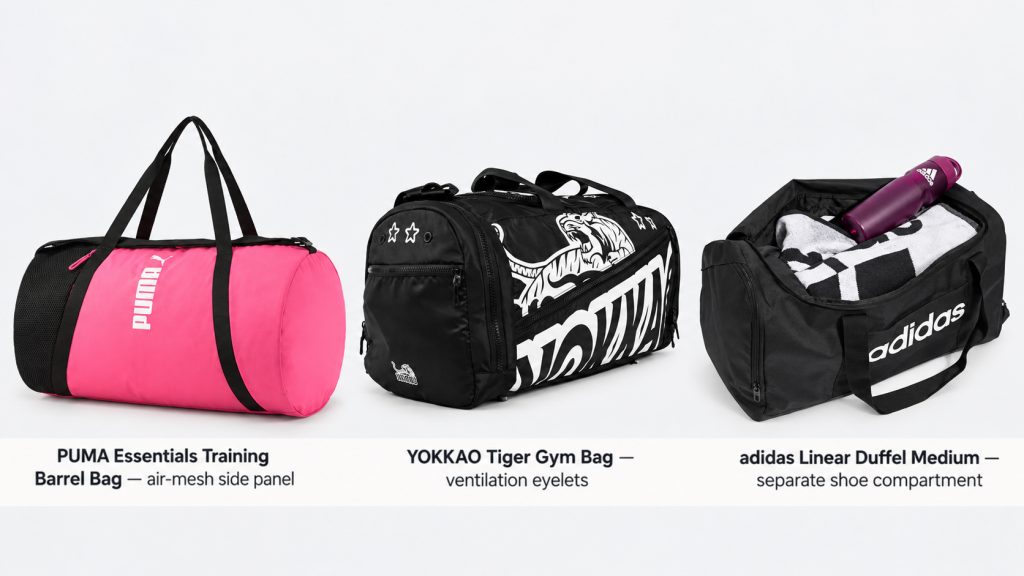
Commercial gym duffels do not all use the same shoe-compartment construction.
Published product specifications from established sports brands show several different approaches.
For example:
- The PUMA Essentials Training Barrel Bag specifies an air-mesh side panel in its internal shoe compartment.
- The YOKKAO Tiger Gym Bag includes a dedicated shoe compartment with ventilation eyelets.
- The adidas Linear Duffel Medium lists a separate shoe compartment without specifying a dedicated ventilation method in its published product description.
These examples do not tell us which construction is most common across the entire market.
They simply show that footwear separation and ventilation can be designed in different ways.
For OEM and ODM development, the useful question is not which brand solution to copy, but which construction best matches the target footwear, storage conditions and product requirements.
What Should Be Locked Before Bulk Production?
By sample approval, “make the shoe compartment breathable” is no longer a sufficient production instruction.
The decision needs to be translated into something the sample room, production team and QC can reproduce consistently.
Confirm Whether Dedicated Ventilation Is Required
Before finalizing construction, we confirm whether the approved shoe compartment:
- uses a regular fabric panel without dedicated vents
- uses eyelets
- uses mesh
- uses a perforated synthetic panel
- uses another specifically approved ventilation construction
If there is no dedicated vent, sample review should still check:
- shoe fit
- divider construction
- lining
- cleaning access
- how the compartment behaves when the main bag is loaded
If ventilation is required, the approved specification should clearly identify the vent type, size, position, backing and reinforcement.
These details should also be transferred into the bag tech pack or another controlled production document.
Lock the Vent Geometry
For mesh, we normally confirm:
- actual mesh construction
- panel dimensions
- backing layers
- stretch
- seam reinforcement
For eyelets, “six eyelets” is still incomplete.
We also need:
- finished inside diameter
- spacing
- location
- hardware material
- finish
- reinforcement around the holes
For perforated synthetic panels, we confirm:
- actual material construction
- hole diameter
- spacing
- total perforated area
- backing
- panel dimensions
A perforation pattern can look almost identical from a distance while providing a different effective opening area.
Approve It with the Shoes Inside
We prefer to approve ventilation together with actual shoe fit rather than treating these as separate checks.
Put the target footwear inside and look again:
- Are the vents still exposed?
- Is the shoe pressing directly against the panel?
- Does the main compartment push the divider into the shoes?
- Has the usable air space changed?
For a soft shoe tunnel, we would also load the main compartment to a realistic level before approval.
Carry the Same Reference into First Production
Once bulk production starts, the approved sample should remain the reference.
For mesh, we watch for changes in panel size, backing and seam quality.
For eyelets, count and location are easy to inspect, but setting quality and reinforcement matter as well.
For perforated panels, the material, perforation pattern and backing should remain consistent with the approved version.
This is part of the broader control needed when moving from sample development into bulk production. Our guide to why a bag sample and bulk production can feel different explains why construction and production conditions still need to be checked against the approved reference.
By this stage, ventilation should be a reproducible construction detail—not simply a visual feature on the design drawing.

Frequently Asked Questions
Do All Gym Bags with Shoe Compartments Have Ventilation Holes?
No. Some use regular fabric compartments without dedicated ventilation openings, while others use eyelets, mesh or perforated materials.
Is a Shoe Compartment Without Ventilation a Bad Design?
Not necessarily. A regular fabric compartment can be practical for relatively dry footwear and shorter storage periods.
Is Mesh Better Than Eyelets?
Not always. Mesh usually provides more open area, while eyelets keep more of the outer panel closed and provide more localized ventilation.
How Many Eyelets Does a Shoe Compartment Need?
There is no fixed number. Inside diameter, total open area, spacing, location and shoe blockage matter more than the count alone.
Are Perforated Synthetic Panels Really Breathable?
They can be, but only if the holes pass through the relevant material layers and the backing does not block the airflow.
Does Ventilation Prevent Shoe Odor?
No. Ventilation can help moisture escape and support drying, but it cannot guarantee an odor-free compartment.
Can a Ventilated Shoe Compartment Still Be Water-Resistant?
The surrounding shell can still use water-resistant materials, but the vent openings remain possible entry paths for splash and moisture. Airflow and water protection therefore need to be balanced.
Should Ventilation Holes Be Placed on the Bottom?
Usually not unless drainage is also an intended function. Bottom openings are more exposed to wet floors, dirt and abrasion.
Final Words
A shoe compartment does not need the most ventilation—it needs the right ventilation for how the footwear will actually be used.
If you’re developing a custom gym or sports duffel, contact Osgoodway with your shoe-compartment requirements, and we can help evaluate a practical construction for sampling and bulk production.