Updated September 2026 | Reviewed from a backpack manufacturing perspective
When consumers pick up a backpack, they often notice the design or pocket layout first. From a manufacturing perspective, however, the shoulder straps are one of the most important—and often overlooked—parts affecting comfort and durability.
Most padded backpack shoulder straps combine a nylon or polyester outer fabric, foam cushioning, and a body-facing fabric or mesh. Woven webbing connects the adjustable section to buckles or ladder locks, while reinforced stitching secures the straps to the backpack body.
The performance of a shoulder strap depends on how these materials and components work together. Thicker foam or a more expensive fabric cannot compensate for an unsuitable strap shape, a slipping adjuster or a weak attachment point.
For brands, designers and procurement managers, understanding this construction helps them evaluate specifications more accurately and avoid costly problems during sampling and production. This guide explains backpack strap materials, construction and reinforcement from a manufacturer’s perspective—and how each choice affects the finished bag.
The Anatomy of a Backpack Strap: The Layered Construction

A typical padded shoulder strap has three main layers, plus adjustment components and reinforced connections.
| Part | Materials commonly considered | Main role |
|---|---|---|
| Outer shell | Woven polyester or nylon, including Oxford and ripstop constructions | Protects the padding and contributes to the sewn structure |
| Padding | EVA, PE or flexible PU foam; sometimes layered combinations | Cushions contact and helps distribute pressure |
| Body-facing layer | Spacer mesh, other knitted mesh or soft fabric | Provides the contact surface against clothing or skin |
| Adjustment webbing | Polyester, nylon or polypropylene | Adjusts strap length and carries tension through the hardware |
| Hardware | Plastic or metal adjusters and buckles, depending on the design | Holds adjustment or provides a release function |
| Attachment and reinforcement | Webbing, backing fabric and suitable stitching | Transfers force between the strap and bag body |
Shoulder straps are one part of the complete carrying system. Our guide to backpack anatomy explains how they relate to the back panel, hipbelt and other backpack components.
Not every backpack uses all these elements. A simple drawstring bag may use cords, while a running vest may use a broad mesh harness with little conventional foam padding.
Because padded shoulder straps are widely used in everyday, school, laptop, travel and outdoor backpacks, the following material sections focus mainly on their layered construction.
How Backpack Strap Construction Changes by Bag Type

Not every backpack shoulder strap uses the same construction. The intended load, user group and carrying activity determine whether the strap needs foam padding, a shaped profile or integration with a larger harness system.
| Backpack type | Typical strap construction | Main points to evaluate |
|---|---|---|
| Promotional or drawstring bag | Cord, tape or unpadded webbing | Edge comfort, attachment strength and adjustment |
| Everyday or school backpack | Padded straight or curved shoulder straps | Fit, foam recovery, strap spacing and attachment reinforcement |
| Laptop or travel backpack | Wider padded straps, sometimes with a sternum strap | Comfort under sustained load, edge pressure and hardware reliability |
| Hiking backpack | Contoured padded straps connected to the back panel or internal frame system | Load transfer, torso fit, load-lifter position and compatibility with the hipbelt |
| Running vest or hydration pack | Broad lightweight mesh harness, often with minimal conventional foam | Movement control, breathability, stretch and chafing |
| Convertible travel bag | Detachable or stowable padded straps | Hook orientation, connection strength, storage method and twisting |
| Children’s backpack | Shorter, narrower straps with child-specific spacing | Adjustment range, edge comfort and fit for the intended age group |
A strap shape should not be selected from appearance alone. Straight, J-shaped and S-shaped straps can fit users differently around the neck, shoulder and chest. The curve, attachment angle and spacing must be evaluated on the complete backpack.
For load-bearing hiking packs, the shoulder straps should also be reviewed as part of the complete carrying system. The frame or reinforced back panel, shoulder straps, load lifters and hipbelt need to work together to transfer and stabilize the load. Adding thicker foam to the shoulder straps cannot correct an unsuitable torso length or a poorly positioned hipbelt.
The Core: Foam Padding Materials

The foam inside a padded shoulder strap strongly affects cushioning and support, but foam alone does not determine whether a strap is premium.
EVA, PE and flexible PU foams are options for backpack padding. Their names identify material families, not fixed comfort or durability grades.
| Foam option | Why it may be considered | What to evaluate |
|---|---|---|
| EVA foam | Available in grades suitable for cushioning and shaped padding | Firmness, flexibility, compression recovery and finished thickness |
| PE foam | Available in lightweight cushioning grades, including crosslinked constructions | Exact grade, compression behavior, recovery and flexibility |
| Flexible PU foam | Can provide a soft contact feel and different levels of support | Firmness, support, fatigue performance and moisture behavior |
| Layered foam | Combines different cushioning characteristics | Whether the combination improves fit enough to justify added assembly and bonding |
Common closed-cell EVA and PE grades limit water uptake into their cell structure. However, this does not make the whole shoulder strap waterproof. Water can remain in the covering, seams or spaces between layers.
Flexible PU foam is often open-cell, but “PU” does not mean that every grade is too soft to support a useful strap construction. The actual formulation and compression response matter.
Why thicker or denser foam is not automatically better
Thickness, density and firmness describe different properties.
A thick, soft pad can compress heavily under load. A firm pad may retain its shape but create uncomfortable pressure at an edge. Increasing thickness can also make a narrow or sharply curved strap harder to assemble neatly.
The Polyurethane Foam Association’s performance guidance distinguishes foam density from firmness and explains how support and fatigue are assessed. Those properties should be reviewed separately when selecting a flexible PU grade.
For a useful comparison, keep the strap shape and covering consistent while evaluating different foam samples. Check how the assembled strap feels under the intended load and how it recovers afterward.
When does layered padding make sense?
A firmer layer combined with a softer contact layer can be worth testing, but it is not automatically more comfortable than a single suitable foam.
Additional layers introduce cutting, alignment and potentially bonding work. Adhesive coverage may change flexibility, and poorly controlled layers can shift or create uneven edges.
For a bulk order, specify the approved foam grades, individual thicknesses and assembly method. A description such as “dual-density premium foam” leaves too much undefined.
The Exterior: Shell Fabrics and Durability
The outer fabric protects the padding and forms part of the strap’s sewn structure. Polyester and nylon are common choices, but neither name establishes the performance of the finished strap.
Review:
- Abrasion and tear performance of the proposed fabric
- Flexibility around the shoulder and at folded edges
- Coating or backing behavior
- Colorfastness for the intended use
- Compatibility with the rest of the bag
A higher-denier fabric is not automatically the best choice. At a strap edge, the shell, contact fabric, binding and reinforcement can form a thick stack. A heavier shell may add bulk without improving comfort or the strength of the critical attachment.
Does ripstop make a strap tear-proof?
No. Ripstop incorporates reinforcement yarns intended to help limit tear propagation, but it does not prevent every puncture, abrasion failure or seam tear.
At a loaded attachment, the surrounding construction still matters. A strong fabric can tear beside a poorly supported stitch line, so evaluate the material and connection together.
The Body-Facing Layer: Mesh, Feel and Moisture

The inner surface of a shoulder strap affects friction, perceived warmth and comfort against clothing.
Three-dimensional spacer mesh has two fabric faces connected by a spacer structure. It can provide thickness and air space, but its performance depends on the knit, compression and surrounding layers.
A mesh surface does not guarantee a cool or sweat-free strap. Contact pressure, clothing, foam and movement all affect moisture and heat management.
For sample approval, check:
- Surface roughness against the intended clothing
- Compression under load
- Pilling, snagging and rubbing
- Binding or seam ridges at the edges
- Drying behavior after wetting
Smoothness at first touch is useful, but it cannot establish long-term compatibility with delicate clothing. Evaluate the selected material and assembled edge rather than approving only the mesh’s appearance.
What material works for waterproof bag straps?
First define the requirement: low water uptake, quick drying, wipe-clean surfaces or protecting the bag’s contents.
Closed-cell padding can reduce water uptake into the foam, but a mesh cover and woven webbing can still hold water. Some bag straps use coated webbing for a wipe-clean surface; this requires suitable hardware, flexibility and edge finishing.
For a waterproof backpack, the strap attachment must also preserve the bag body’s water barrier. Stitching a strap through an otherwise waterproof panel introduces potential entry points.
Specify wet-use behavior separately from the finished bag’s water-protection requirement. A dry-feeling strap and a watertight bag are different outcomes.
Webbing and Hardware: Strength and Reliable Adjustment

While the foam and fabric provide comfort, the webbing and hardware provide security. As manufacturers, we often call these the "failure points." If a buckle snaps or webbing frays, the entire backpack becomes useless.
Backpack webbing is commonly made from polyester, nylon or polypropylene. The right option depends on the required strength, stretch, feel, exposure and adjustment behavior.
| Webbing material | Points to consider |
|---|---|
| Polyester | Evaluate strength, elongation, surface texture and outdoor exposure performance |
| Nylon | Evaluate strength, flexibility, elongation and behavior when wet |
| Polypropylene | Evaluate strength, heat and UV performance, and compatibility with the selected adjuster |
Do not identify webbing by shine or softness alone. “Seatbelt-style” describes an appearance or construction; it does not prove that the webbing is nylon or that it carries an automotive safety rating.
Why Do Backpack Straps Slip Through Their Adjusters?
Straps usually slip when the webbing and adjuster are not properly matched. Key factors include:
- Webbing thickness, weave and surface finish
- Adjuster slot and bar geometry
- Threading direction and angle of pull
For a closer look at common causes and practical fixes, see our guide on why backpack straps keep slipping.
Approve the webbing and adjuster as a pair, then test them on the assembled backpack under repeated loading and, where relevant, wet conditions.
Is POM Better Than Plastic?
POM, or acetal, is itself a type of plastic. Buckle performance depends on the material grade, geometry, molding quality and operating conditions—not simply the label “POM.”
Record the approved hardware model and material. For cold-weather bags, test the actual component at the required temperature.
Why bar-tack stitching is only part of the attachment
Bar-tacks can reinforce a connection, but they cannot compensate for insufficient seam allowance, a weak backing panel or an unsuitable load path.
Review the webbing overlap, supporting layers, thread, stitch pattern and direction of force. Excessively dense stitching can also damage some material constructions.
The key question is where the force goes after it leaves the webbing. If it enters a small unsupported area of the bag shell, adding more stitches at the same point may not solve the problem.
Budget vs. Premium Backpack Strap Materials
Budget and premium straps may use the same material families. The difference often lies in the selected grade, construction and verified performance—not simply whether the label says PE, EVA or nylon.
To help you decide which materials fit your brand’s positioning, here is a quick comparison chart based on our manufacturing standards.
| Component | Cost-Conscious Option | Potential Premium Upgrade | What to Check |
|---|---|---|---|
| Foam padding | A suitable single-layer PE or EVA foam | A grade with better verified compression recovery, or layered cushioning | Comfort under load, recovery and finished thickness |
| Outer fabric | Polyester matched to everyday use | A selected nylon or higher-performance polyester fabric | Abrasion, tear resistance and flexibility at seams |
| Body-facing layer | Smooth fabric or basic mesh | Spacer mesh selected for cushioning and contact comfort | Rubbing, snagging, compression and drying |
| Webbing | Standard PP or polyester matched to the adjuster | A selected polyester or nylon webbing with the required feel and performance | Strength, stretch and adjustment slippage |
| Hardware | A suitable standard buckle or ladder lock | A model verified for more demanding loads, environments or repeated use | Compatibility, retention and durability |
| Attachment | Reinforcement suited to the intended load | Additional support where heavier use requires it | Complete connection strength, including the surrounding fabric |
Where should you spend more? Upgrade the part that addresses a demonstrated weakness. Better foam recovery may help a daily laptop backpack; compatible webbing and adjusters may solve slipping straps. More expensive shell fabric will not correct either problem.
Keep secure attachments and reliable adjustment as requirements at every price level. Compare upgrades on an assembled sample before approving the added cost.
Material selection also needs to account for how the harness is adjusted. Our guide to load lifters and sternum straps explains their roles in positioning the pack and shoulder straps.
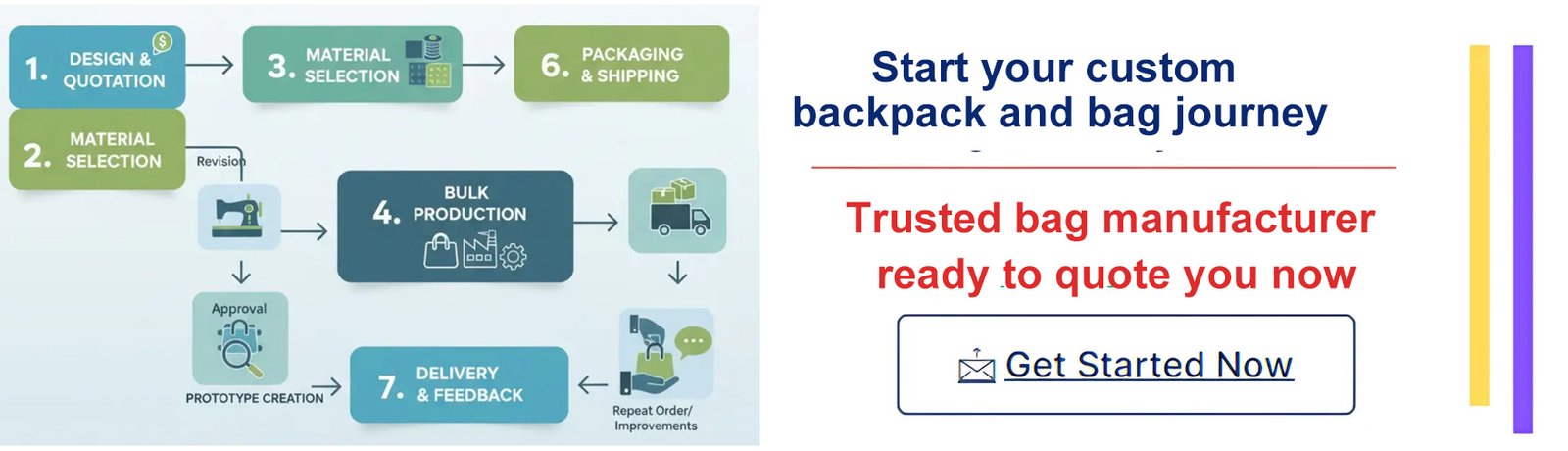
What to Confirm Before Bulk Production
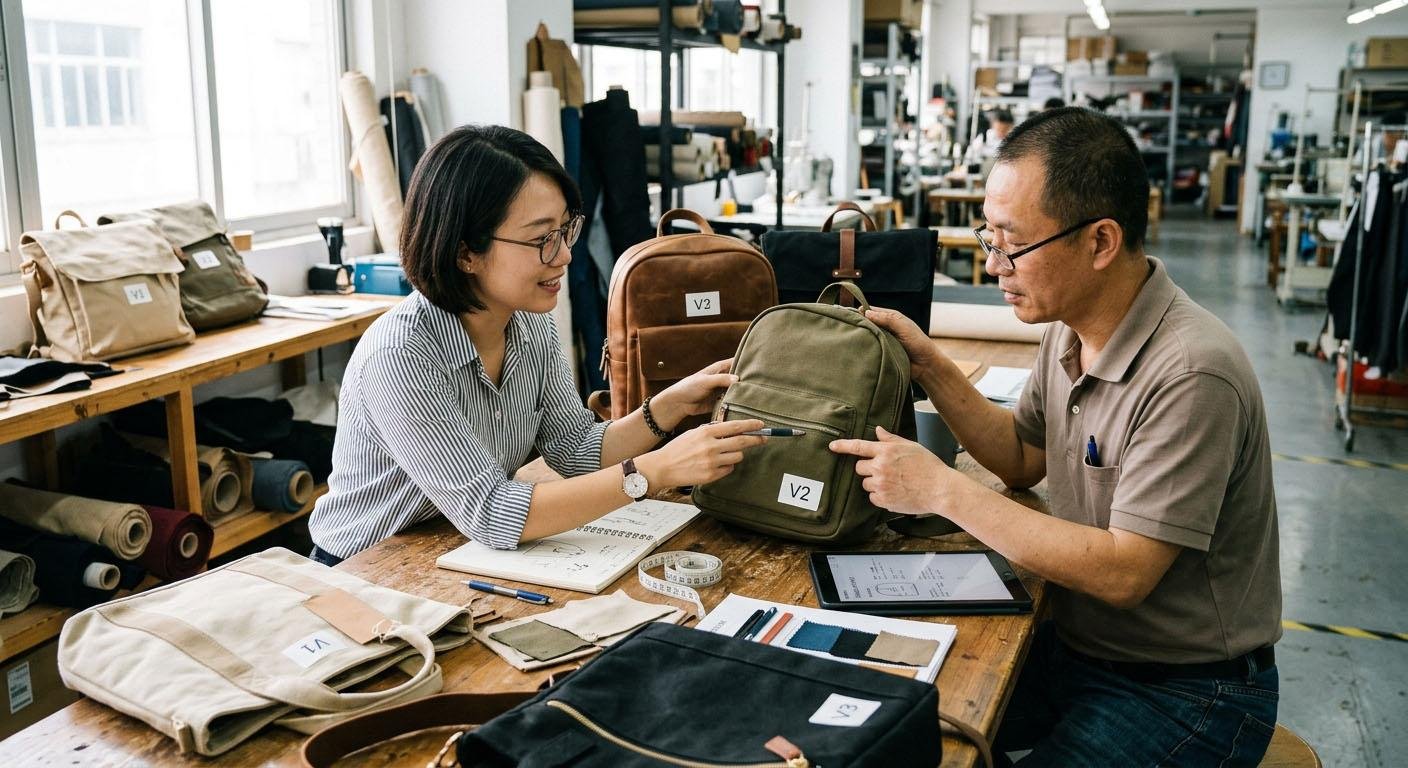
A strap sample should be evaluated as part of the backpack. Loose swatches cannot establish fit, edge pressure or the performance of the connection to the bag.
Confirm:
- Dimensions and geometry: Padded length, width, curve, attachment spacing and adjustment range.
- Materials: Shell, body-facing fabric, foam grades, webbing, thread and hardware references.
- Construction: Foam placement, edge finish, reinforcement and attachment details.
- Performance checks: Relevant load, repeated-use, slippage, compression, rubbing and wet-use assessments.
- Approval records: The current specification, approved sample and written control of substitutions.
Agree on test conditions and acceptance criteria for the actual project. Webbing breaking strength is not the same as the safe carrying capacity of a finished backpack.
After a cost-saving substitution, repeat the checks affected by the change. A new foam can alter fit; a new webbing can change adjustment; a thinner shell can affect the attachment.
Discuss Your Backpack Strap Requirements with Osgoodway
For a planned OEM/ODM backpack order, share your drawings or reference photos, intended carrying load, user group, quantity per color, target FOB price and delivery requirement.
Include any existing concerns such as flattened padding, rough mesh, slipping adjusters or attachment failures. These details help Osgoodway review material and construction options for the complete backpack before sampling and bulk production.