You are sitting in front of three fabric quotes from Chinese suppliers—same denier, wildly different prices, and zero explanation. Pick the middle price out of "safety," and six months later your bulk order arrives with base panels that pill after two trail outings, leaving you with angry retail buyers and costly credit notes.
I’ve watched this happen for 12 years from the factory floor. It’s not carelessness; it’s because nobody warns buyers that denier isn’t a durability metric, that coatings mean entirely different things by supplier, and that your sampling-stage choices lock in your margins, compliance risks, and return rates for the next two years.
Ripstop nylon is the most practical workhorse for volume B2B hiking pack orders, balancing cost and durability. Dyneema offers premium ultralight performance but requires high BOM costs and specialized labor. Recycled fabrics (rPET/nylon) provide a competitive, eco-friendly middle path, essential for compliance-driven EU markets.
How Do You Read a Fabric Spec Sheet Before Comparing Materials?

A fabric spec sheet has six numbers that actually matter for backpack production: denier (D), weight (g/m²), tensile strength (N), tear strength (N), hydrostatic head (mm), and coating type. If a supplier can’t give you all six upfront, that spec sheet is decoration — not documentation.
I see buyers compare fabrics based on denier alone. That’s like judging a truck by engine displacement and ignoring payload rating, fuel consumption, and frame strength. Denier tells you thread thickness. It tells you nothing about how the fabric actually performs under load, abrasion, or sustained rain.
Here’s what each spec field means on our factory floor — and where the red flags hide:
| Spec Field | What It Measures | Acceptable Range (Trail Pack) | Red Flag |
|---|---|---|---|
| Denier (D) | Fiber thread thickness | 210D–840D depending on panel zone | "High denier" with no number given |
| Weight (g/m²) | Fabric mass per square meter | 90–350g depending on denier | Weight omitted or bundled with coating weight |
| Tensile Strength (N) | Force required to tear fabric apart | ≥800N warp & weft for 420D body | Below 600N for any main body panel |
| Tear Strength (N) | Force to propagate an existing tear | ≥30N per ASTM D1424 | No test standard cited at all |
| Hydrostatic Head (mm) | Water pressure resistance before leakage | ≥1,000mm for trail packs; ≥10,000mm for waterproof | Listed as "waterproof" with no mm value |
| Coating Type | Surface treatment applied | PU, silicone, DWR, TPU laminate | "Coated" with no chemistry specified |
Factory Secret: The number I check first is tear strength, not tensile strength. Tensile tells you when the fabric catastrophically fails. Tear strength tells you what happens after the first puncture from a trail branch — does it hold, or does it rip clean open? Suppliers who can’t give me a tear strength figure with a cited test method get cut from our vendor list immediately.
What Is Ripstop Nylon — and Is It Still the Default for Hiking Backpacks?

Ripstop nylon remains the most practical all-around fabric for hiking backpack production. For most B2B buyers sourcing 500–5,000 units, it delivers the best balance of durability, cost, and vendor availability. In 2026, expect USD $2.80–$5.50/meter depending on denier and coating.
Ripstop works because of its grid-reinforced weave — typically a 2×2 or 4×4 interlocked pattern that stops tears from spreading. Add a PU or silicone coating and you get decent water resistance without paying for a membrane.
The Denier Trap Nobody Warns You About
Most buyers ask for "high denier" thinking it means stronger. That’s not always true.
Here’s what actually matters in production:
- 210D ripstop nylon — light panels, good for inner pockets and top lids; not for base or side panels under load
- 420D ripstop nylon — our go-to for mid-range trail packs; strong enough for abrasion zones, not overkill on weight
- 840D ripstop nylon — military-grade carry panels; adds significant weight; only justified for expedition or tactical packs
| Denier | Weight (g/m²) | Best Use Zone | Typical FOB Price |
|---|---|---|---|
| 210D | ~95g | Lids, inner pockets | $2.80–$3.20/m |
| 420D | ~180g | Main body, sides | $3.80–$4.50/m |
| 840D | ~340g | Base, carry panels | $5.00–$5.50/m |
Deep read more about: What Exactly is Ripstop Nylon Fabric? Don’t Buy Before Reading
Factory Secret: We often mix deniers within a single bag — 420D body with 840D base and 210D lining. It cuts material cost by 15–20% without compromising structural integrity. Most buyers ordering "all 420D" are paying for overkill in zones that never take stress.
Is Dyneema Worth the Price Premium for B2B Hiking Backpack Orders?

Dyneema DCF (Dyneema Composite Fabric) runs $30–$45/yard retail — that’s roughly $33–$50/meter — and authorized factory MOQs typically start at 300–500 finished units due to the fabric supply constraints. For B2B buyers, it only makes commercial sense above a $180 retail price point. But there’s a second option most buyers don’t know exists: Chinese domestic UHMWPE composite fabrics at a fraction of the cost.
Dyneema Composite Fabric (DCF, formerly Cuben Fiber) is now a trademark of Avient Corporation after DSM’s fiber business was acquired. The fabric itself is still manufactured under strict licensing. A 20L DCF pack can weigh under 200g — that’s real. But so is the production friction.
Authorized DCF: What It Actually Costs in Production
Authorized DCF fabric sourced through licensed distributors like Ripstop by the Roll is priced at $30–$45/yard by-the-yard retail. Wholesale full-roll pricing comes in 9.8-yard (≈9m) sections per roll. For factory orders, expect:
- Fabric cost: $22–$38/meter at factory wholesale volume (500m+)
- Production MOQ: 300–500 finished packs minimum — driven by fabric roll minimums, not factory capacity
- Lead time on fabric: 8–14 weeks from authorized distributors; longer for custom colorways
- Sewing labor premium: DCF can’t be sewn with standard thread tension. Bonded seams or seam tape required — adds $4–$10 per unit in labor cost
- Repairability risk: End users cannot field-repair DCF. Warranty return rates are meaningfully higher than ripstop packs
Chinese Domestic UHMWPE Composites: The Option Nobody Talks About
Here’s the thing most Western brands don’t know: China has its own UHMWPE fiber production at significant scale. Domestic producers like Beijing Tongyizhong and manufacturers in Hebei and Jiangsu produce UHMWPE-based composite fabrics that are not authorized Dyneema DCF — but use the same base fiber chemistry.
The trade-offs are real and you need to understand them clearly:
| Factor | Authorized Dyneema DCF | Chinese Domestic UHMWPE Composite |
|---|---|---|
| Price (factory wholesale) | $22–$38/meter | $8–$15/meter |
| MOQ (fabric) | 9.8-yard roll sections | 1,000–2,000m per spec |
| MOQ (finished packs) | 300–500 pcs | 500–800 pcs |
| Brand usage rights | "Dyneema" trademark licensable | Cannot use "Dyneema" name |
| Performance consistency | Tightly controlled by Avient | Varies by supplier — requires your own QC |
| Western retail acceptance | High — brand recognized | Low — requires education at buyer level |
| Lead time | 8–14 weeks | 3–6 weeks |
The domestic option makes sense in one specific scenario: you’re building a private-label ultralight pack for a market that doesn’t care about the Dyneema trademark — outdoor rental fleets, corporate gifting in Asia, or brands building their own ultralight positioning without licensing costs. The moment your product goes to REI, MEC, or any Western specialty retailer that knows what DCF is, you need the real thing or you’ll get called out.
Factory Secret: I’ve seen suppliers on Alibaba list fabric as "Dyneema-like" or "UHMWPE composite (Dyneema quality)" to blur this line intentionally. If a brand buys this fabric and then markets their pack as "Dyneema construction" to a Western retailer, that’s a trademark violation — and it happens more than you’d think. Always get the fiber certification and check whether the supplier has Avient’s authorization in writing before you spec it into a product with any Dyneema branding.
When Authorized DCF Makes Sense
- Retail price point is $180+ and the Dyneema name is part of your brand story
- Your wholesale buyer is an outdoor specialty retailer who will verify material claims
- You can absorb a $22–$38/meter fabric cost within your BOM and still hit margin
When to Consider Chinese Domestic UHMWPE Instead
- You need ultralight performance at a $100–$160 retail price without the DCF licensing cost
- Your market doesn’t recognize or require the Dyneema trademark
- You have the QC infrastructure to vet domestic suppliers rigorously per batch
Are Recycled Fabrics Actually Good for Hiking Backpacks — or Just a Marketing Play?

Recycled fabrics — primarily rPET (recycled polyester from plastic bottles) and recycled nylon — can match virgin material performance at 5–15% cost premium. The real value is certification: a verified GRS certificate opens doors to ESG-focused retail buyers and European markets where sustainability documentation is increasingly mandatory.
Let me be direct: I’ve seen brands use "recycled" as pure greenwashing. And I’ve seen recycled fabric outperform virgin nylon in abrasion tests. The difference is the supplier and the spec.
Which Recycled Fabrics Actually Work for Hiking Backpacks?
Not all recycled fabrics are built for trail use. Here’s what we actually run in production and where each one belongs:
-
rPET (Recycled Polyester from PET bottles) — Most common, easiest to source with GRS cert. Good UV resistance. Moderate abrasion resistance. Best used for: main body panels on lower-stress packs, linings, hipbelt webbing, top lids. Cost premium over virgin polyester: +5–10%.
-
Recycled Nylon (e.g., ECONYL® from Aquafil) — Made from discarded fishing nets and industrial nylon waste. Higher abrasion resistance than rPET. Closer performance to virgin nylon. Best used for: main body, base panels, shoulder strap fabric. Cost premium: +10–15%. Requires ECONYL® chain-of-custody documentation on top of GRS if you want to use the brand name.
-
Recycled Ripstop Nylon — Recycled nylon yarn woven in a ripstop grid pattern. Functionally equivalent to virgin ripstop for most trail applications. This is our most-specified recycled option for mid-range hiking packs ($80–$180 retail). Available in 210D, 420D. Becoming more accessible from Taiwanese and Chinese mills with GRS certification.
-
rPET Oxford / rPET Dobby — Heavier recycled polyester weaves (300D–600D). Less technical than ripstop but viable for casual hiking daypacks, hipbelt panels, and internal dividers. Lower cost entry point into a sustainability story.
-
Recycled Canvas (Cotton/Poly blend) — Occasionally requested for lifestyle-oriented "outdoor" packs. Not recommended for technical trail use — absorbs moisture, heavier, harder to certify for recycled content percentage.
What I do not recommend: Any fabric labeled "partially recycled" or "eco blend" without a GRS Transaction Certificate. That’s marketing, not material science.
rPET vs Recycled Nylon — Not the Same Thing
| Property | rPET (Recycled Polyester) | Recycled Nylon (e.g., ECONYL®) |
|---|---|---|
| Abrasion Resistance | Moderate | High |
| UV Resistance | Good | Moderate |
| Moisture Wicking | Lower than virgin | Similar to virgin |
| Cost Premium vs Virgin | +5–10% | +10–15% |
| Certification Available | GRS, bluesign® | GRS, ECONYL® verified |
| Best For | Panels, linings, straps | Main body, base panels |
Factory Secret: Some suppliers blend 30% recycled fiber into a "recycled" fabric and still market it as such. Always request the GRS Transaction Certificate (TC), not just a scope certificate. The TC tracks the recycled content through every production stage. We use Intertek and Bureau Veritas for our GRS audits. If a supplier can’t produce a TC within 48 hours, walk away.
The European Buyer Demand Is Real
Since the EU’s Green Claims Directive entered implementation phases in 2024, European retail buyers have started requiring verifiable recycled content documentation — not just "eco-friendly" claims. If your distribution includes the EU, recycled fabric with GRS is no longer optional. It’s table stakes.
How Do These Three Materials Compare Head-to-Head for B2B Sourcing?

For most B2B hiking backpack buyers, ripstop nylon is the default workhorse. Dyneema is a premium niche play. Recycled fabrics are the smart middle path for sustainability-driven markets. The choice depends on your price tier, certification needs, and volume.
Here’s the full factory-level comparison:
| Factor | Ripstop Nylon | Dyneema (DCF) | Recycled Fabrics (rPET/Nylon) |
|---|---|---|---|
| Material Cost | $2.80–$5.50/m | $25–$60/m | $3.50–$6.50/m |
| MOQ Flexibility | Low (500+ pcs viable) | Medium (200+ pcs) | Low (500+ pcs viable) |
| Production Complexity | Standard | High (bonded seams) | Standard |
| Weight | Medium | Ultra-low | Medium |
| Durability | High | Very High (puncture-sensitive) | High |
| Sustainability Story | None | Moderate | Strong (with GRS cert) |
| Target Retail Price | $40–$150 | $150–$400+ | $60–$200 |
| EU Market Readiness | Low | Low | High (with GRS TC) |
How Do You Match Fabric to Your Retail Channel and Price Point?
Your retail channel determines your fabric spec more than any performance data sheet. A pack sold on Amazon at $65 and a pack sold at REI at $180 should never be built from the same material — not because one is "better," but because the margin math, the buyer expectation, and the return risk are completely different.
I’ve built packs for all three tiers below. Here’s exactly how the fabric decision changes at each level.
| Retail Channel | Retail Price Range | Recommended Fabric | Certification Need | MOQ Sweet Spot |
|---|---|---|---|---|
| Amazon / Mass Market | $40–$80 | 420D ripstop nylon, PU-coated | None required | 1,000–3,000 pcs |
| Outdoor Specialty (REI, MEC, etc.) | $80–$180 | 420D–630D ripstop nylon + rPET lining | GRS recommended | 500–1,500 pcs |
| Premium / EU Sustainability Retail | $120–$220 | Recycled nylon (ECONYL®) or rPET body, GRS-certified | GRS TC mandatory | 500–1,000 pcs |
| Ultralight / Technical Specialty | $180–$400+ | Dyneema DCF or 210D silnylon hybrid | None standard; brand-driven | 200–500 pcs |
Amazon & Mass Market: Cost Is the Spec
At this price tier, margin lives or dies on BOM control. The right call is simple — and it’s not premium fabric.
- Spec: 420D ripstop nylon, PU-coated. Nothing more.
- Do not: Add a recycled lining to chase an eco story. Amazon’s algorithm doesn’t surface sustainability claims. You pay a +8% fabric premium for a story nobody reads.
- Do: Spend that money on hardware instead — YKK zippers, reinforced bartacks at stress points. That’s what drives review scores and reduces returns.
- Certification needed: None. Save the GRS audit budget for when you actually need it.
Outdoor Specialty: Where Recycled Fabric Earns Its Cost
REI, MEC, Decathlon’s upper tier — GRS is moving from "nice to have" to a gate requirement. These buyers now ask for recycled content documentation at the buyer meeting stage, not after you win the account.
- Spec: 420D recycled ripstop nylon body + rPET lining
- Certification: GRS Transaction Certificate per shipment — scope cert alone is not enough
- Cost delta vs virgin ripstop: +$1.20–$2.80 per unit at 500–1,500 unit volume
- Verdict: Fully absorbable at $120–$180 retail. Opens doors that virgin nylon closes.
EU Sustainability Retail: GRS Is Not Optional
In the last 12 months, I’ve had three European retail buyers send pre-qualification questionnaires requiring GRS TC documentation before they’d schedule a sample review. This is no longer a future trend. It’s happening now.
- Markets where this applies: Germany, Netherlands, Scandinavia, France — any EU retailer with a formal sustainability program
- What they require: GRS Transaction Certificate, not just a scope cert; increasingly also bluesign® fabric-level certification
- Critical timing: Spec recycled fabric with GRS from day one. Retrofitting after production is expensive and often impossible — GRS requires documented chain of custody from fiber to finished product. If you didn’t track it during production, the certificate doesn’t exist.
- Rule of thumb: If your target retail buyer has a sustainability page on their website, assume GRS TC is a future requirement even if they haven’t asked for it yet.
Factory Secret: I’ve seen brands try to get GRS certified after the fact by "back-tracing" their supply chain. It doesn’t work. GRS requires documented chain of custody from fiber to finished product. If you didn’t track it during production, the certificate doesn’t exist. Build the documentation into your production workflow from the first sample, not the first shipment.
For a deeper look at how to structure a full bulk sourcing strategy around material choice and margin, read our guide: How to Source High-Margin Hiking Backpacks in Bulk.
How Do Coatings and Treatments Change the Material Game?
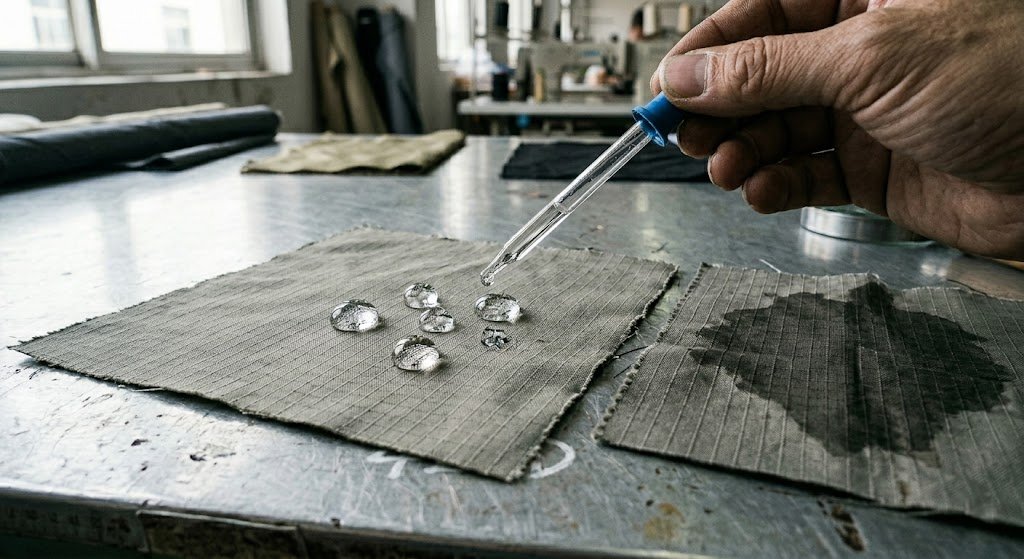
The fabric is only half the equation. PU coating, silicone coating, DWR treatment, and TPU lamination can fundamentally change how any base fabric performs in the field — and dramatically affect your production cost, compliance requirements, and export documentation.
This is where I see buyers get blindsided.
Coating Options by Priority
- PU Coating (Polyurethane): Most common. Adds water resistance rated 1,000–3,000mm hydrostatic head. Cost-effective. Degrades with UV over 3–5 years. Fine for 90% of trail packs.
- Silicone Coating: Lighter and more durable than PU. Harder to seam-seal. Better for ultralight applications. Adds $0.30–$0.80/m.
- DWR (Durable Water Repellent): A surface treatment, not a coating. Beads water off the face fabric. Wears off with washing. Most brands apply DWR on top of a PU or silicone base. Check for PFAS-free DWR if selling to EU — the REACH regulation restricts certain fluorochemicals.
- TPU Lamination: Waterproof membrane bonded to fabric. Most expensive. Required for fully waterproof packs. Adds significant weight and stiffness.
Factory Secret: A lot of brands spec DWR thinking they’re getting a waterproof pack. DWR alone is not waterproof. If your marketing says "waterproof," you need either a PU-coated fabric with sealed seams or a TPU-laminated shell. We’ve had to re-sample three orders this year because of this misunderstanding.
Which Material Choice Affects REACH and Chemical Compliance for Export?
REACH compliance is non-negotiable for EU export. As of 2024, PFAS-containing DWR treatments face increasing restriction, and certain PU coatings using DMF (dimethylformamide) as a solvent are tightly regulated. Always request an OEKO-TEX STANDARD 100 or bluesign® certification from your fabric supplier before finalizing specs.
Key compliance checkpoints by material:
- Ripstop Nylon: Confirm REACH-compliant dyestuffs; check for azo dyes in colored fabrics
- Dyneema: Generally compliant; verify coating or laminate applied over the DCF
- Recycled Fabrics: GRS scope cert needed; also confirm no restricted substances introduced during recycling
Our factory works with suppliers certified under OEKO-TEX STANDARD 100 and bluesign®. We can provide full test reports with every order if required by your retail buyers.
Also worth noting: if your pack contains any metal components (buckles, zippers, D-rings), those need separate REACH compliance for nickel release. This is a separate test from the fabric. Don’t assume one certificate covers everything.
Ready to Get a Factory Quote on Your Hiking Backpack Specs?
You’ve read the breakdown. Now let’s talk about your actual order.
Tell us your target retail price, volume, and preferred material — and we’ll come back with a realistic BOM, lead time, and sample cost within 48 hours. No template reply. An actual factory answer from the people who will make your bag.
Ready to get a factory quote? Tell us your specs → Contact Our Team at Osgoodway Bag
Or if you’re still mapping out your sourcing strategy, start here: How to Source High-Margin Hiking Backpacks in Bulk

Frequently Asked Questions
Q1: What is the minimum order quantity for Dyneema hiking backpacks from a Chinese factory?
Most Chinese factories that genuinely work with Dyneema Composite Fabric require a minimum of 200–500 units per style. The higher MOQ is driven by the fabric minimum from certified DCF distributors (typically 100–200m per colorway) and the specialized labor cost for bonded seam construction. Below 200 units, per-unit cost is rarely viable for commercial margins.
Q2: Is ripstop nylon or 600D polyester better for hiking backpacks?
Ripstop nylon outperforms 600D polyester in tear resistance and weight-to-strength ratio for hiking applications. 600D polyester is heavier, cheaper, and better suited for casual daypacks or promotional bags. For trail-use hiking packs, 420D ripstop nylon is the standard minimum. 600D poly is often used where cost is the primary driver and technical performance is secondary.
Q3: What GRS certification do I need for selling recycled fabric backpacks in Europe?
You need both a GRS Scope Certificate (issued to the factory) and a GRS Transaction Certificate (issued per order/shipment). The scope cert proves your facility is audited; the TC proves the specific recycled content in each production batch. European retail buyers increasingly require the TC, not just the scope cert. Certification bodies include Intertek, Bureau Veritas, and Control Union.
Q4: How much does switching from ripstop nylon to recycled nylon add to per-unit cost?
Switching from virgin 420D ripstop nylon to a GRS-certified recycled nylon equivalent typically adds $0.40–$1.20 per unit in material cost at the 500–2,000 unit volume range. Adding the GRS audit cost (amortized across an order) adds another $0.50–$2.50 per unit depending on order size. Total sustainability premium: roughly $1–$3.50 per unit — often recoverable through retail positioning.
Q5: Can a Chinese factory produce PFAS-free DWR hiking backpacks that meet EU REACH requirements?
Yes. PFAS-free DWR treatments using C0 (fluorine-free) chemistry are now standard at compliant Chinese factories. Performance is slightly lower in initial water beading compared to C8/C6 fluorinated DWR, but meets REACH Annex XVII restrictions. Request a test report for PFAS content (specifically PFOA, PFOS, and related compounds) under EN ISO 17353 or EPA Method 537. Our factory sources PFAS-free DWR exclusively for EU-bound orders.