You’re sitting on a product idea. You’ve found a factory (maybe ours, maybe not). You’re ready to pull the trigger on your first order of custom backpacks for Amazon USA.
Then someone mentions "certifications" and everything stalls.
I’ve watched this happen to dozens of buyers — not because the rules are impossible, but because nobody gives them a straight answer. Most factories either don’t know, or they know and stay quiet because certifications cost money and slow down orders.
I’m going to fix that right now.
Which Certifications Are Actually Required to Sell Backpacks on Amazon USA?

The non-negotiable baseline: CPSC compliance, a valid Children’s Product Certificate (CPC) if your backpack targets kids under 12, and an ASTM F963 test report if any component qualifies as a toy or toy-adjacent accessory. For adult backpacks, a General Conformity Certificate (GCC) plus REACH/Prop 65 chemical testing covers 90% of what Amazon will ask for.
Here’s the thing most suppliers won’t tell you: Amazon doesn’t publish a single fixed list. What they enforce depends on your product category, whether it’s marketed to children, and which ASIN flags their algorithm triggers. I’ve seen identical bags — same factory, same SKUs — one get listed clean, one get hit with a "Document Required" suppression notice because the title used the word "school."
That single word changed the compliance path entirely.
The Two Tracks: Adult vs. Children’s Backpack
This is the fork in the road. Get this wrong and you’re paying to redo everything.
| Product Type | Key Standard | Certificate Needed | Who Tests |
|---|---|---|---|
| Adult backpack (13+) | 16 CFR Part 1500 (general) | General Conformity Certificate (GCC) | CPSC-accepted lab |
| Children’s backpack (under 12) | ASTM F963, CPSC §101 | Children’s Product Certificate (CPC) | CPSC-accepted lab only |
| Backpack with metal buckles / decorative hardware | CPSC lead content limits | Included in GCC/CPC | Same lab |
| Backpack with drawstrings (child size) | ASTM F1816 | Separate test report | Same lab |
Factory Secret: The drawstring rule is the #1 silent killer for children’s backpacks. ASTM F1816-18 explicitly prohibits drawstrings in the hood and neck area for children’s upper outerwear sizes 2T through 12 — and Amazon’s compliance team has started treating hooded backpacks like outerwear. If you’re designing a kids’ pack with any hood or neck-area drawstring, kill it in the design phase. Retrofitting costs more than starting over.
What Does CPSC Compliance Actually Mean for a Backpack Factory?
CPSC compliance means your product, materials, and manufacturing process meet the U.S. Consumer Product Safety Improvement Act (CPSIA) standards. For backpacks, this primarily covers lead content in surface coatings and substrates (less than 100 ppm for children’s products per CPSIA Section 101, 15 U.S.C. § 1278a), phthalates in PVC components, and sharp-edge/small-parts requirements.
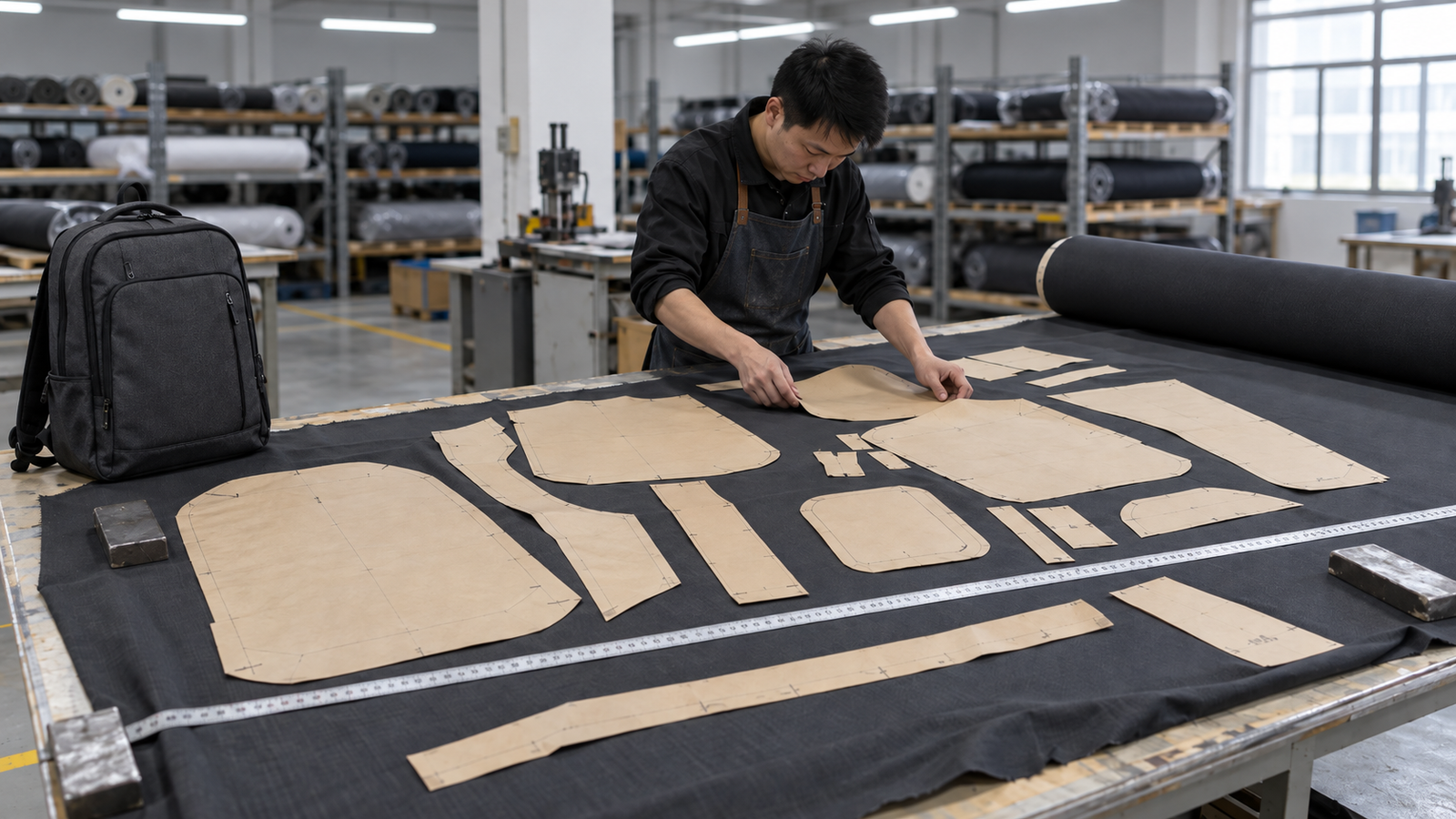
At our factory, every new fabric roll from a new supplier gets a basic XRF scan before it goes near a cutting table. This isn’t altruism — it’s self-preservation. We failed a lead test once, back in 2014, on a batch of printed canvas. The ink supplier swore it was clean. It wasn’t. We ate the cost of 2,000 units and a full retest cycle.
Now we test first, cut second.
What CPSIA Actually Tests in a Backpack
- Lead in substrate — fabric, foam, webbing, any solid material. The current limit is 100 ppm for all accessible components in children’s products, per CPSC’s Total Lead Content guidance.
- Lead in surface coating — screen prints, PU coatings, lacquers on hardware
- Phthalates — any PVC zipper tape, rain cover, or coating (DINP, DEHP, etc. ≤0.1% per 16 CFR Part 1307)
- Small parts — any component that fits in a small-parts cylinder = failure for under-3 products
- Sharp points/edges — especially on metal frames and exposed zipper teeth
The lab that runs this must be CPSC-accepted. Not ISO-certified. Not SGS-certified for Europe. Specifically CPSC-accepted. Search the official CPSC lab database here — searchable by standard and country. Many China-based branches of SGS, Intertek, Eurofins, and Bureau Veritas appear on this list. Verify every time; accreditation scopes can change.
Does Amazon Require Chemical Testing Like REACH or Prop 65?

Yes — not always on paper, but always in practice. Amazon’s Restricted Products team will suppress listings and request documentation for chemical compliance if your product triggers a flag. California Proposition 65 warnings and EU REACH SVHC screening are now de facto requirements for any bag sold to a broad U.S. audience, even though federal law doesn’t mandate them universally.
Here’s my honest take: Prop 65 is California law, not federal law. Technically you can sell a non-Prop-65-compliant backpack in 49 states. But Amazon is a national marketplace, and they don’t want the legal exposure. Per 2025 amendments to Prop 65 effective January 1, 2025, short-form warning labels must now name the specific chemical — not just carry a generic triangle warning. The list currently covers over 900 chemicals, updated most recently in December 2025. If your product contains any listed chemical above threshold, you either label correctly or pull the product.
The most common triggers in backpacks:
- DEHP/DBP in PVC zippers or coatings
- Lead in metal hardware (buckles, D-rings, zipper pulls)
- Cadmium in some printed inks and dyes
- Formaldehyde in certain fabric finishing treatments (yes, this is real — some wrinkle-resistant fabrics release it)
REACH vs. Prop 65: Quick Comparison
| Standard | Jurisdiction | Enforcement | Action Limit |
|---|---|---|---|
| EU REACH SVHC | European Union | EU customs + market surveillance | 0.1% by weight |
| California Prop 65 | California (via Amazon: all U.S.) | Lawsuits + Amazon suppression | Chemical-specific |
| CPSC Lead (children) | Federal USA | CPSC enforcement | 100 ppm |
Factory Secret: If a supplier tells you their fabric is "REACH-certified," push back. REACH certification doesn’t exist as a single document. What exists is an SVHC screening test report from a lab. Anyone selling you a "REACH certificate" is either confused or lying. Ask for the actual test report with substance-by-substance results.
What About Amazon’s Own Compliance Program — APLUS or Seller Central Docs?
Amazon uses an internal system called Seller Central’s Product Compliance dashboard. When triggered, they demand test reports, certificates, and sometimes product images within 7 days. Miss the window, your listing gets suppressed. Miss it twice, and you risk account-level consequences.
I’ve worked with buyers who got hit by this 3 weeks after a successful launch. The listing ran fine, then a competitor reported it, Amazon’s bot flagged it, and suddenly 300 units in FBA are frozen while they wait for docs.
The documents Amazon typically requests for backpacks:
- Test report from a CPSC-accepted lab (full CPSIA battery)
- GCC or CPC (signed by the manufacturer — that’s us, the factory)
- Prop 65 compliance statement or warning label proof
- Product images showing labels (care label, country of origin, material composition)
That last one catches people. The "Made in China" label and fiber content label are not optional. Under the FTC’s Textile Fiber Products Identification Act (16 CFR Part 303), all covered textile products sold in the U.S. must disclose fiber content by percentage, country of origin, and manufacturer identity. The FTC Care Labeling Rule (16 CFR Part 423) adds mandatory care instructions for wearing apparel and textile accessories. We sew both labels in by default because U.S. Customs will hold your shipment without them.
How Long Does Certification Testing Actually Take?
Standard turnaround at a CPSC-accepted lab (SGS, Bureau Veritas, Intertek, TÜV, Eurofins) is 7–15 business days for a full CPSIA battery on a children’s backpack, and 5–10 days for an adult GCC package. Rush service halves the time and roughly doubles the cost.
Plan your launch calendar around this. The single biggest mistake I see from first-time importers: they finalize production, book freight, and then ask about certifications. That’s backwards.
Here’s the sequence that actually works:
The Right Order of Operations
- Lock the design and materials — every component that goes in the bag needs to be tested
- Submit pre-production samples to lab — ideally at 30–50% production stage
- Run testing in parallel with remaining production
- Receive test reports before goods leave the factory
- Prepare GCC/CPC with lab report references before customs entry
If your factory pressures you to ship before testing is complete, that’s a red flag. We hold shipments. Always. The cost of a compliance failure at the Amazon warehouse or U.S. port of entry is 10x the cost of a 2-week delay.
What Certifications Do Backpack Straps and Padding Specifically Need?

No separate certificate exists for straps alone, but the foam padding inside back panels and shoulder straps is frequently tested for formaldehyde and phthalates — especially in children’s products. If the padding is accessible to a child’s mouth (drawstring opening, removable pad), small-parts and choking-hazard rules apply.
This is where the "premium foam" upsell gets dangerous. I’ve seen buyers request high-density memory foam for a "luxury feel" on a kids’ backpack. That foam came from a supplier who used a chemical blowing agent that triggered formaldehyde off-gassing above Prop 65 thresholds.
The buyer spent $800 on the foam upgrade. Then spent $2,400 retesting. Then switched back to standard foam.
Expensive foam ≠ safe foam. Always test what you actually use.
2026 Certification Checklist: What to Collect Before You Ship
Use this before every production run. Not after. Before.
For Adult Backpacks (13+):
- GCC (General Conformity Certificate) — signed by manufacturer
- CPSIA test report — lead, phthalates, sharp edges from a CPSC-accepted lab
- Prop 65 screening report or updated warning label (2025 short-form requirements now in effect)
- Care label sewn in (fiber content + care instructions)
- Country of origin label
- Fiber content label (FTC Textile Act — 16 CFR Part 303)
For Children’s Backpacks (Under 12):
- CPC (Children’s Product Certificate) — signed by manufacturer
- Full CPSIA test report from CPSC-accepted lab
- ASTM F963 test report (if any toy features present)
- ASTM F1816-18 compliance (drawstring test — zero hood/neck drawstrings for sizes 2T–12)
- Prop 65 screening
- Tracking label (lot/date code for recall traceability — required under CPSIA 15 U.S.C. § 2063(a)(5))
- Care + fiber content + origin labels
The tracking label requirement is the one that blindsides people. Per CPSC’s official tracking label guidance, all children’s products must carry a permanent marking — on both the product and its packaging — showing manufacturer name, production date, location of manufacture, and lot/batch number. Amazon will ask for proof this exists. We include it on a woven label inside the main compartment, always. Hangtags and adhesive stickers on the product itself do not satisfy the "permanent" requirement.
Ready to Get a Factory Quote With Compliance Built In?
We handle GCC/CPC preparation, lab coordination, and documentation packages as part of our standard export process — not as an upsell.
If you’re sourcing custom backpacks for Amazon USA and want a factory that won’t leave you guessing on compliance, tell us your specs.
Get a factory quote → Contact OSGW Bag
Or explore our capabilities first: