You’ve got the product concept. You know your customer. Maybe you’ve even pulled a few samples. But you’re stuck on one thing: which fabric actually belongs in this bag?
I’ve been on the factory floor since 2006. Wrong fabric choice is the single most expensive mistake I see buyers make — not at production, but at the sampling stage. One wrong call costs you 3–4 months and $2,000–$5,000 in rework. This is how we actually make that decision at our factory before a single panel gets cut.
To choose the right duffel bag fabric, you must align your material’s physical properties with your target retail price and use case. High-end outdoor brands require 1000D Cordura, ripstop nylon, TPU or PVC Tarpaulin; urban streetwear demands high-density twill nylon; Travel and lifestyle brands need aesthetics + light durability (canvas, waxed canvas, or recycled polyester), while high-volume fitness markets rely on cost-effective 600D to 900D polyester.
What Are the Core Duffel Bag Fabrics and Which Market Do They Serve?
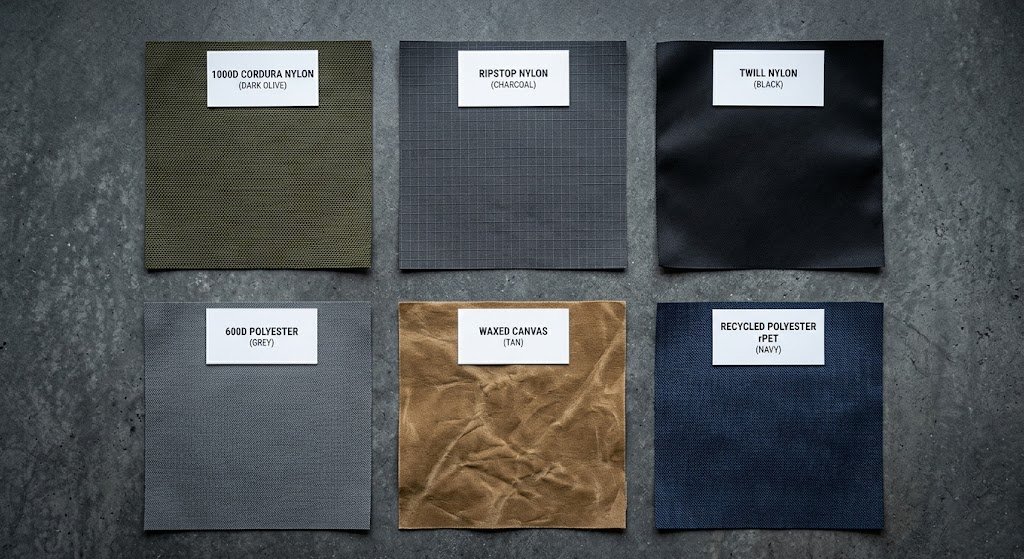
The fabric landscape for duffel bags breaks into six real categories. Each one targets a specific combination of price point, end-use, and brand positioning. There is no universal “best fabric.” There is only the right fabric for your market.
Before I walk through each segment, use this table as your quick-reference starting point. For full technical specs on each fabric — denier ratings, tensile strength, coating options — read our complete duffel bag fabric types guide. This article picks up where that one ends: the why behind the choice, not just the what.
The Duffel Bag Fabric Selection Matrix
| Market Segment | Primary Fabric | Denier Range | Avg. Fabric Cost (FOB) | Key Property |
|---|---|---|---|---|
| High-end Outdoor / Tactical | Cordura® nylon, TPU Tarpaulin | 500D–1000D | $4.50–$9.00/m | Abrasion + waterproof |
| Outdoor Packable / Ultralight | Ripstop nylon | 210D–420D | $2.50–$5.00/m | Weight efficiency |
| Urban Streetwear | High-density twill nylon | 420D–840D | $3.50–$6.50/m | Drape, texture, matte finish |
| Gym / Fitness | Polyester oxford | 600D–900D | $1.20–$2.80/m | Cost + washability |
| Travel / Lifestyle | Canvas, waxed canvas, rPET | Varies | $2.00–$6.00/m | Aesthetics + light durability |
| Corporate / Promotional | Polyester oxford | 300D–420D | $0.80–$1.50/m | Printability + price |
The Three Questions I Ask Every Buyer First
Before I pull a single swatch, I need three answers:
- What is the end user physically doing with this bag? Not demographics — behavior. Sweating in it daily? Checking it on a flight? Stuffing it in a car trunk for weekend trips?
- What is your target retail price? Fabric cost is 30–40% of total COGS on a duffel. A $19 retail price leaves no room above 420D polyester. A $149 retail price demands something better.
- What is your market’s top return reason? Gym bags: zipper failure and odor. Travel bags: scuffing and strap breakage. Corporate bags: print cracking. Fabric choice directly feeds those failure points.
Once I have those three answers, I narrow from six fabric families to one or two real candidates. Every time.
Which Fabric Is Right for High-End Outdoor and Tactical Duffel Bags?
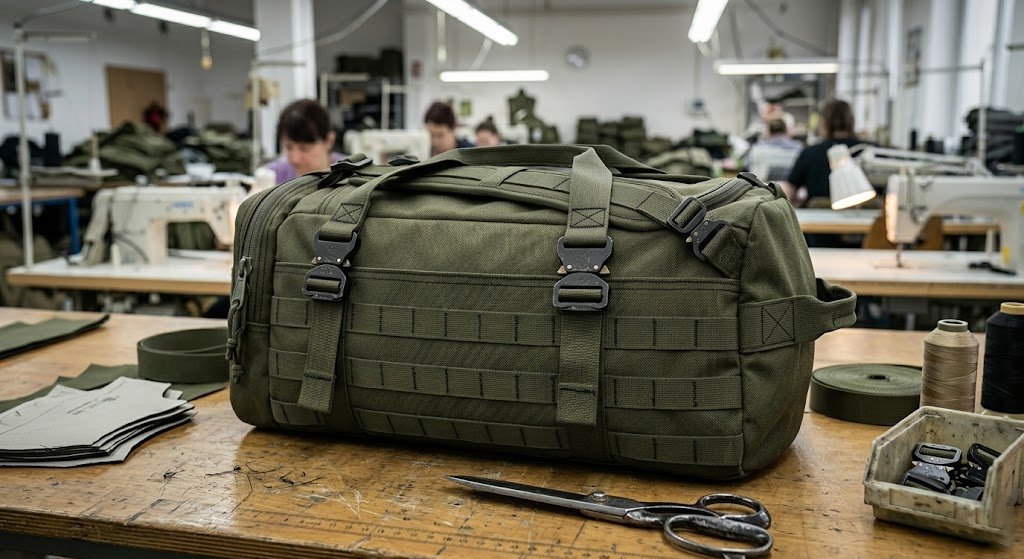
For outdoor and tactical duffel bags, 1000D Cordura® nylon or TPU/PVC Tarpaulin is the only defensible choice. These are the only fabrics that survive dragging across rock, gravel, and rough terrain while maintaining waterproof integrity. Nothing else in this price tier holds up.
This is the one segment where I tell buyers: do not cut corners on fabric. Your customer is testing this bag in the field. One failure and they never come back — and they’ll tell their community about it.
Cordura® vs. TPU Tarpaulin: Which One?
| Property | 1000D Cordura® Nylon | TPU Laminated Tarpaulin |
|---|---|---|
| Abrasion Resistance | Extremely high (ASTM D3884) | High |
| Waterproofing | Needs seam sealing | Fully waterproof, no seaming needed |
| Weight | Heavier | Moderate |
| Aesthetics | Tactical, matte, structured | Industrial, utilitarian |
| Cost Premium vs. 600D Polyester | +$4–7/unit | +$5–9/unit |
| Best For | Military, tactical, premium outdoor | Dry bags, boating, expedition use |
The Packable/Ultralight Sub-Market
Not every outdoor duffel needs to be a tank. If your product is a packable duffel — folds into a pocket, used for day hiking or travel overflow — 210D–420D ripstop nylon is the correct call.
- Shell: 210D ripstop nylon with silicone or PU coating
- Lining: 70D nylon taffeta
- Bottom panel: 420D ripstop reinforcement
- Target weight: under 350g for the bag itself
Ripstop’s grid-weave construction stops tears from propagating — that’s its core function. For a lightweight packable bag, this is more important than raw denier strength.
Waterproofing: Water-Resistant vs. Fully Waterproof
Buyers say “waterproof.” They usually mean “water-resistant.” These are not the same thing — and the factory cost difference is real.
- DWR coating = water-resistant. $0.30–$0.80/unit added cost. Repels light rain. Seams are NOT sealed.
- TPU laminate + seam sealing = waterproof. $3–8/unit added cost. Submersion-tested.
Most outdoor lifestyle bags need the first option. Expedition and tactical bags need the second. Know which one your customer actually needs before you lock the spec. We validate waterproofing with AATCC 35 rain test and ISO 811 hydrostatic pressure test — we provide reports on request.
Factory Secret: Buyers who spec full TPU waterproofing on a lifestyle outdoor duffel are adding $5–8/unit for a feature 80% of their customers will never need. I’ve talked three clients out of this in the last two years. They thanked me later when their margins held.
What Fabric Do Urban Streetwear and Fashion Duffel Brands Need?
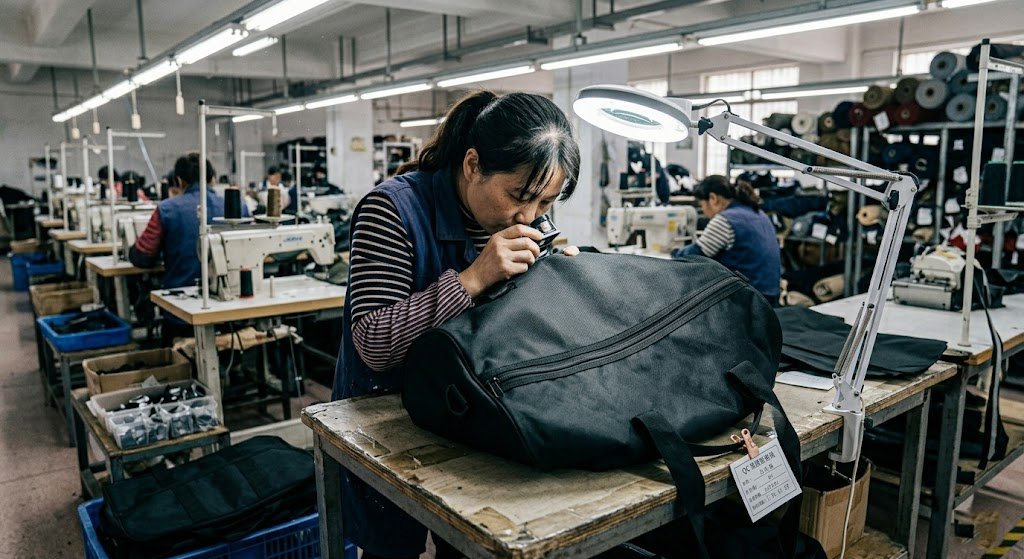
Urban streetwear duffel bags demand high-density twill nylon — typically 420D to 840D. The reason is texture and drape, not just durability. Twill nylon has a diagonal weave that photographs differently, hangs differently, and feels different from flat-weave polyester. That tactile and visual difference is exactly what streetwear customers are paying for.
This is a segment most fabric guides completely ignore. Everyone talks about outdoor and gym. Nobody talks about how fabric texture is a core design element for streetwear and fashion brands.
Why Polyester Won’t Work for Streetwear
I’ve had streetwear clients try to use 600D polyester to cut costs. It always backfires.
- Flat-weave polyester has a plasticky sheen that reads as “cheap” in lifestyle photography
- It doesn’t drape — it holds a rigid shape that looks stiff on the body
- Pantone matching on polyester in fashion colorways (dusty rose, sage, ecru) is harder to nail with precision
High-density twill nylon solves all three problems.
Streetwear Fabric Spec Breakdown
- Primary shell: 420D–840D high-density twill nylon, matte finish preferred
- Lining: 210D ripstop nylon or premium recycled polyester in contrast color
- Hardware: Matte black or antique brass only — shiny silver hardware destroys the aesthetic
- Strap webbing: 38mm nylon webbing minimum, not polyester — nylon webbing has better hand-feel and doesn’t fray at cut ends
The Color Limitation Nobody Warns You About
Nylon is harder to dye to exact Pantone specifications than polyester. I tell every streetwear client the same thing: budget one extra sampling round for color approval. On complex fashion colorways, we sometimes go three rounds before the color is right. That’s not a factory failure — that’s the reality of nylon dyeing. Build it into your timeline.
Factory Secret: If you’re working with a very specific Pantone color and need tight batch-to-batch consistency, ask your factory to run a small color-retention wash test before bulk production. Nylon’s dye fastness varies by supplier. We learned this the hard way on a dark navy order for a European streetwear brand — second production batch shifted warm. Never again.
Which Fabric Should a Gym or Fitness Duffel Brand Choose?
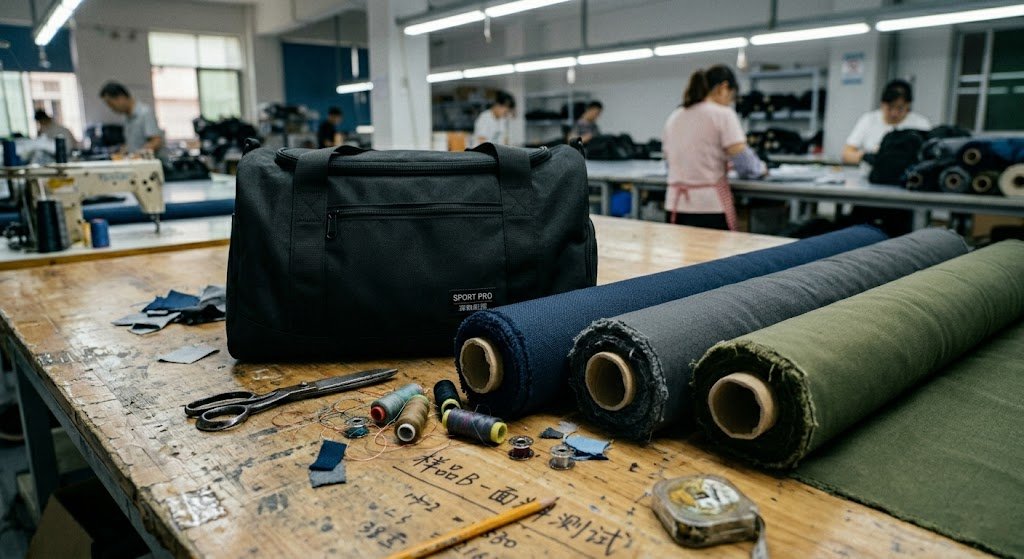
For gym and fitness duffel bags, 600D–900D polyester oxford with PU 1500mm coating is the industry floor. It handles sweat, machine washing, and daily abrasion at a cost that keeps your margins healthy. The only reason to go above this is if your retail price is $80+ and you’re positioning as premium.
Most gym brands I work with land on exactly two specs:
- Budget/mid-range ($25–60 retail): 600D polyester oxford, PU coated, reinforced bottom panel
- Premium ($80+ retail): 420D ballistic nylon or 840D nylon, same PU coating, upgraded hardware
What Kills Gym Bag Launches
| Common Mistake | Real Problem | Fix |
|---|---|---|
| Using canvas for “premium look” | Canvas absorbs sweat, smells within 60 days | Matte-finish nylon — same look, zero odor trap |
| Dropping to 300D to cut $0.50/unit | Zipper stress points tear out within 6 months | Floor at 600D for any bag holding shoes + clothes |
| Skipping DWR coating | First rain, customer returns spike | Add DWR — costs $0.30–$0.80/unit, kills returns |
| Ignoring lining fabric | Wet gear destroys cheap linings | Use 210D polyester or antimicrobial mesh lining |
Gym Bag Fabric Stack
- Main body: 600D polyester oxford, PU 1500mm minimum
- Lining: 210D polyester or moisture-wicking mesh
- Bottom panel: 900D polyester or EVA board backing
- Zipper zones: secondary 420D reinforcement layer (see Factory Secret below)
Factory Secret: The #1 gym bag return trigger is zipper failure — not the zipper itself, but the fabric around the zipper attachment points. Thin shell fabric + high-cycle YKK zipper = tape pulls free within months. We add a secondary 420D reinforcement patch at every zipper attachment point. Adds less than $0.15/unit. Eliminates the failure mode entirely.
What Fabric Works Best for Travel and Lifestyle Duffel Brands?
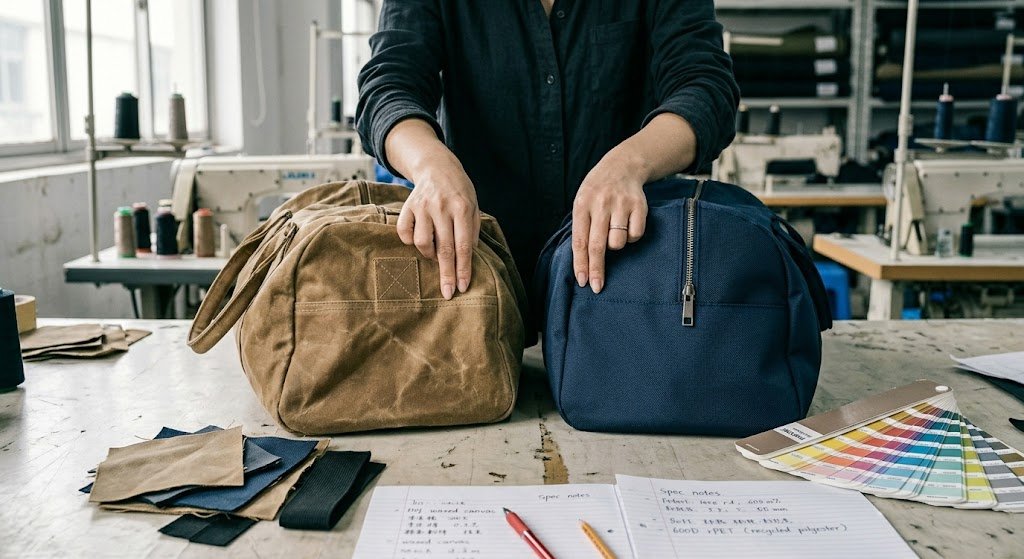
Travel and lifestyle duffel brands have the most options — and the highest risk of a wrong choice. For premium travel, waxed canvas or 600D recycled polyester (rPET). For boutique DTC lifestyle, structured canvas with reinforced base. For mass-market travel, 420D–600D rPET with matte finish. Aesthetics lead the decision here, but must be engineered around the fabric’s structural limits.
This segment is where I spend the most time in client conversations. Because “it looks great” is not a fabric spec. It’s a starting point.
The Canvas Trap I See Every Year
A buyer wants a premium canvas duffel. They’ve seen it on Instagram. It looks incredible. Here’s what raw canvas actually does in the field:
- Zero abrasion resistance on the bottom panel — scuffs and wears through on airport floors
- Wicks moisture upward from wet surfaces
- Loses shape under heavy loads without internal structure
I don’t tell them to abandon canvas. I tell them to engineer around it:
- Bottom panel: Replace canvas with 600D polyester or PU leather-look base
- Interior: EVA board insert for shape retention
- Waxed canvas upgrade: Adds $1.50–3.00/unit, transforms moisture and abrasion performance
The rPET Opportunity Nobody Is Ignoring Anymore
Recycled polyester (rPET) is now cost-competitive with virgin polyester and the demand from EU and US retailers is real. Certifications like GRS (Global Recycled Standard) are increasingly a retailer requirement, not a differentiator. If you’re selling to European chains, ask about rPET early — it could be a gating factor.
Travel Fabric Specs by Sub-Segment
| Sub-Segment | Recommended Fabric | Notes |
|---|---|---|
| Premium carry-on duffel | Waxed canvas + 600D base | Internal EVA structure required |
| Mid-range weekend bag | 600D rPET, matte finish | GRS cert available |
| Boutique DTC lifestyle | Heathered nylon or structured canvas | Photography-first choice |
| Mass-market travel | 420D–600D polyester | Cost controls everything |
Does Your Target Export Market Change the Fabric Spec?
Yes — and this is the section most guides skip entirely. EU buyers require sustainability certifications that rule out certain coatings. The US market demands abrasion and tear data. Japan will reject any fabric with surface inconsistencies. Geography is not just a logistics question — it changes which fabric properties are non-negotiable.
I’ve had to learn this order by order over 12 years. A European sporting goods brand we produce for requires OEKO-TEX Standard 100 on every fabric — that immediately eliminates certain PU coating chemistries. An Australian outdoor brand requires UV stabilizers in every PU coating we apply.
Market-Specific Non-Negotiables
| Target Market | Non-Negotiable | Fabric Impact |
|---|---|---|
| EU / Germany / Nordics | REACH compliance + OEKO-TEX or GRS cert | Limits coating chemistry; rPET preferred |
| USA (outdoor / tactical) | Tear strength + abrasion data (ASTM) | Pushes toward Cordura® or ballistic nylon |
| UK (retail chains) | GRS cert increasingly required for rPET | Virgin polyester being phased out |
| Japan | Zero surface flaws, tight weave consistency | Premium grade only; higher rejection rate |
| Australia / NZ | UV and heat resistance | UV-stabilized PU coatings required |
| Southeast Asia | Price efficiency | 300D–600D polyester; no coating upgrades |
What Certifications Do You Actually Need?
- OEKO-TEX Standard 100: Tests for harmful substances in fabric and coatings. Required by most EU retailers.
- GRS (Global Recycled Standard): Validates rPET content. Increasingly required by EU and UK chains.
- REACH compliance: EU chemical regulation. Applies to all coatings and dyes used in production.
- CPSC compliance: US product safety. Critical for promotional and gift items sold to US retailers.
We hold documentation for all four at our factory and can provide test reports during sampling.
How Does Fabric Choice Affect MOQ and Sample Timeline?
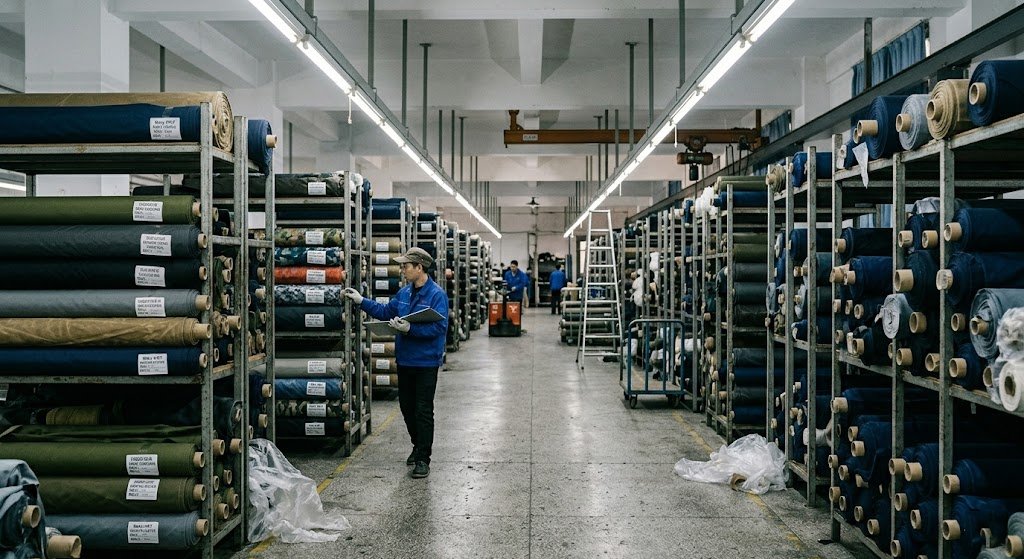
Standard polyester and stock-color nylon have no fabric-roll minimums at our factory — we stock both year-round and can start samples within 7–10 days. Specialty fabrics (Cordura®, waxed canvas, custom-color rPET) are governed by fabric mill minimums, which translate into 300–500 piece finished bag MOQs. This is not a factory policy — it’s a supply chain reality.
I’ve had clients fall in love with a specific custom-color waxed canvas, then walk away when they found out the minimum dye lot requirement forced a 500-unit order. Don’t let fabric choice blindside your inventory plan.
MOQ and Lead Time by Fabric Type
| Fabric Type | Stock Status | Finished Bag MOQ | Sample Lead Time |
|---|---|---|---|
| 300D–600D polyester | Always in stock | 100–200 pcs | 7–10 days |
| 420D–840D nylon (stock colors) | Usually in stock | 200–300 pcs | 10–14 days |
| High-density twill nylon | Partial stock | 200–300 pcs | 10–14 days |
| Ripstop nylon (standard colors) | Partial stock | 200–300 pcs | 10–14 days |
| 1000D Cordura® | Roll order required | 300–500 pcs | 14–21 days |
| Waxed canvas | Special order | 300–500 pcs | 21–30 days |
| Custom rPET (specific color) | Dye lot minimum | 500+ pcs | 21–30 days |
| TPU Tarpaulin | Roll order required | 300–500 pcs | 14–21 days |
The Hidden Cost of Custom Colors
Every custom Pantone color on any fabric adds 2–3 weeks to your sample timeline and typically requires a minimum dye lot — usually 300–500 meters. That’s not something any factory can negotiate around. It’s the mill’s minimum. Stock colors bypass this entirely.
If you’re on a tight timeline or a small first order, choose a stock color and lock in the custom color on your second run once volume justifies it.
Factory note: We produce custom duffel bags starting at 300 pieces on standard polyester. On Cordura® or waxed canvas, the floor is 500 pieces. These aren’t arbitrary thresholds — they reflect the actual fabric minimums our mills impose.
The One Framework That Ends All the Fabric Confusion?
Every buyer eventually says: “Just tell me what fabric to use.”
My answer is always the same: Tell me where your bag ends up and who’s holding it.
Not your brand story. The literal scenario. A gym-goer throwing it in a locker room every day. A traveler carry-on packing for weekend trips. A streetwear customer photographing it in natural light. A corporate attendee stuffing it in a closet after the event.
Once I know that, I can give a fabric spec in 10 minutes — one that survives the use case, fits the price point, and clears every retailer compliance requirement.
That’s what 12 years on the factory floor actually teaches. Not which fabric is “best.” Which fabric is right for that person in that situation.
For a deep dive into the technical properties of each fabric — denier ratings, weave structures, coating chemistries — our 8 types of duffel bag fabrics guide has every spec laid out. Use that as your reference. Use this article as your decision logic.
Ready to Get a Factory Fabric Recommendation for Your Brand?
Tell us your market, target retail price, and estimated annual volume. We’ll send a fabric shortlist with costs, MOQs, and sample options within 24 hours.
Ready to get a factory quote? Tell us your specs →