Worried your products won’t stay cold long enough for your customers? This can damage your brand’s reputation. Understanding insulation technology is key to choosing the right bag that delivers.
A standard insulated bag keeps items cold for 2-4 hours. High-performance models with advanced foam and ice packs can extend this to 12-24 hours or even several days. The duration depends heavily on the bag’s construction, insulation type, and external conditions.

The difference between a few hours and a few days is huge for your customers. As a brand owner, you need to know what makes an insulated bag truly effective. I’ve spent years in the bag industry, and I’ve seen what works. Let’s dive into the details so you can make the best choice for your brand and give your customers the quality they expect.
[claim claim=”All insulated bags can keep food frozen for at least 24 hours.” istrue=”false” explanation=”Only high-performance bags with thick insulation and used with ice packs can achieve this. Standard bags typically last only a few hours.”]
[claim claim=”The effectiveness of an insulated bag is significantly influenced by its insulation material and thickness.” istrue=”true” explanation=”Materials like closed-cell foam are more effective than simple foil liners, and thicker insulation provides a better thermal barrier.”]
What Are Insulated Bags and How Do They Work?
You see "insulated" on bag descriptions, but what does it really mean for performance? Choosing the wrong type can mean offering a product that doesn’t meet customer expectations for freshness.
Insulated bags work by using layers of material to slow down heat transfer. An outer layer protects the bag, a middle foam layer traps air to prevent heat from entering, and an inner waterproof lining contains the contents. This creates a thermal barrier, keeping the inside cold.

I remember working with a client who wanted to launch a line of lunch bags. They initially thought a simple foil lining was enough. I had to explain the core principles of thermal insulation. It’s all about slowing down the three types of heat transfer. A well-designed bag combines materials that tackle all three, which is why a bag from a specialized manufacturer will always outperform a cheap, mass-produced one.
Conduction
This is heat moving through direct contact. The thick foam insulation in quality bags is a poor conductor. It creates a barrier between the warm outside and the cool inside.
Convection
This is heat moving through the air. The foam traps air in tiny pockets. This stops warm air from circulating and reaching your cold items.
Radiation
This is heat moving through invisible waves. The shiny, reflective inner lining, often PEVA or aluminum foil, bounces heat away.
| Heat Transfer Type | How Insulated Bags Counter It | Key Material |
|---|---|---|
| Conduction | Thick foam layer acts as a poor conductor. | Closed-cell foam (PE, EPE) |
| Convection | Trapped air pockets in foam prevent air circulation. | Foam insulation |
| Radiation | Reflective lining bounces heat waves away. | Aluminum foil, PEVA lining |
[claim claim=”The shiny inner lining of an insulated bag is just for looks.” istrue=”false” explanation=”The reflective lining is crucial for blocking radiant heat, a major factor in how quickly items warm up.”]
[claim claim=”Insulated bags work by actively cooling the contents inside.” istrue=”false” explanation=”Insulated bags do not generate cold; they are passive devices that slow down the process of heat entering the bag from the outside.”]
Which Types of Insulated Bags Are Available in the Market?
The market is flooded with options, from soft coolers to lunch totes. Picking a style that doesn’t fit your customer’s lifestyle means missed sales and wasted inventory. Let’s categorize them.
Insulated bags range from simple grocery totes and lunch bags to high-performance soft coolers and specialized delivery bags. Each type uses different materials and construction, tailored for specific uses, from keeping a sandwich cool for hours to preserving food for a weekend trip.

As a brand owner like Emily, understanding the different segments is crucial for positioning your product. You’re not just selling a bag; you’re selling a solution for a specific need. I’ve helped brands navigate this choice many times. You need to decide which market you want to serve.
Everyday Lunch Bags & Totes
These are the most common. They’re designed for short-term use, like keeping lunch cool until noon. Insulation is usually thin. They are affordable and great for corporate branding or as a basic lifestyle product.
High-Performance Soft Coolers
This is where brands like YETI and RTIC shine. They use thick, closed-cell foam, waterproof zippers, and durable outer shells. These are for serious outdoor enthusiasts and can keep ice for days. They represent a premium market segment.
Insulated Backpacks & Delivery Bags
These combine portability with performance. Backpacks are for hikers or commuters. Delivery bags are for the growing food delivery industry. They need to be durable, ergonomic, and highly efficient.
| Bag Type | Typical Use Case | Insulation Level | Price Point |
|---|---|---|---|
| Lunch Tote | Daily lunch, short trips | Low | $ |
| Grocery Bag | Shopping trips | Low-Medium | $ |
| Backpack Cooler | Hiking, picnics, events | Medium-High | $$ |
| Soft Cooler | Camping, boating, multi-day trips | High | $$$ |
[claim claim=”All soft coolers are the same, regardless of brand.” istrue=”false” explanation=”Brands like YETI and RTIC use proprietary foam technology, welded seams, and waterproof zippers that significantly outperform generic soft coolers.”]
[claim claim=”Insulated backpacks offer a hands-free way to carry cold items, making them ideal for active users.” istrue=”true” explanation=”Their design distributes weight evenly, making them more comfortable than traditional coolers for activities like hiking or attending festivals.”]
What Factors Influence How Long Insulated Bags Keep Things Cold?
You’ve seen bags claim "24-hour cooling," but real-world results vary wildly. Misunderstanding these factors can lead you to source a product that underperforms. Let’s uncover the key variables.
The duration of cooling depends on several factors: the type and thickness of insulation, the bag’s seal, the initial temperature of the contents, the use of ice packs, the ambient external temperature, and how often the bag is opened.

I always tell my clients that a bag’s performance isn’t just about its specs on paper. It’s a system. Think of it like a team; every player has to do their part.
The Bag Itself
This is the foundation. As my research shows, high-density, closed-cell foam is the most important part. The thicker the foam, the better. Also, look at the construction. Are the seams stitched or welded? Welded seams prevent air leaks. Is the zipper standard or waterproof? A waterproof zipper creates a much better seal.
How You Use It
This is just as important. Pre-chilling the bag and its contents makes a huge difference. Using solid block ice or quality ice packs is better than loose ice cubes, which melt faster. The ratio of ice to contents is also key. And, of course, every time you open the bag, you let cold air out and warm air in.
| Factor | Low Performance | High Performance |
|---|---|---|
| Insulation | Thin PE foam, foil liner | Thick closed-cell foam |
| Seal | Standard zipper, stitched seams | Waterproof zipper, welded seams |
| Ice Type | Loose ice cubes | Block ice, quality ice packs |
| Packing | Warm contents, lots of air space | Pre-chilled contents, packed full |
| Usage | Opened frequently | Kept closed, in the shade |
[claim claim=”The color of the insulated bag has no effect on its performance.” istrue=”false” explanation=”Lighter-colored bags reflect more sunlight and absorb less heat than darker-colored bags, which can help keep contents cooler for longer in direct sun.”]
[claim claim=”Filling empty space in an insulated bag with towels or newspaper can help it stay cold longer.” istrue=”true” explanation=”Air is a poor insulator. Filling empty space reduces air volume, minimizing convection and slowing down the warming process.”]
So, How Long Can Insulated Bags Really Keep Things Cold?
You need a straight answer. How many hours or days can you promise your customers? Overpromising leads to disappointment, while underpromising might lose you a sale. Let’s provide some realistic timelines.
A basic lunch bag keeps things cold for 2-4 hours. A mid-range soft cooler can last 8-12 hours with ice packs. High-performance bags from brands like YETI can maintain ice for 24-72 hours or more under optimal conditions.
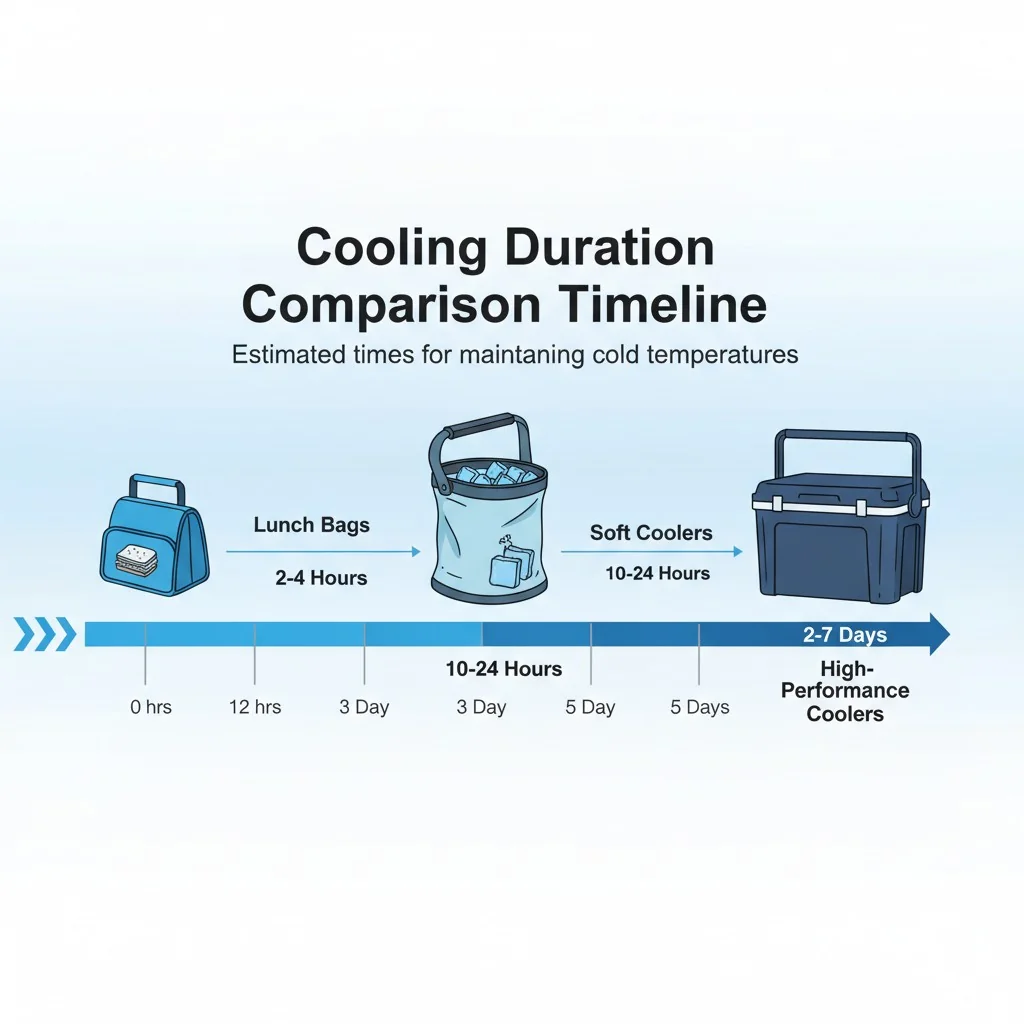
During my time in the industry, I’ve seen countless tests. The numbers can be impressive, but they always come with conditions. As a brand owner, it’s your job to understand that context.
The "Up To" Disclaimer
When a brand claims "keeps ice for 3 days," that’s usually based on a controlled test. The bag is pre-chilled, filled entirely with ice, and left unopened in a cool room. This isn’t a realistic scenario for your average customer.
Real-World Expectations
For a customer going on a picnic, a good quality soft cooler should keep food and drinks cold for a full day (8-12 hours). For a weekend camping trip, a high-performance bag is necessary. I always advise my clients to market their bags based on practical use cases. For a lifestyle brand, focusing on a "full day at the beach" is more effective than quoting lab-tested numbers.
| Bag Category | Realistic Cooling Duration (with ice packs) | Ideal Use Case |
|---|---|---|
| Basic Lunch Bag | 2-4 hours | Daily work/school lunch |
| Mid-Range Cooler | 8-12 hours | Day trips, picnics, sports events |
| High-Performance Cooler | 24-72+ hours | Camping, boating, multi-day trips |
[claim claim=”An insulated bag can keep food at a safe temperature (below 40°F or 4°C) indefinitely as long as there is ice inside.” istrue=”false” explanation=”Once ice melts, the temperature will rise. Food safety depends on maintaining a temperature below 40°F. Relying on a bag for long-term preservation without monitoring is risky.”]
[claim claim=”The amount of ice used directly impacts how long the contents stay cold.” istrue=”true” explanation=”More ice (or ice packs) provides more cooling mass to absorb heat, significantly extending the duration the bag can maintain a cold temperature.”]
Do Insulated Bags Keep Food Hot?
Yes, a insulated bags are designed to maintain the temperature of the contents, meaning they can keep food hot as well as cold.The insulation works by reducing heat transfer between the bag’s interior and the external environment. When you place hot food inside an insulated bag, the material slows down heat loss, allowing the food to stay warm for hours.
The effectiveness of keeping food hot depends on several factors, including the bag’s insulation material, thickness, and how well the bag seals. For example, thicker foam or thermal linings and airtight closures improve heat retention. Additionally, preheating the insulated bag with warm water before adding hot food can extend the warming effect.
Heat Retention Comparison of Different Insulated Bags
| Bag Type | Average Heat Retention Time | Key Features |
|---|---|---|
| Basic Insulated Bag | 1-2 hours | Lightweight, moderate insulation |
| Thick Thermal Bag | 3-4 hours | Thick lining, often with foil layer |
| High-End Vacuum Bag | 5+ hours | Vacuum-sealed, superior heat block |
How Can You Maximize the Cooling Duration of Your Insulated Bag?
You’ve sourced a great bag, but customers aren’t getting the performance they expect. This can lead to negative reviews. Let’s create a simple guide on how to use an insulated bag properly.
To maximize cooling, pre-chill the bag and its contents overnight. Use large, solid ice blocks instead of cubes, and fill the bag completely, leaving no air gaps. Keep the bag in the shade and open it as infrequently as possible.
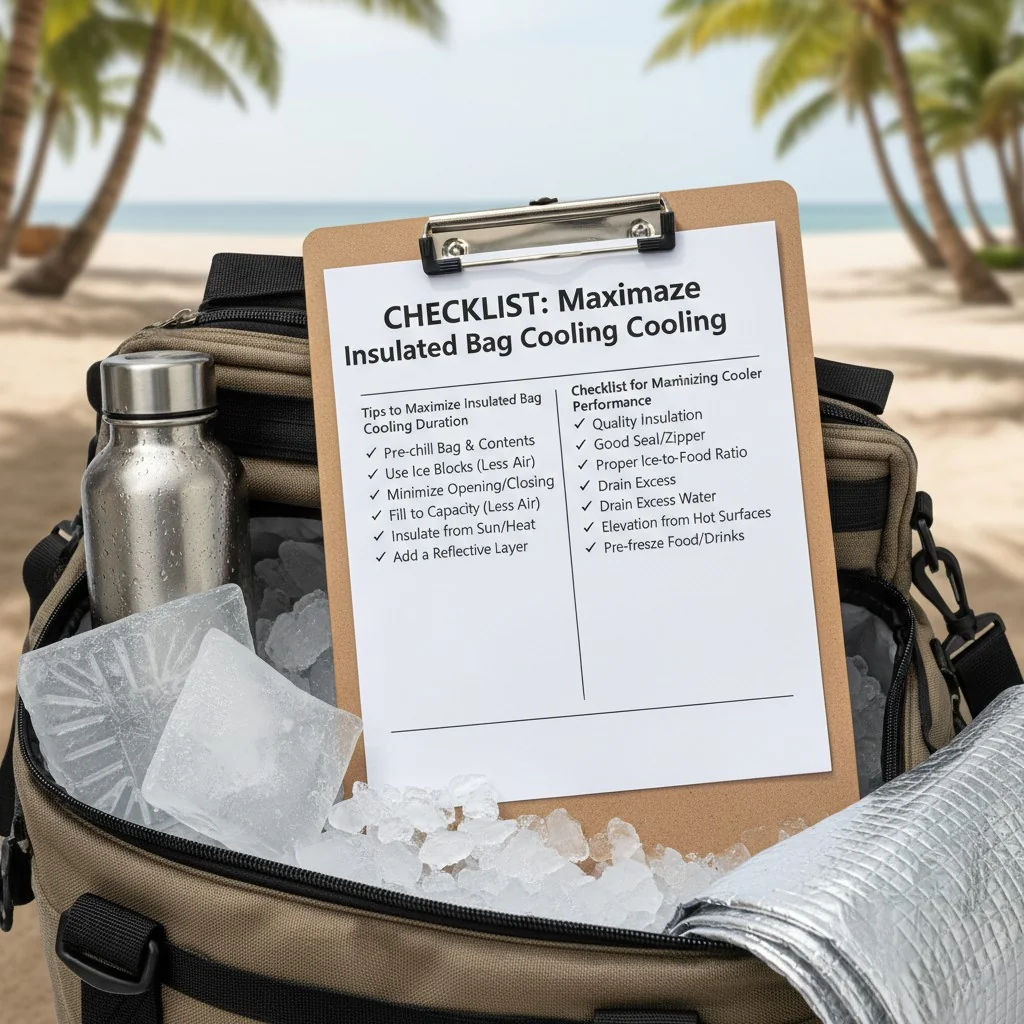
This is a fantastic opportunity for value-added content for your brand. You can include a small "Pro Tips" card with every bag you sell. It shows you care about the customer’s experience. Here are the tips I always share with my partners.
Preparation is Everything
- Pre-Chill: The night before, put the empty, open bag in your freezer. Also, chill all food and drinks beforehand. Putting warm items in a cool bag works against you.
- Ice Choice: Block ice melts much slower than cubed ice. For the best results, use a combination: block ice on the bottom and some cubes to fill in the gaps. High-quality gel packs are also a great, reusable option.
Pack Like a Pro
- Layering: Put a layer of ice on the bottom, then your food, and then another layer of ice on top. Cold air sinks, so a top layer is crucial.
- Eliminate Air: Air is the enemy. Fill any empty spaces with extra towels or more ice. A full bag stays colder longer.
[claim claim=”Putting hot and cold items together in an insulated bag is fine.” istrue=”false” explanation=”Placing hot items in an insulated bag with cold items will cause the cold items to warm up rapidly and the hot items to cool down, compromising both.”]
[claim claim=”Pre-chilling your insulated bag can significantly improve its performance.” istrue=”true” explanation=”An already-cold bag won’t waste the cooling power of your ice on bringing the bag’s own temperature down. It dedicates all its effort to maintaining the cold of your contents.”]
Is It Safe to Rely Solely on Insulated Bags for Food Preservation?
Your customers trust your bags to keep their food safe. But is that trust always warranted? A foodborne illness linked to a failed bag could be a disaster for your brand.
No. Insulated bags are for temporary storage, not long-term preservation. For food safety, perishable items must be kept below 40°F (4°C). Without a thermometer to monitor the internal temperature, relying solely on the bag for more than a few hours is risky.

This is a critical point for any brand selling insulated products. I always stress the importance of clear communication about food safety. An insulated bag is a tool to slow down warming, not a portable refrigerator.
The "Danger Zone"
Food safety experts define the temperature "danger zone" for bacteria growth as between 40°F (4°C) and 140°F (60°C). Perishable foods should not be in this zone for more than two hours.
Your Responsibility as a Brand
Your marketing should be clear. Avoid making absolute claims about food safety. Instead, educate your customers. Advise them to use a food thermometer and pack raw meat separately. This responsible approach builds trust and protects both your customer and your brand. It shows you’re an expert, not just a seller.
[claim claim=”If an insulated bag feels cold on the outside, it means it’s working well.” istrue=”false” explanation=”A bag that feels cold on the outside is experiencing ‘sweating’ or condensation, which means cold is escaping. A high-quality, well-insulated bag should feel close to room temperature on its exterior.”]
[claim claim=”Perishable food should not be left in the ‘danger zone’ (40°F – 140°F) for more than two hours.” istrue=”true” explanation=”Bacteria can multiply rapidly in this temperature range, increasing the risk of foodborne illness. This time is reduced to one hour in temperatures above 90°F.”]
Which Brands and Types Keep Things Cold the Longest?
You want to offer a premium product. Which features and brands truly deliver top-tier performance? Investing in the wrong technology means a higher cost for a product that doesn’t stand out.
High-performance brands like YETI, RTIC, and Hydro Flask lead the market. Their bags keep things cold longer due to thick, closed-cell foam insulation, waterproof zippers, and durable, welded-seam construction. These features create a superior thermal barrier.
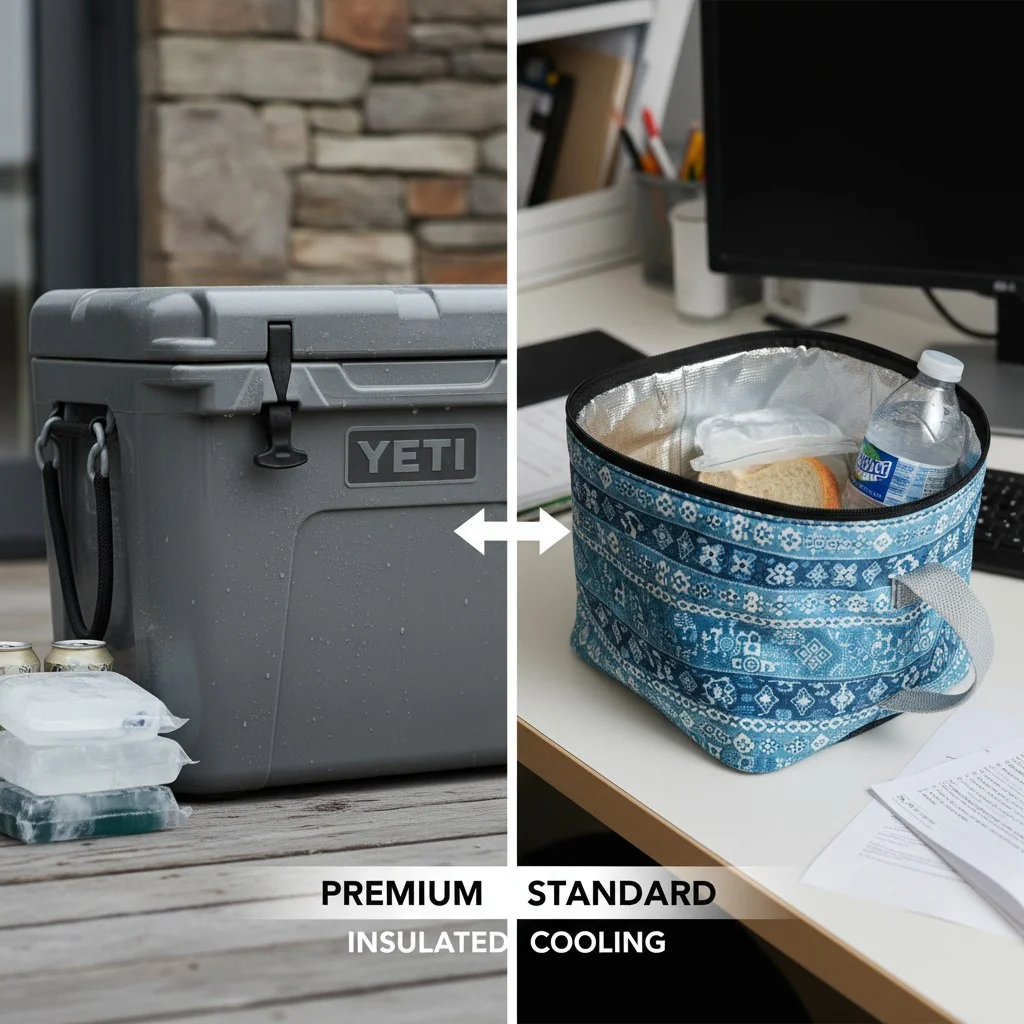
From my experience with manufacturers, the difference is in the details and materials. It’s what I call the "performance trifecta."
1. Superior Insulation
Leaders like YETI use up to an inch or more of high-density, closed-cell foam. This isn’t the flimsy stuff in cheap bags. My expert advice is to always ask a potential manufacturer about the type and density of the foam they use.
2. Airtight Seal
A bag is only as good as its weakest point. Premium brands use waterproof, airtight zippers, similar to those on a dry suit. This completely stops air exchange.
3. Welded Construction
Instead of stitching, which creates tiny holes, high-end bags use RF welding to fuse the material together. This creates a seamless, leak-proof, and airtight body. As a brand owner, sourcing a bag with these features allows you to compete in the premium market.
| Feature | Standard Bag | High-Performance Bag |
|---|---|---|
| Insulation | Thin open-cell foam | Thick closed-cell foam |
| Zipper | Standard nylon zipper | Waterproof/Airtight zipper |
| Seams | Stitched | RF Welded |
| Outer Shell | Basic polyester | High-denier, TPU-laminated nylon |
[claim claim=”Vacuum-sealing technology is commonly used in soft insulated bags.” istrue=”false” explanation=”While vacuum insulation is used in hard-sided thermoses, it’s not practical for flexible soft bags. High-end bags rely on advanced foam insulation, not a vacuum.”]
[claim claim=”RF welded seams create a stronger and more waterproof seal than traditional stitching.” istrue=”true” explanation=”Welding fuses the materials together, creating a continuous, leak-proof barrier, whereas stitching creates puncture holes that can leak air and water.”]
Are There Any Innovative Features in Modern Insulated Bags?
Modern insulated bags have come a long way from the simple, traditional coolers and lunch bags of the past. Manufacturers are continuously innovating to enhance the cooling performance, usability, and durability of these bags. Here are some of the innovative features you may find in today’s insulated bags:
1. Advanced Insulation Materials
Traditional insulated bags often relied on basic foam or bubble insulation. However, modern versions utilize cutting-edge materials such as NASA-grade insulation (like ThermoLite and Reflective Mylar) that significantly improve their ability to maintain temperatures for longer periods. These materials have superior thermal resistance, preventing both heat from entering and cold from escaping, which extends the cooling duration of the bag.
2. Leak-Proof and Waterproof Linings
Many high-end insulated bags now come with leak-proof linings, preventing liquids from seeping out and ensuring your contents stay secure. These linings are often made of waterproof materials like PVC or TPU (Thermoplastic Polyurethane), which not only protect against spills but also make cleaning the bags easier. Some brands also integrate antimicrobial coatings to minimize odor buildup and mold growth, enhancing hygiene. Learn more about the benefits of waterproof bags.
3. UV-Resistant Coatings
For those who use insulated bags outdoors—whether for camping, picnicking, or traveling—UV-resistant coatings are becoming increasingly common. These coatings prevent the exterior fabric from degrading under direct sunlight, thus enhancing the bag’s longevity. They also help maintain the bag’s aesthetic, as exposure to sunlight can cause fading in materials like polyester or canvas.
4. Collapsible and Space-Saving Designs
Space-efficient designs are increasingly popular, especially in insulated bags used for travel or those designed for compact storage. Collapsible insulated bags can be easily folded or rolled up when not in use, making them a great option for users who need a bag that doesn’t take up much storage space. These bags combine portability with functionality, as they still maintain solid insulation when expanded.
5. Dual-Zone or Multi-Compartment Designs
Some innovative bags now feature dual-zone or multi-compartment designs, allowing users to store different items at separate temperatures. For example, a bag may have one section that maintains cold temperatures (for food or beverages) and another for dry or room-temperature items. This is especially useful for those who need to transport a variety of items—such as drinks and perishable foods—without compromising on the temperature of any of them.
6. Smart Insulated Bags
With the rise of smart technology, certain high-end insulated bags are now equipped with Bluetooth or Wi-Fi technology. These bags feature temperature monitoring systems that track the internal temperature and alert users via a smartphone app when the temperature begins to rise above a set threshold. This is particularly beneficial for individuals transporting temperature-sensitive items such as medication or certain food products. Some even have built-in solar panels that can charge the bag’s temperature-monitoring system while you’re on the go.
7. Ergonomically Designed Straps and Handles
Comfort is key when it comes to carrying insulated bags, especially larger ones that may need to be transported over long distances. Modern insulated bags often come with ergonomically designed straps, handles, and shoulder straps that distribute weight evenly. Some bags also incorporate reinforced handles for additional support, and adjustable shoulder straps with extra padding, which can reduce strain and discomfort.
8. Sustainable Materials
As environmental concerns grow, more insulated bags are being made with eco-friendly materials. For example, some manufacturers use recycled fabrics (such as recycled polyester or nylon) or plant-based insulation materials. Biodegradable linings are another recent advancement, ensuring that the bags have a smaller environmental footprint after disposal. These bags are becoming a popular choice for eco-conscious consumers who still need high performance in their products. Explore eco-friendly backpack options here.
9. Integrated Cooler Compartments and Cup Holders
Some bags have been redesigned to meet the needs of people on the go, with features like built-in cooler compartments and cup holders. These features make it easy to store drinks without worrying about them tipping over and making a mess, or using a separate cooler for beverages. It’s especially helpful for people who like to enjoy cold drinks while on the move, such as at a beach or sports event.
10. Customizable Features
Customization has also become a growing trend, with many insulated bags offering the option to personalize the bag’s size, compartments, and even the insulation material. This allows users to tailor the bag to their specific needs, whether they need extra space for food, insulation for beverages, or specialized compartments for tools, snacks, or accessories.
Conclusion
Choosing the right insulated bag depends on understanding its technology and intended use. With these insights, you can source a product that truly meets your customers’ needs for quality and performance.