You’re sourcing backpacks from China for the first time — or scaling your second collection — and every factory rep you email says the same thing: "We do OEM and ODM, no problem!"
That answer is useless. It tells you nothing.
Osgoodway brings over 12 years of industry experience. We’ve seen brands burn $20,00 on unnecessary sample rounds, lock into the wrong manufacturing models, and miss their launch windows by entire quarters. The OEM vs ODM decision looks simple on paper. In practice, it determines your cost structure, your IP ownership, your lead time, and how much leverage you have with your factory.
OEM vs ODM isn’t just a manufacturing term — it’s a strategic decision that determines who owns your product, who holds leverage in the supplier relationship, and whether you can walk away from a bad factory without losing everything. OEM: you own the design, the factory executes. ODM: the factory owns the design, you own the label. Most brands pick wrong on their first order. Here’s the factory-floor reality sourcing guides skip.
Let me cut through the noise.
What Exactly Is OEM Backpack Manufacturing?

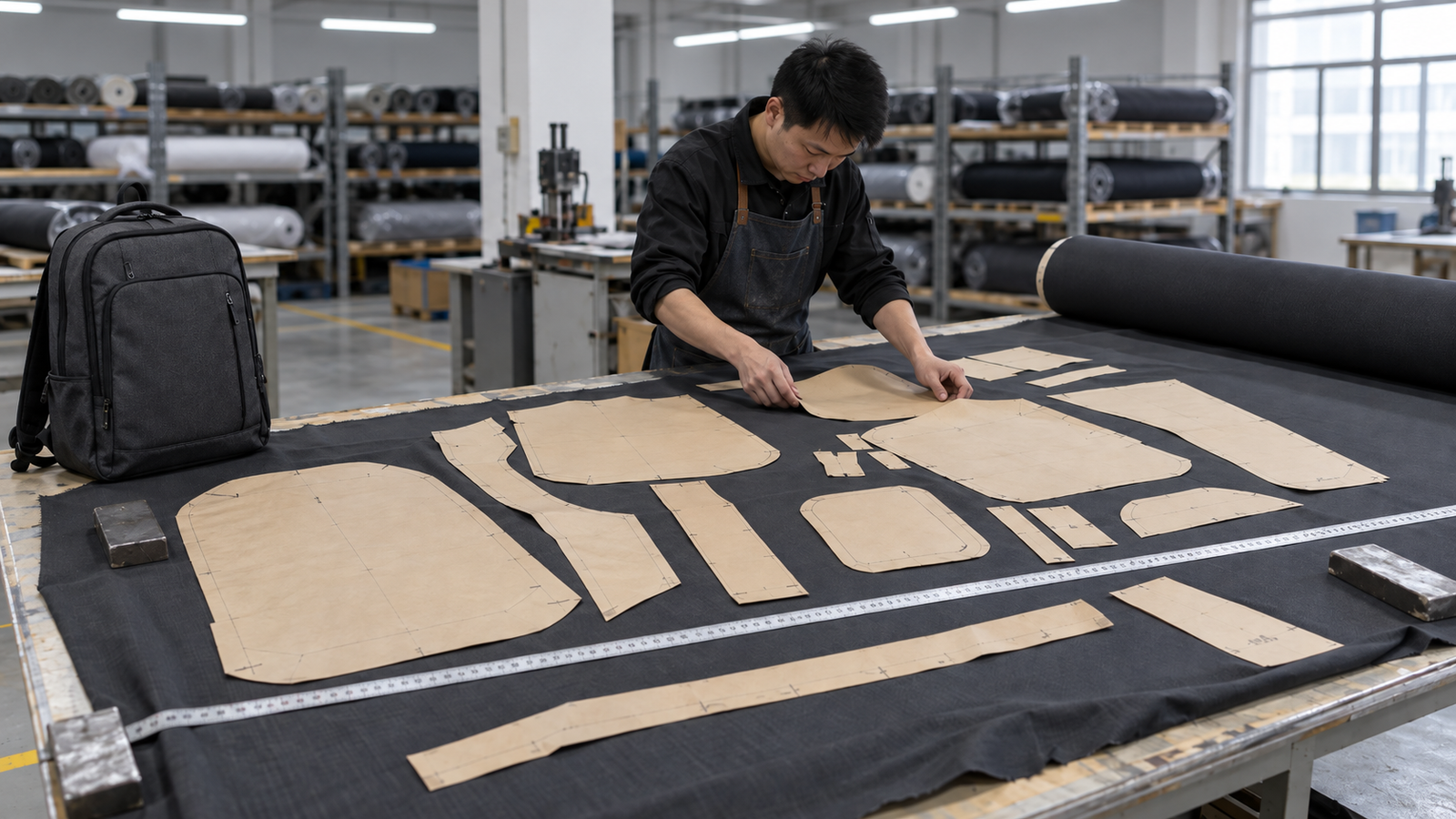
OEM (Original Equipment Manufacturing) means you own the design. Every zipper gauge, every panel dimension, every stitch density — your call, your spec, your IP. The factory is pure production capacity. Your design lives in your tech pack, not their pattern room. That portability is the entire strategic value of OEM.
You supply: tech pack, material callouts, hardware specs, branding files, compliance requirements.
The factory supply: production, raw material sourcing, QC execution, export documentation.
What OEM actually looks like on our floor:
- Client sends a tech pack — or we co-develop one together
- We build a full Bill of Materials against their confirmed spec
- Pre-production sample → client approval → bulk run
- Lead time: 90–120 days from locked tech pack to FOB shipment
OEM sample cost: $120–$300 for standard styles. The number jumps the moment you introduce custom hardware, custom zippers, or EVA components — because those require tooling (molds) before a single sample can be made. → What is a mold fee in bag manufacturing — and when do you actually need one?
The part nobody warns first-time OEM buyers about:
Your tech pack has gaps. Every new buyer’s does. A vague zipper callout becomes a generic stamped zinc pull. A missing lining note becomes whatever recycled poly we have in-stock that week. This isn’t dishonesty — production floors can’t pause for ambiguity. We make a judgment call and keep moving.
The fix: spend two extra weeks closing spec gaps before you submit. That two weeks saves you one full sample round — and four weeks you will not get back.
Factory Secret — "Factory Standard" is a financial trap: Every time you see those two words in a factory quote or sample sign-off, push back. "Factory standard" means it defaults to whatever protects our margin, not your customer experience. Demand a named spec — material code, supplier, gauge — every single time.
What Exactly Is ODM Backpack Manufacturing?

ODM (Original Design Manufacturing) means the factory already owns a fully developed design — patterned, sampled, debugged — and you choose from that library, apply branding, and ship. You’re not buying a product. You’re buying access to one. Speed and low upfront cost are real. So is the fact that the factory holds the IP, the patterns, and ultimately, the leverage.
You supply: logo files, colorway, minor modification requests, packaging spec.
The factory supply: design, pattern, BOM, materials, production, export.
What ODM actually looks like on our floor:
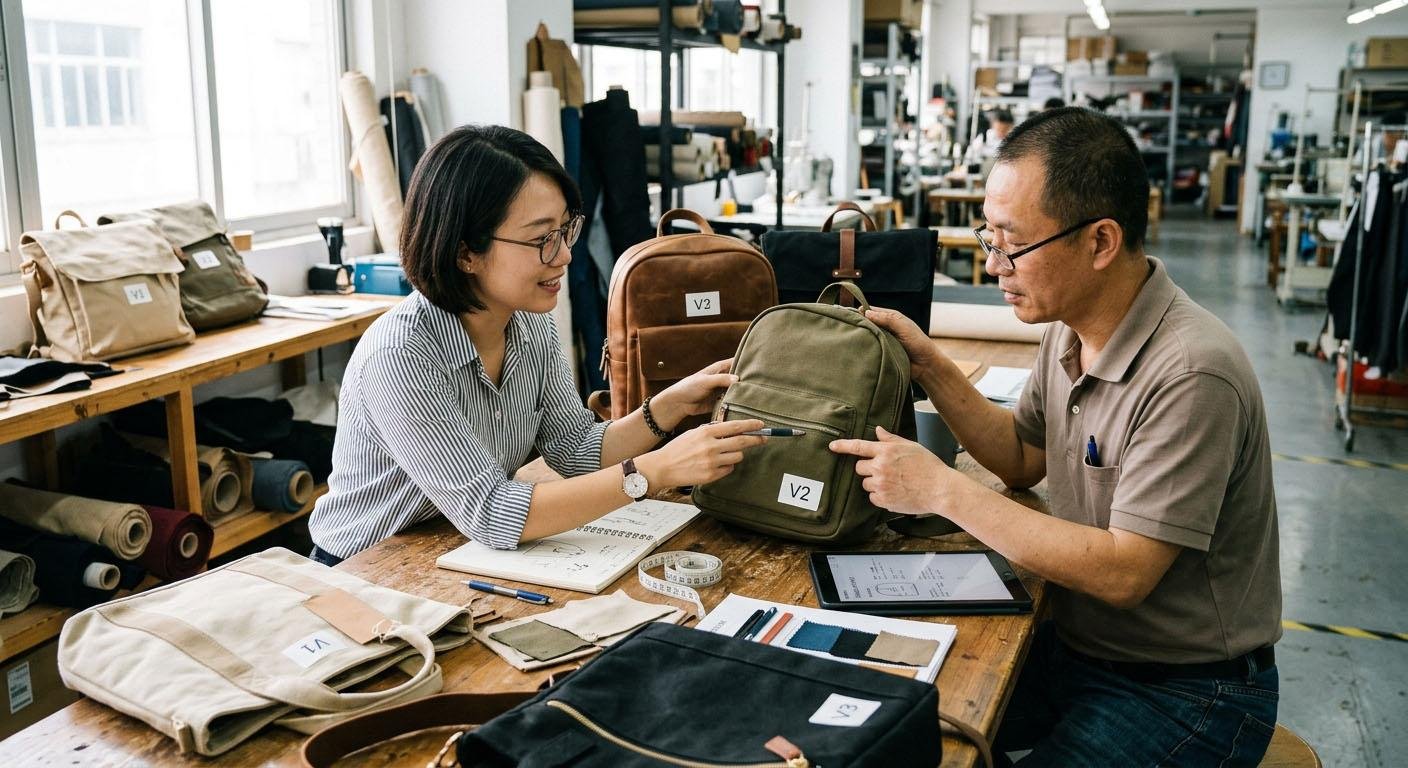
- Client browses our physical sample room or catalog — we carry 200+ active base styles
- They select a silhouette, request changes: zipper color, lining print, label content, logo placement
- We produce a branded sample
- Lead time: 45–60 days from confirmed style selection to FOB shipment
The thing most factories won’t say out loud:
Right now, I could name three brands in the US outdoor accessories space selling products built from the same base mold — different logos, different colorways, identical internal structure and silhouette. Their customers have no idea. If those brands shared a trade show floor, it would be obvious to everyone else.
That’s the real ODM picture. You’re accessing a product, not owning one. For brands whose moat is community, content, or distribution — that’s fine. For brands whose moat is the product design — it’s an existential risk.
Factory Secret — "Exclusive" is nearly meaningless without a contract: We get asked for exclusivity on ODM styles constantly. Here’s the real conversation: without a signed exclusivity agreement — specific markets, minimum 12-month term, volume commitment of 1,000+ units per order, and a design lockdown fee ($500–$2,000 depending on style) — that design stays in our open catalog. We won’t proactively sell it to your known direct competitors. But if they email us, we take the order. Get it in writing with real terms, or assume you’re sharing that product with the market.
OEM vs ODM: The Comparison That Actually Matters?
The real difference isn’t design origin — it’s supplier leverage. OEM gives you a portable asset: your tech pack goes wherever you go. ODM locks your "product" inside the factory’s pattern room. The moment you need to switch suppliers, OEM clients take 30 days. ODM clients take 3 months and $1,500 in redevelopment. That switching cost is the hidden price of ODM that never appears on a quote.
| Factor | OEM | ODM |
|---|---|---|
| Design IP | You own it | Factory owns base design |
| Upfront dev cost | $120–$1,000+ depending on custom components | $80–$200 — sample cost only |
| MOQ | 500–1,000 pcs typical | 200–300 pcs typical |
| Lead time (new style) | 90–120 days | 45–60 days |
| Customization depth | Unlimited | Modifications only |
| Exclusivity | Full | Rarely guaranteed without contract |
| Supplier switching cost | Low — take your tech pack, leave | High — rebuild from scratch |
| Factory leverage over you | Low | High |
| Best for | Product-led brands, funded SKUs | Market validation, tight timeline, low capital |

Which Model Actually Fits Your Brand Stage?
Brand stage is the real deciding factor — not budget. A $50K budget can be wasted on OEM if you haven’t validated demand yet. A $10K budget on ODM can be the smartest move if you know exactly what you’re testing. The question is: are you validating a market or building a defensible product?
Go OEM if:
- You have a validated product concept and a real tech pack (or budget to build one)
- Your MOQ is 500+ units with clear reorder intent
- Your product design is literally why customers choose you over alternatives
- You want supplier portability — the ability to move factories without starting over
- You can absorb 90–120 days of lead time without inventory pressure
Go ODM if:
- You’re entering a new product category with no design history
- Your MOQ is 200–300 units or below
- You need product delivered in under 60 days
- Product design is not your moat — your marketing, community, or distribution is
- You need to prove demand exists before committing to design ownership
The hybrid most factories won’t tell you exists:
About 30% of our clients land here — and it’s genuinely the most underutilized path in backpack sourcing.
They start by selecting a base style from our ODM catalog — an existing silhouette that’s already been patterned, sampled, and production-tested. Then they commission a full redevelopment: new internal structure, new panel geometry, new hardware spec, new material BOM. We use the original as reference geometry only. The result is a product the client owns rights to, built 35–40% faster than a ground-up OEM project.
Development cost: $100–$300. Sample Lead time: 15–20 days.
Most factories won’t offer this because it requires genuine design effort from their team on a development fee — not the more profitable bulk margin. We do it because clients who own their design come back. Clients who borrow a design eventually get commoditized by someone else using the same mold.
What Does This Actually Cost at Our Factory?

Real numbers — not strategic ranges designed to avoid commitment. These are our 2026 pricing floors for a standard mid-tier backpack. Your spec will move them. But at least you’ll know where we start.
OEM — 500–1,000 units, 30L daypack, 600D polyester body, YKK #5 zippers:
- Pre-production sample, first round: $120–$300
- Sample revision round (if triggered): Minor adjustments are usually free, but major design changes will require a re-sampling fee at $80–$150
- Custom hardware / EVA mold (if applicable): $200–$800 one-time → What triggers a mold fee?
- Bulk unit cost: $18–$26 FOB Guangzhou
- Total committed before bulk ships: $300–$1,300+ (depending on custom components)
ODM — 200–300 units, existing base style, standard 600D body:
- Branded sample: $80–$200
- Label + hang tag setup: $50–$150 one-time
- Total committed before bulk ships: $150–$350
That delta is real. What ODM buys you is a product the factory has run 50+ times, with no development risk and debugged production patterns. What OEM buys you is a product that’s actually yours. They’re not the same purchase — don’t compare them on price alone.
One more number buyers always forget: US import duty. Backpacks fall under HTS 4202.92 — current duty rate is 17.6% on FOB value. Build that into your landed cost model before you lock a price point. For EU and US retail channels, also factor in OEKO-TEX Standard 100 certification for fabrics — not optional if you’re selling through major retail buyers.
What Are the Risks Nobody Else Puts in Their Blog Post?
Most sourcing articles stop at "OEM costs more, ODM is faster." Here are the three risks that actually kill brands — none of them show up on a factory quote.
Risk 1: 100-Unit ODM Has a Math Problem
The MOQ sounds great. The unit economics don’t.
| Cost Item | Amount |
|---|---|
| FOB unit cost (100 pcs) | ~$17.00 |
| LCL ocean freight per unit | $1.80–$2.50 |
| US import duty (HTS 4202.92, 17.6%) | ~$3.00 |
| Customs broker fee spread across 100 units | ~$1.50 |
| Landed cost | $25–$28 |
Retail at $45 → gross margin ~38% before marketing, platform fees, or returns.
That’s a proof of concept, not a business. Go in knowing which one you’re running.
Risk 2: OEM Doesn’t Die on Sample Cost — It Dies on Revision Rounds
We average 1.7 sample rounds per new OEM style. Brands that hit round three aren’t dealing with a bad factory. They approved an incomplete tech pack.
The tech pack red flags I spot in under 5 minutes:
- No interior dimension callouts
- Hardware spec listed as "TBD" or "factory standard"
- Lining material left vague or unspecified
- No stitch density requirement on stress points
Rushing your spec to save $400 costs you $600 in repeat samples + 8 weeks of lost time. Every time.
Risk 3: Switching Factories Mid-ODM Is Harder Than It Looks
Factory raises prices 15%. You think: leave. Here’s the problem:
- OEM client → packs up tech pack, gets 3 competing quotes in 30 days
- ODM client → design lives in factory’s pattern room. Moving means new patterns, new samples, new approvals: $800–$1,500 + 60–90 days
That portability gap is the hidden long-term cost of ODM that never appears on a quote.
⚠️ Children’s backpacks for the US market: ASTM F963 compliance is non-negotiable. Spec it in during sampling — retrofitting after bulk is expensive and sometimes impossible.
How Do You Protect Your Design in Either Model?

File before you produce. Not after bulk approval. Not after launch. Before. Most brands get this backwards — and by the time they realize it, the design is already on Alibaba.
We’ve covered this topic in full detail here: How Do I Protect My Backpack Design IP? — worth reading before your first sample approval.
The short version by model:
If you’re doing OEM:
- Your tech pack = your primary IP asset. Keep every version. Back it up off-site.
- File a design patent with USPTO (US) and CNIPA (China) before bulk production runs.
- Timeline reality: patent applications take 3–18 months. Start during sampling, not after launch.
If you’re doing ODM:
Any feature you’ve paid to develop — custom hardware, proprietary layout, unique panel structure — needs a written exclusivity clause. Get it signed before samples, not after.
The clause must specify three things:
- Which markets are covered
- How long the exclusivity lasts
- What happens if you miss volume commitments
The factory NDA test:
Ask any factory to sign a basic NDA before you share specs.
If they hesitate → walk away. That hesitation tells you exactly how they’ll handle your design when you’re not watching.
Our factory signs NDAs and design exclusivity agreements as standard — on orders as small as 300 units. If yours won’t, that’s your answer.
A Real Case From Our Floor — What Happens When You Pick the Wrong Model?
One brand. One wrong assumption. $50,000 in missed revenue. Nobody lied and nobody made a bad product — the wrong model was chosen at the wrong moment.
What happened:
Order 1 — Correct ODM decision:
- 200 pcs, 20L daypack, standard ODM style
- Delivered in 53 days, sold out in 6 weeks
- Clean. Fast. Right call for that stage.
Order 2 — Where it went wrong:
They came back wanting the "same bag" but with:
- Repositioned hidden laptop sleeve (new internal structure)
- MOLLE-compatible webbing on front face
- Custom die-cast metal zipper pull with their wordmark
That’s not an ODM modification. That’s a new product.
They’d told investors it was a reorder. They’d budgeted reorder costs. They’d locked a launch date on ODM lead time.
What it actually cost:
| Item | Reality |
|---|---|
| Zipper pull mold (new tooling) | $650 |
| New patterns + internal geometry | Included in redevelopment |
| Total redevelopment cost | $1,340 |
| Actual lead time | 11 weeks |
| Expected lead time | 6 weeks |
| Q4 window missed | Black Friday — lost at full margin |
| Estimated revenue impact | $50,000+ |
The rule I give every client now:
Can you describe what you want in 2 sentences, and do we have something close in our sample room?
→ That’s ODM.Does it take a paragraph and a reference sketch?
→ That’s OEM. Budget and timeline accordingly — before you commit.
FAQ: OEM vs ODM Backpack Manufacturing
Q1: What is the main difference between OEM and ODM in backpack manufacturing?
OEM means you own the design and supply complete specifications — the factory is a production vendor. ODM means the factory owns the base design and you apply branding and limited modifications. The critical operational difference: in OEM your design is portable across factories; in ODM it lives in the factory’s pattern room and switching suppliers means rebuilding from scratch.
Q2: What is the minimum order quantity for OEM vs ODM backpacks from a Chinese factory?
ODM typically starts at 100–200 pieces per style. OEM typically requires 300–500 pieces minimum due to pattern development, custom material sourcing, and tooling costs that need to amortize across the run. Both figures vary by factory capability and product complexity.
Q3: Can I switch from ODM to OEM as my brand grows?
Yes — but it requires a full redevelopment: new tech pack, new sample round, 90–120 days of lead time, and $500–$1,500 in development cost. There is no upgrade path from ODM to OEM on the same style. Plan for this transition before you’re mid-reorder-cycle, not during one.
Q4: Does the factory own my design if I use OEM manufacturing?
No. In a properly structured OEM contract, you own the design, the tech pack, and any tooling you’ve paid for. The contract must explicitly state: the factory cannot produce your design for third parties, cannot reuse your tooling for other clients, and must return or destroy all patterns if the relationship ends. Get this language in writing before sampling begins.
Q5: How do I verify a factory is doing real OEM versus relabeling an existing ODM product?
Request three things before you place any order: a blank (unbranded) pre-production sample, the physical pattern pieces or CAD file, and a full BOM with named material supplier codes. A legitimate OEM factory provides all three without hesitation. Resistance to any of these — especially the BOM — is a reliable signal you’re getting labeled ODM, not true custom OEM.
Ready to Get a Factory Quote?
Tell us your specs, your target price point, and your timeline. We’ll respond within 24 hours with an honest assessment of which path — OEM, ODM, or hybrid development — makes sense for your situation, and what it’ll actually cost you, line by line.
Ready to get a factory quote? Tell us your specs →
We work with brands from 100-unit test orders to 10,000-unit seasonal programs. No templated catalog responses. No ghosting after sample approval.

Related reading: