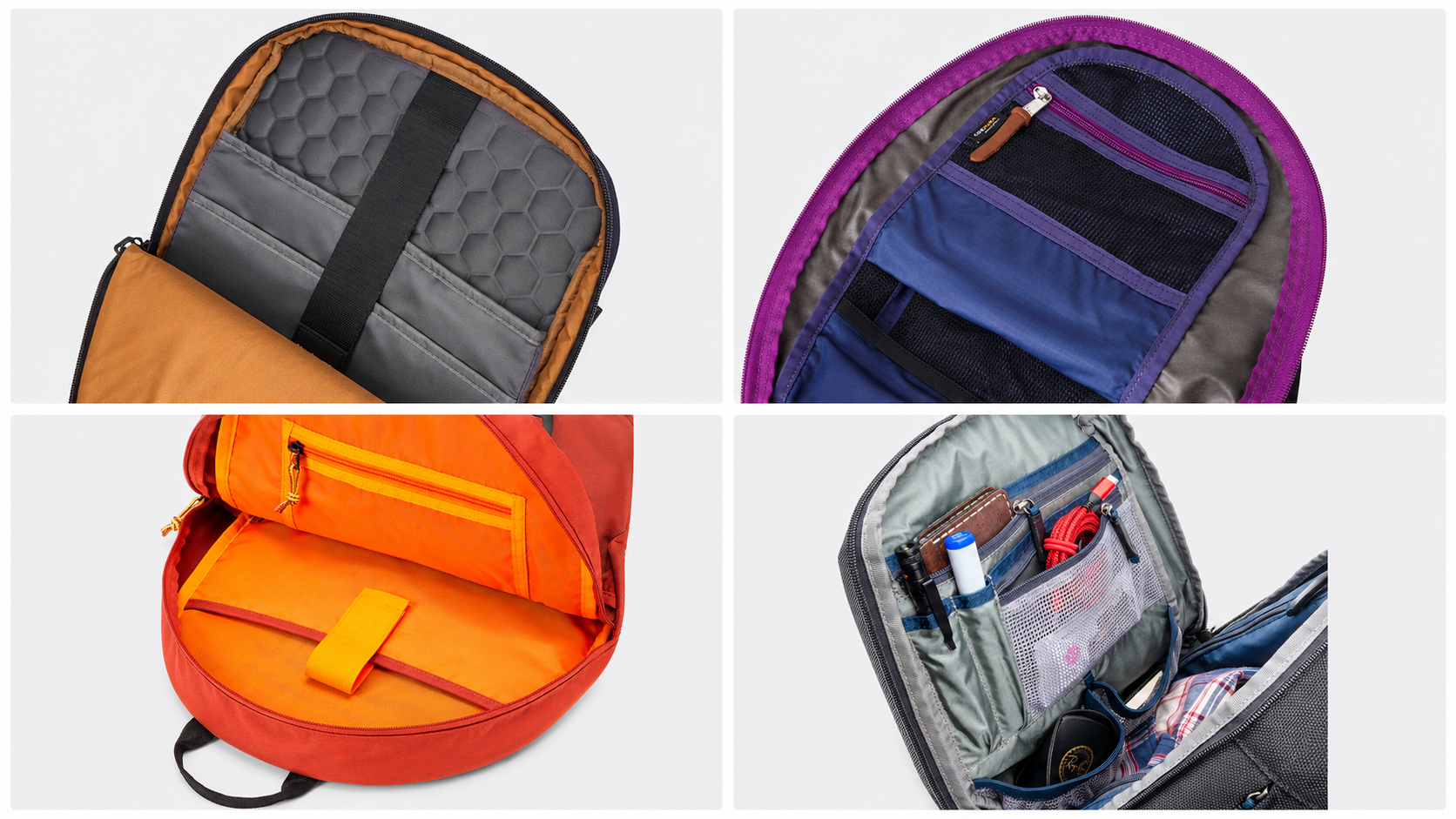
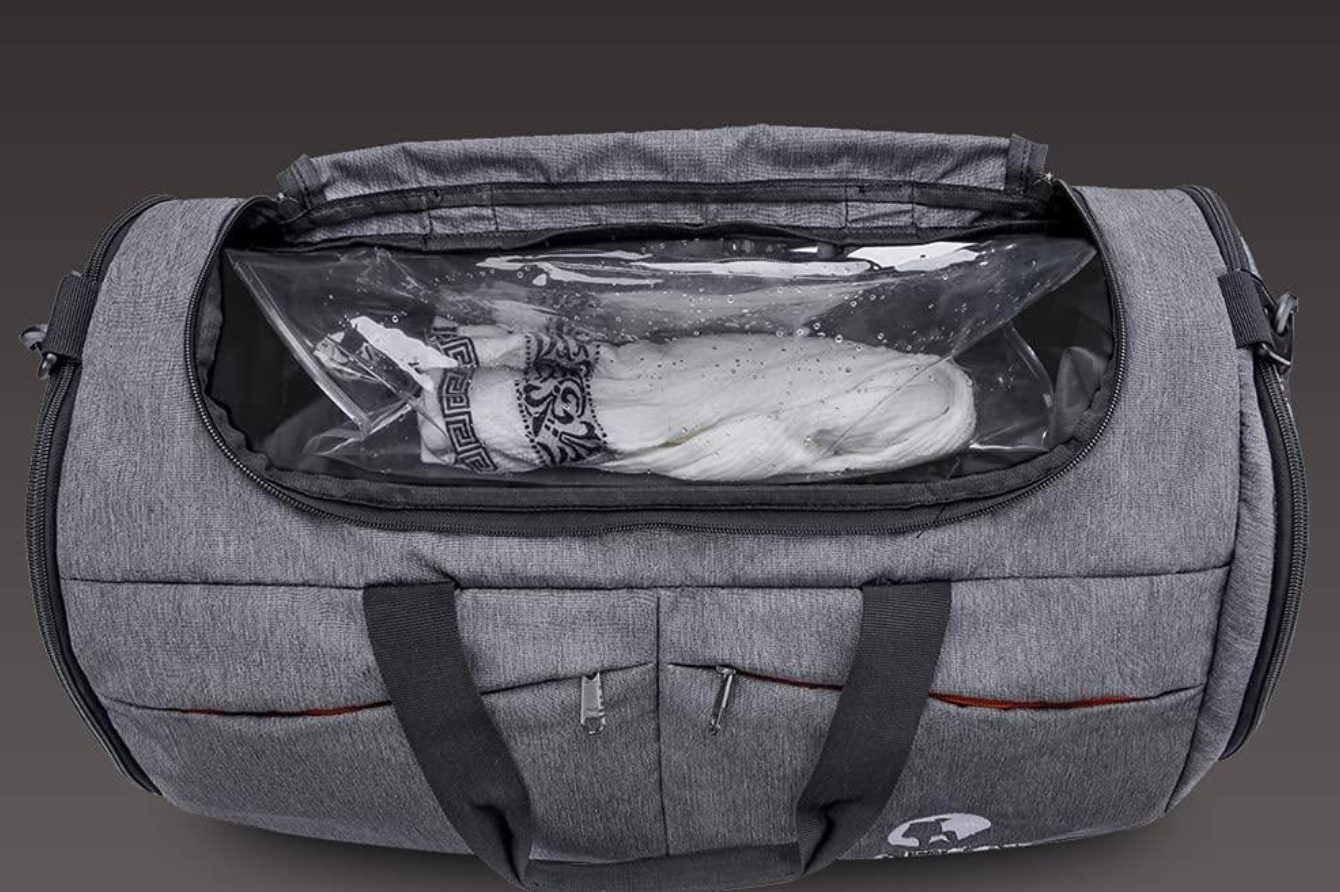
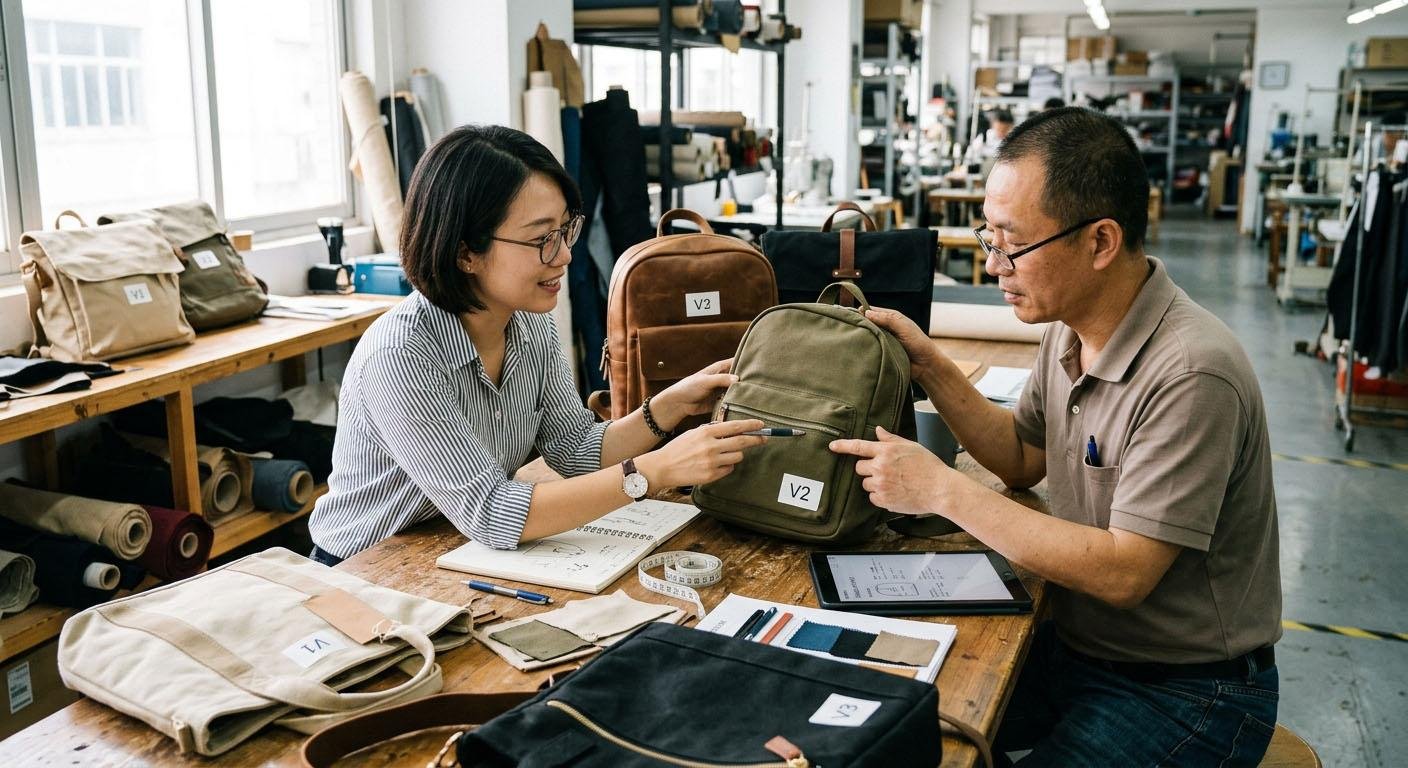
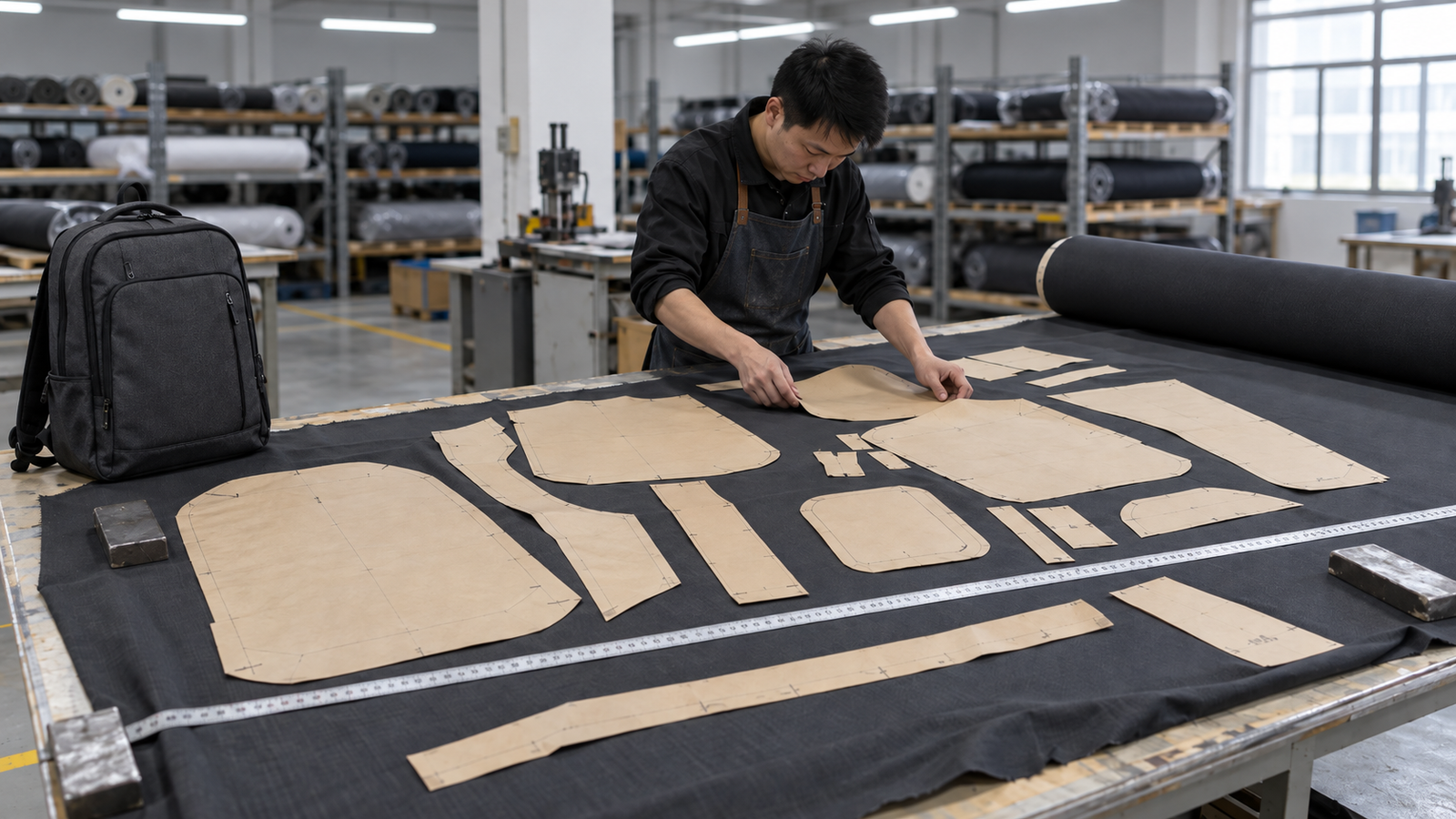
A backpack usually loses its shape because the pattern, foam, support sheet, seams, fabric and packing method are not working together. Foam affects panel fullness and recovery, support sheets stabilize larger areas, while pattern geometry and sewing control the finished silhouette. If one part is mismatched to the load or shipping method, the bag may sag, twist, curl or collapse.
When a buyer sends us a photo of a sagging sample, we do not start by asking, “What density foam are you using?” We first look at where the bag is deforming and when it happens.
Does the same side cave in every time? Does the bottom sag only after a laptop is loaded? Does the backpack look good before packing but arrive flat? Does only part of the bulk production look twisted?
Those details usually tell us much more than the word “soft.”
This matters because changing the wrong material often creates a second problem without fixing the first one. Harder foam can make a panel feel firmer while the pattern is still pulling inward. A thicker bottom board can make the base rigid while the bag still tips forward. More piping can make a distorted edge even more obvious.
For buyers developing custom backpacks, the useful starting point is not “How do we make it harder?”
It is:
Which area needs to hold its shape, under what condition, and what is making that area fail?
How Can You Tell What Is Causing a Backpack to Lose Its Shape?

Before changing materials, look at where and when the deformation appears.
Different symptoms point to different structural problems.
| What You See | What We Would Check First | Common Causes | What Usually Does Not Fix It |
|---|---|---|---|
| Front panel looks hollow | Foam and panel construction | Poor recovery, weak panel support, fabric/foam mismatch | Adding a bottom board |
| Side panels cave inward | Pattern and gusset | Incorrect geometry, insufficient side support, sewing tension | Harder front foam |
| Backpack will not stand upright | Base geometry | Narrow base, poor balance, insufficient bottom support | Thicker back padding |
| Top opening curls inward | Opening construction | Pattern shape, zipper tension, weak local reinforcement | Thicker bottom board |
| Zipper line looks wavy | Sewing and pattern | Uneven feeding, zipper tape tension, seam variation | Higher-density foam |
| One side looks twisted | Pattern, cutting and sewing | Panel mismatch, seam variation, uneven positioning | Changing fabric alone |
| Bottom sags under load | Bottom structure | Insufficient support, wrong board size or placement | More front padding |
| Looks good before shipping but flat on arrival | Packing and material recovery | Compression, folding, low-recovery materials | Redesigning the whole bag first |
| Approved sample looks good but bulk varies | Production repeatability | Positioning, sewing control, accumulated tolerances | Blaming one material immediately |
There is also a useful clue in consistency.
If every sample collapses in almost exactly the same place, we would look closely at the pattern and structural design. If the approved construction is correct but only occasional production units show distortion, cutting, positioning or sewing variation moves higher on the list.
That is not a universal rule, but it is a good way to decide where to investigate first.
Is Losing Shape Always a Backpack Quality Defect?

No. A backpack looking soft does not automatically mean it is defective. Shape retention must be judged against the intended design, use condition and approved specification.
A packable daypack is supposed to collapse. A structured business backpack may be expected to remain clean and upright on a desk. A hiking backpack may look relatively soft when empty but become properly structured after loading.
The same visual condition can therefore be acceptable in one product and unacceptable in another.
Empty Shape, Display Shape and Carry Shape Are Different
During development, we prefer to separate at least three conditions:
- Empty shape — how the backpack looks with nothing inside.
- Display shape — how it should look for retail display or product photography.
- Loaded shape — how it behaves with its intended contents.
For e-commerce products, there is often a fourth:
- Post-shipping shape — how the backpack looks after unpacking and recovering from transport compression.
A buyer may approve a beautiful stuffed sample without realizing that mass production will be shipped flat.
Conversely, a lightweight commuter backpack may intentionally have little empty-bag structure because reducing weight was part of the original design brief.
That is not necessarily a quality problem. It is a specification question.
A Better Way to Specify Shape
We prefer a requirement that can actually be checked.
For example:
- “The front panel should stay visually smooth when the bag is empty.”
- “The bottom should not visibly sag under the agreed test load.”
- “After the approved flat-packing method, the side panels should recover without unacceptable permanent creasing.”
Those statements give the factory something to engineer and the QC team something to compare.
Words such as firm, structured and not too soft do not.
What Are the Main Causes of a Backpack Losing Its Shape?
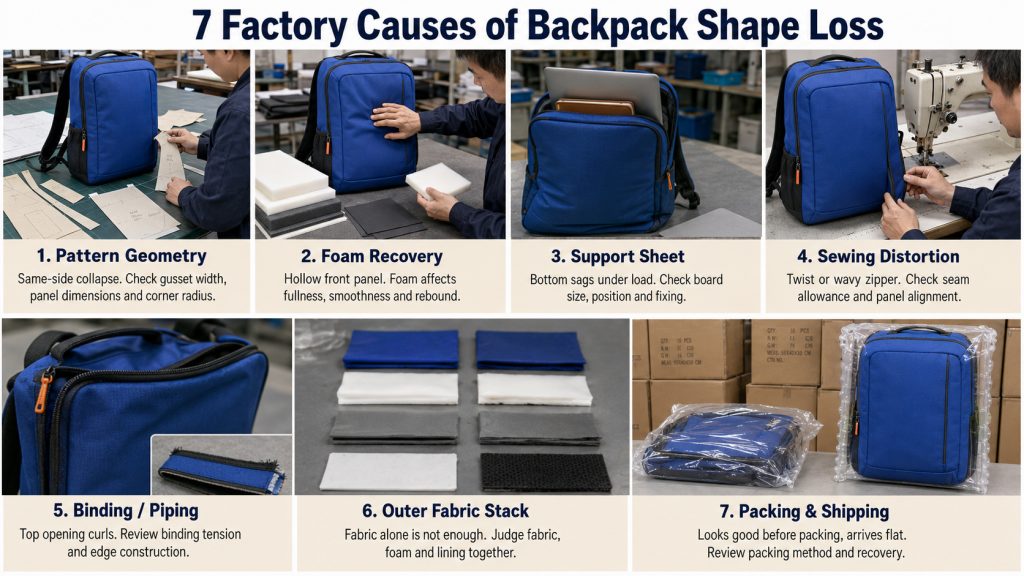
Most backpack shape problems can be traced back to seven areas: pattern geometry, foam, structural support, sewing, edge construction, outer fabric, and packing. More than one can be involved at the same time, so we first look at where the deformation starts before changing materials.
The important part is finding out where the deformation starts. A collapsed side panel and a sagging bottom may look like the same “soft bag” problem, but they usually need different fixes.
1. The Pattern Is Pulling the Bag Out of Shape
If the same side caves inward on every sample, we would check the pattern before changing the foam.
A gusset that is too narrow, a mismatched panel length, or an unsuitable corner radius can create tension after sewing. Harder foam may hide the problem slightly, but it cannot remove that tension.
What to check: gusset width, panel dimensions, corner shape and zipper-opening geometry.
2. The Foam Is Not Doing the Job You Need
Foam is probably the first material buyers think about when a backpack feels too soft.
Foam can make a panel fuller, smoother and more padded, but it does not automatically make the whole backpack structured.
What Does Foam Actually Do in a Backpack?
In conventional sewn backpacks, foam is commonly used to provide:
- Padding
- Local panel fullness
- Surface smoothness
- Hand feel
- Impact cushioning
- Shape recovery after light compression
It can contribute to the backpack’s silhouette, particularly when foam is laminated across larger front or side panels.
But foam alone normally cannot compensate for incorrect pattern geometry or replace a structural sheet where significant rigidity is required.
Where Does Foam Affect Backpack Shape Most?
| Area | Foam Mainly Helps With |
|---|---|
| Front | Fullness and surface smoothness |
| Side | Local silhouette |
| Back | Mainly comfort |
| Bottom | Cushioning rather than rigid support |
3. The Support Sheet Is Not Doing Its Job
If foam mainly manages local padding and fullness, structural sheets help stabilize larger areas.
Common Backpack Support Materials
| Material | Typical Character | Moisture Resistance | Common Application |
|---|---|---|---|
| PE sheet | Flexible to semi-rigid | Good | Back and bottom support |
| Solid PP sheet | Semi-rigid | Good | Structural panels |
| Corrugated PP sheet | Lightweight, directional structure | Good | Lightweight support applications |
| Greyboard/cardboard | Economical, rigid when dry | Poorer | Cost-sensitive dry-use construction |
| Foam-backed sheet | Combines cushioning and support | Depends on material | Comfort + structure |
| Technical frame sheet/stay | Higher structural function | Depends on system | Hiking/load-bearing backpacks |
The correct material is not necessarily the hardest material.
A PE or PP sheet can help stabilize the back or bottom, but simply adding a thicker board is not always the answer. If the board is too small or positioned too far from the area that is collapsing, the bag can still sag.
What to check: board material, dimensions, position and fixing method.
4. Sewing Is Distorting the Panels
A pattern can be correct on paper and still change during assembly.
Uneven seam allowances, zipper tension or material feeding can make one side tighter than the other. The result may be a twisted body, uneven corners or a wavy zipper line.
If only some bulk units show the problem, sewing consistency becomes one of the first things we investigate.
What to check: seam allowance, zipper installation, panel alignment and left/right symmetry.
5. Binding, Piping and Edge Construction Are Not Controlling the Outline
Binding and piping should help create a clean edge, but too much tension can do the opposite.
Tight binding can pull a seam inward, while piping can make an already distorted outline more obvious.
So if the top opening curls or the edge puckers, we do not automatically blame the foam.
What to check: binding tension, piping construction and the pattern around the affected edge.
6. The Outer Fabric Does Not Match the Structure
Heavier fabric does not always mean better shape retention.
A heavy but soft fabric can still sag, and it may compress weak foam underneath. A lighter laminated fabric can sometimes produce a cleaner panel because the complete material stack has more body.
This is why we judge the fabric, foam, lining and reinforcement together, not as separate materials.
What to check: fabric hand feel, backing or lamination, foam compatibility and panel construction.
7. The Bag Is Losing Shape During Packing and Shipping
This is one of the most overlooked causes of shape complaints. The backpack can pass final inspection and still look different when the customer opens the carton.
The problem appears after the bag has been folded, compressed in a polybag and stacked inside cartons for transport.
This is particularly important when the approved sample was displayed with stuffing inside but bulk production will be shipped flat.
Flat-Packed vs. Semi-Stuffed vs. Fully Stuffed
| Packing Method | Shipping Volume | Shape Protection | Best Fit |
|---|---|---|---|
| Flat-packed | Lowest | Lower | Cost-sensitive and soft-structure bags |
| Semi-stuffed | Medium | Medium | Bags requiring some silhouette protection |
| Fully stuffed / pre-shaped | Highest | Higher | Shape-critical retail presentation |
There is no universally “best” method.
What to check: folding method, carton pressure, foam recovery, fabric creasing and the backpack’s condition after unpacking.
How Much Structure Does Each Type of Backpack Need?
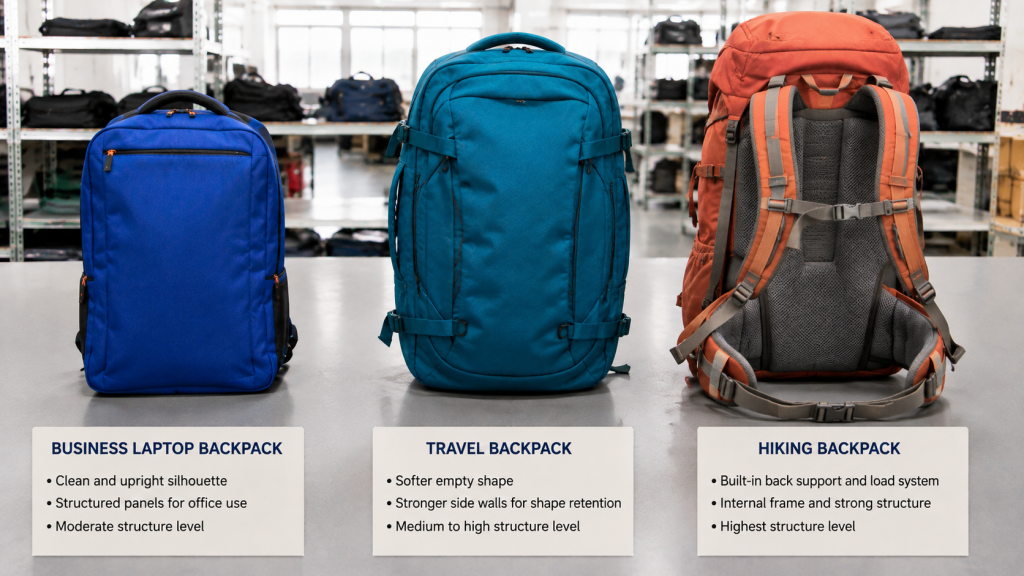
There is no “best” backpack structure without a use case.
| Backpack Type | Shape Priority | What Usually Matters Most |
|---|---|---|
| Business / laptop backpack | Clean empty and lightly loaded silhouette | Front panel, laptop area, base stability, zipper lines |
| Travel backpack | Stable shape under load | Side walls, opening geometry, load distribution, packing recovery |
| Hiking backpack | Performance under load | Back system, frame/support, attachment strength, load transfer |
| E-commerce backpack shipped flat | Recovery after unpacking | Foam recovery, crease resistance, support placement, packing |
| Packable / foldable backpack | Low weight and foldability | Minimal reinforcement and flexible construction |
This is why copying the foam or board specification from one backpack category into another rarely works well.
A hiking pack does not need to look like a rigid business case when empty. A packable daypack should not be filled with structural material just to make the product photo easier. And a business backpack intended to stand beside a desk needs a different conversation from both.
Why Can the Approved Sample Look Better Than Bulk Production?
This is one of the most frustrating backpack sourcing problems because the buyer can physically hold an approved sample and say: “This one is right. Why are these different?”
The answer is not always one dramatic mistake.
Often, it is the difference between sample-room conditions and production-line conditions.
Why Sample-Room Results Can Be Hard to Repeat in Bulk
Making one good sample proves that the design can be made. Bulk production has to prove that it can be made repeatedly.
A sample maker can spend extra time aligning a difficult corner or repositioning foam before closing the lining. A normal sewing line has to reproduce that construction consistently over hundreds or thousands of units.
That is why a design that is extremely sensitive to tiny variations can become difficult to control in bulk.
AQL Does Not Define What “Good Shape” Means
AQL is useful, but it is often misunderstood.
ISO 2859-1:2026 provides acceptance-sampling schemes indexed by AQL for lot-by-lot inspection.
It can help determine how a production lot is sampled and the accept/reject logic applied to the inspection.
It does not tell an inspector what your backpack is supposed to look like.
The buyer and factory still need to define that.
For a shape-sensitive backpack, we would rather have:
- An approved front view
- An approved side view
- An agreed empty or loaded condition
- A clear reference for symmetry
- An agreed packing/recovery condition
than a QC note that simply says:
“Shape must be good.”
AQL can help you sample the lot. It cannot turn “good shape” into an objective visual standard.
How Should Buyers Prevent Shape Problems Before Bulk Production?

You do not need to make every backpack more rigid.
You need to approve it in the same conditions that matter after production.
A practical review can be done in four stages.
Test 1: Check the Backpack Empty
Evaluate:
- Does the front panel collapse?
- Do both sides look symmetrical?
- Does the top opening curl?
- Does the bottom sit evenly?
- Is the bag supposed to stand by itself?
That last question matters.
Do not fail a soft packable backpack because it cannot stand like a business briefcase.
Test 2: Check the Backpack Under Its Intended Load
Use a load that resembles actual use.
For example:
Business Backpack: Possible evaluation contents:
- Laptop
- Charger
- Notebook
- Small accessories
For buyers comparing this type of construction, this professional business backpack shows the type of structured office-backpack category where silhouette and compartment stability are especially important.
Travel Backpack: Evaluate the backpack with a realistic clothing and accessory load.
Hiking Backpack:Evaluate structure under the intended load range and pay more attention to back-system behavior and load transfer than empty-bag aesthetics.
The purpose is not to fill the backpack until it looks good.
The purpose is to determine whether the structure works at the intended operating condition.
Test 3: Pack It the Way Production Will Be Packed
Do not test an artificially protected sample if bulk production will be flat-packed.
Use the intended:
- Folding method
- Polybag
- Filling material
- Carton orientation
- Carton quantity
Then evaluate what happens to shape.
Test 4: Inspect Recovery After Unpacking
After unpacking, look for:
- Persistent front-panel indentation
- Sharp fabric creases
- Side-wall collapse
- Board displacement
- Distorted piping
- Zipper waviness
- Uneven corners
The recovery period and acceptance criteria should be agreed according to the actual product and material combination.
Avoid inventing one universal number such as “every backpack must recover completely in 24 hours.”
There is no single recovery time that is technically correct for every backpack construction.
What Should Be Written Into the Backpack Specification?
A useful structural specification describes the result first and the material second.
Before final sample approval, we suggest confirming:
- Which panels need to retain shape?
- Is the shape judged empty, loaded, or both?
- What load will be used for evaluation?
- Does the bag need to stand upright?
- Has the pattern been checked before increasing reinforcement?
- Is the foam requirement about thickness, firmness, recovery, or all three?
- Does the back need a support sheet?
- Does the bottom need a board?
- Are board dimensions and placement defined?
- Are zipper lines and major edges visually stable?
- Are both sides reasonably symmetrical?
- Is the production packing method confirmed?
- Has a packed sample been checked after unpacking?
- Is there an approved front and side reference for QC?
The biggest improvement is often replacing a material instruction with a performance instruction.
Instead of:
“Use harder 5 mm foam.”
write what you are trying to achieve:
“The front panel should not visibly cave inward when the backpack is empty.”
Instead of:
“Use thick PE board on the bottom.”
define the problem:
“The base should not visibly sag under the agreed test load.”
Now the factory can decide whether the best answer is a different foam, a support sheet, a pattern change, a sewing adjustment—or no extra material at all.
Final Thoughts
A backpack that loses its shape does not always need thicker foam or a stiffer board. The real fix starts with finding where the deformation begins and when it appears.
Pattern, foam, support sheets, sewing, fabric and packing all play a role. The right solution is the one that gives the bag enough structure without adding unnecessary weight, cost or stiffness.
Have a Backpack Sample With a Shape Problem?
If your sample looks saggy, twisted or different from the approved design, send us a few photos together with the intended load and packing method.
We can help identify whether the first area to review is the pattern, foam, support board, sewing or packing before you spend another sampling round changing materials.
Discuss Your Backpack Project With Osgoodway →