Last Updated: July 14, 2026
I’ve spent 12 years building backpacks on the factory floor. Frame choice is not a styling decision. It changes the pattern, back panel, hip belt, hardware, assembly time, sample revisions, and how the finished pack behaves under load.
External and internal frame backpacks differ in where the support structure sits and how the load behaves. Internal frames keep weight close to the body and suit most hiking and travel use. External frames create more airflow and handle bulky, awkward loads better, but they are heavier, costlier, and more complex to build.
Our factory’s blunt view: internal frames win most modern projects. External frames only make sense when the user carries rigid, oversized, or externally mounted equipment. If a buyer cannot define the target carry weight, torso range, terrain, and gear shape before sampling, the frame decision is guesswork—and guesswork creates expensive revisions.
External vs. Internal Frame Backpacks: Quick Comparison

On our factory floor, the frame decision affects far more than carrying comfort. It changes the back-panel pattern, suspension geometry, hardware list, assembly steps, sample cost, and revision time.
| Feature | Internal Frame Backpack | External Frame Backpack |
|---|---|---|
| Frame position | Hidden inside the pack body | Separate chassis outside the pack body |
| Load position | Holds weight close to the wearer | Holds the bag away from the back |
| Movement | Follows the body more naturally | Feels more rigid |
| Terrain | Better for uneven trails, climbing, and general hiking | Better on open terrain with steady movement |
| Ventilation | Depends on the back-panel design | Excellent because of the large air gap |
| Bulky equipment | Best when most gear fits inside the pack | Easier to attach rigid or oversized gear |
| Travel use | Compact and easier to transport | Bulky for vehicles, airports, and storage |
| Production complexity | Medium to high | High |
| Typical applications | Hiking, trekking, travel, and most expedition packs | Hunting, field work, military-style loadouts, and specialized hauling |
Our Factory Verdict
For most hiking and travel projects, we build an internal frame. It gives the buyer more control over fit, balance, appearance, and packing efficiency.
We only recommend an external frame when the product brief clearly requires:
- Large airflow behind the back
- Modular external attachment
- Rigid or unusually shaped equipment
- A replaceable pack body mounted on a separate chassis
Production reality: An external frame is not automatically “stronger.” A poorly designed chassis, weak hip-belt connection, or badly positioned shoulder harness can turn an expensive frame into dead weight.
What Is an Internal Frame Backpack and How Does It Work?
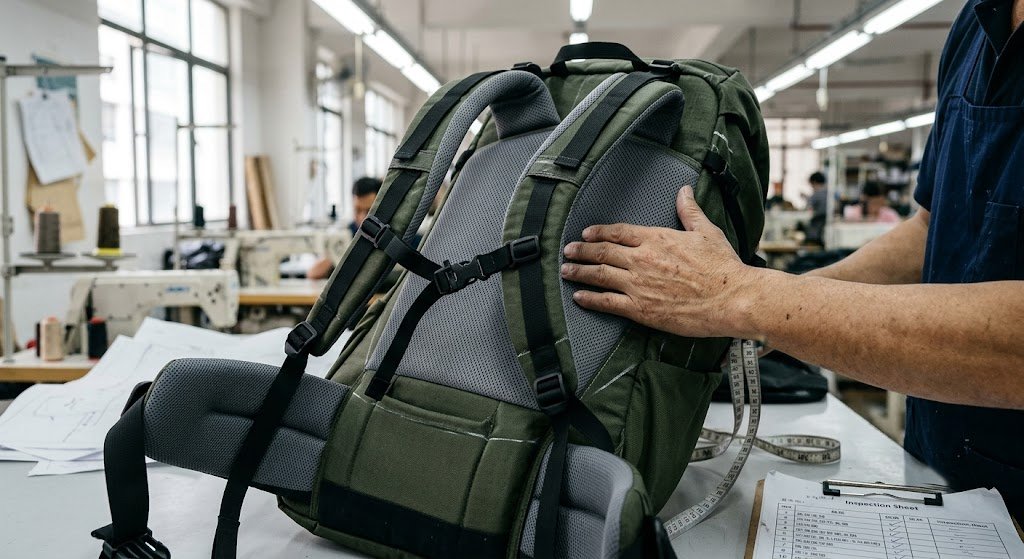
Your customers want a backpack that looks sleek and feels comfortable for travel or hiking. A bulky, awkward design just won’t cut it. The internal frame offers a modern, body-hugging solution.
An internal frame backpack has its support structure, like HDPE sheet or a aluminum stays, built directly into the pack’s body. This design keeps the load close to your back, improving balance and making movement feel more natural.
The hidden frame keeps the load close to the wearer, improving stability and natural movement on uneven terrain. In our factory, this is the starting point for most modern hiking, trekking, travel, and many expedition backpacks.
Internal frames look cleaner than external frames, but they are not automatically easier to build. The torso length, frame shape, hip-belt position, and load-lifter angle must work together. Get one of those wrong, and the frame becomes extra weight instead of useful support.
The Anatomy of an Internal Frame
The support system normally uses two main components.
First, the stays are one or two flat aluminum bars running vertically through the back panel. They may be shaped to follow the wearer’s back and control how much the pack flexes.
Second, the frame sheet is a thin, semi-rigid plastic panel. It adds structure, spreads pressure across the back panel, and prevents hard objects inside the backpack from pressing directly against the wearer.
Some heavier packs combine both components with a peripheral frame or cross-stay for additional support.
How It Distributes Weight
The frame works together with the shoulder straps, load lifters, back panel, and hip belt. It stabilizes the contents, pulls the upper pack closer to the body, and directs part of the load toward the hips.
This close-to-body position is why internal frame backpacks generally perform well on rocky trails, steep climbs, and situations requiring balance.
Internal frames are not limited to lightweight packs. Full internal-frame systems are also widely used in multi-day trekking and expedition backpacks.
Factory note: Before we build an internal-frame sample, we confirm the expected carry weight and target torso-length range. Without those two inputs, the frame, hip belt, and load-lifter geometry are mostly guesswork.
What Is an External Frame Backpack and How Does It Work?
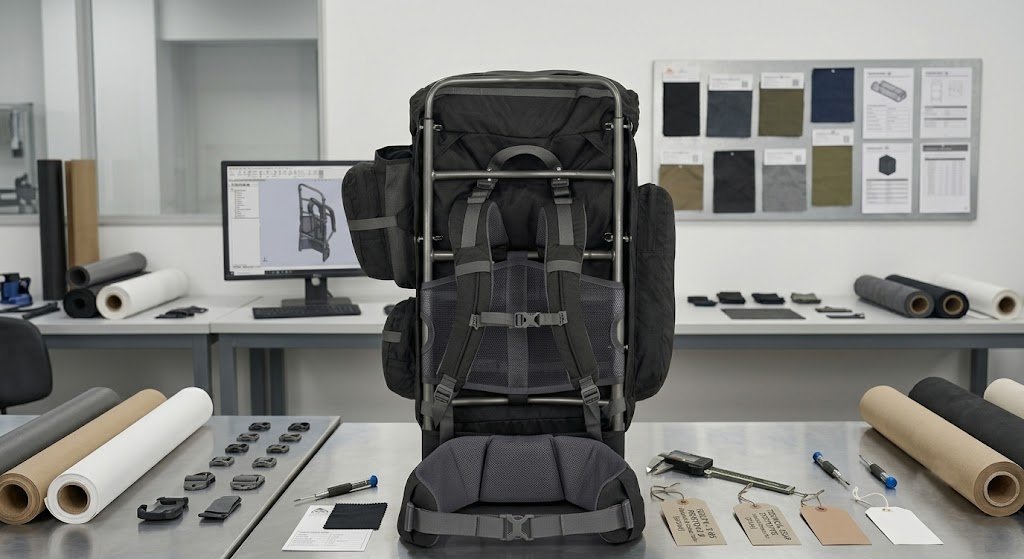
An external frame backpack has a visible, rigid structure, usually made of aluminum tubing, that the pack bag and suspension system attach to. This creates a gap between the pack and your back, offering excellent ventilationand multiple points for lashing on extra gear.
Most external frames use aluminum tubing, reinforced plastic, or a composite structure. The gap between the frame and the wearer’s back creates strong airflow. The rigid chassis also gives users more freedom to strap bulky, rigid, or unusually shaped equipment outside the pack.
How an External Frame Carries the Load
The pack body transfers weight into the rigid chassis. The chassis then connects the load to the shoulder harness and hip belt.
Because the frame does not flex closely with the body, an external frame feels more rigid than an internal frame. It works best during steady movement on open terrain. It is less comfortable when scrambling, climbing, or moving through narrow spaces.
External frames are now a specialized option rather than the mainstream choice. Our factory mainly sees them in:
- Hunting and field-work packs
- Military-style loadout systems
- Equipment carriers
- Modular expedition packs
- Products carrying rigid or oversized gear
Why External Frames Cost More to Build
An external-frame project requires more than sewing a bag onto metal tubing. We must develop and source the chassis, attachment hardware, harness, hip belt, and pack body as one system.
The extra assembly steps increase:
- Sampling time
- Hardware cost
- Packaging volume
- Shipping weight
- Revision risk
Factory note: An external frame is not automatically stronger than an internal frame. If the chassis geometry, hip-belt connection, or harness position is wrong, the user gets more weight, more cost, and no real carrying advantage.
We only recommend an external frame when ventilation, modular attachment, or bulky equipment is a core product requirement—not because it looks more “heavy-duty.”
Frame type is only one way to classify a hiking backpack. See our guide to hiking backpack categories for day, overnight, trekking, and expedition pack definitions.
What Are the Key Differences Between Internal and External Frames?
The differences between the two frame types can seem minor at first. But choosing the wrong one for your product line can lead to poor customer feedback and weak sales. Let’s put them head-to-head to make the choice clear.
The key differences are in fit, load management, and versatility. Internal frames provide a snug, body-hugging fit for better balance. External frames prioritize raw carrying capacity and ventilation with a more rigid, upright structure.
Fit and Movement
An internal frame holds the load close to the body. It follows the wearer better on steep, narrow, or uneven trails.
An external frame is more rigid. The pack sits farther from the back, so it feels less agile but more stable during steady movement on open terrain.
Ventilation
External frames win here. The rigid chassis creates a real air gap behind the wearer.
Internal frames depend on foam channels, spacer mesh, or a suspended back panel. Good designs ventilate well, but cheap mesh alone does very little.
Gear Shape and Attachment
Internal-frame packs work best when most equipment fits inside the bag.
External frames make more sense for rigid, oversized, or awkward gear that must be strapped to a chassis.
Production Complexity
Internal frames usually involve stays, a frame sheet, load lifters, and a structured hip belt.
External frames require a separate chassis, mounting hardware, additional assembly, and larger packaging. That means more sourcing friction and more expensive revisions.
Our factory verdict: Internal frames are the right choice for most hiking, trekking, travel, and many expedition packs. External frames belong in specialized projects where airflow, modular attachment, or bulky equipment is the actual requirement.
Which Backpack Frame Is Better for Hiking, Camping, or Travel?
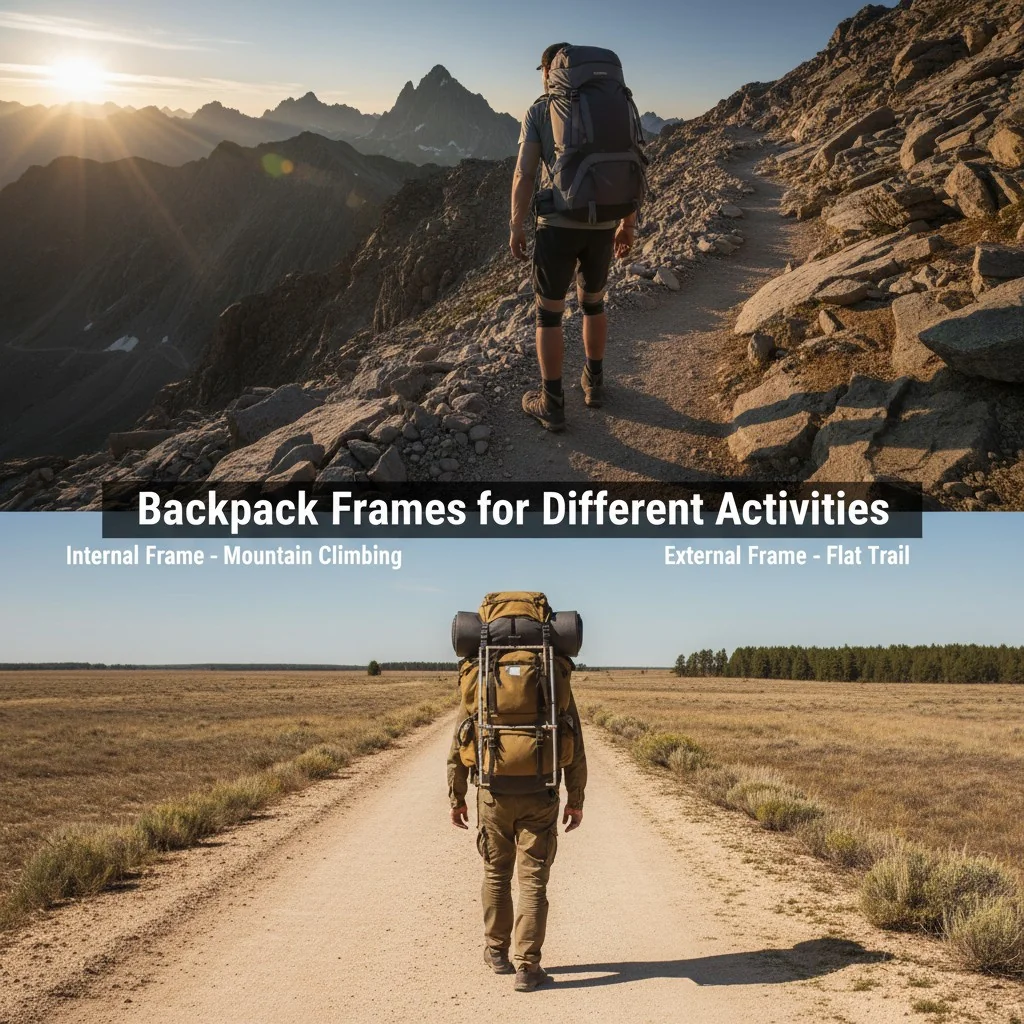
For most hiking, camping, and travel use, we choose an internal frame backpack. It keeps the load close, moves better on uneven terrain, and packs more cleanly. We only recommend an external frame when airflow, modular attachment, or bulky, rigid equipment matters more than compact handling.
That is how we decide on the factory floor. We do not choose a frame because one option sounds more “heavy-duty.” We choose it around the terrain, gear shape, target load, and how the user actually moves.
| Use Case | Our Default Choice | Why |
|---|---|---|
| Day hiking | Internal frame or frameless | Light, compact, and easy to move with |
| Multi-day trekking | Internal frame | Better balance on uneven terrain |
| General camping | Internal frame | Gear packs efficiently inside the bag |
| Expedition backpack | Heavy-duty internal frame | Handles substantial loads without a bulky chassis |
| Hunting or field work | External frame may make sense | Easier to attach rigid or awkward equipment |
| Airline and train travel | Internal frame | Cleaner profile and easier handling |
| Hot, open terrain with bulky gear | External frame may help | Strong airflow and modular attachment |
Hiking and Trekking
We build internal frames for most trail projects. The pack sits close to the body. It moves better on rocks, steep climbs, and narrow trails.
A larger capacity does not automatically mean the bag needs an external frame. Many modern trekking and expedition packs use full internal-frame systems with aluminum stays, a structured hip belt, and adjustable torso length.
Camping and Specialized Loads
For normal tents, clothing, food, and sleeping gear, an internal frame remains the practical choice.
We consider an external frame when the user must carry items that do not pack neatly inside a bag—field equipment, rigid cases, hunting loads, or modular gear attached directly to a chassis.
Travel
For travel, internal frames win. Full stop.
They are easier to store, easier to move through airports, and less likely to catch on seats, luggage racks, and vehicle doors. An external frame only makes sense when the trip is built around specialized equipment rather than normal passenger travel.
Factory reality: Choose the frame around the gear shape and terrain—not around a marketing claim such as “heavy-duty” or “expedition.”
For OEM frame specifications, construction risks, and sample checks, read our guide to the most important hiking backpack features.

How Do Comfort, Weight, and Load Distribution Compare?
Comfort is the most important factor for your customers. An uncomfortable backpack gets returned, gets bad reviews, and damages your brand’s reputation. Let’s dig into how each frame type truly affects the wearer’s experience.
Internal frames generally offer better comfort by moving with your body, while external frames provide excellent ventilation. For load distribution, internal frames create a lower center of gravity for agility, whereas external frames carry weight higher and more rigidly.
In our factory, we do not judge comfort by adding thicker foam. That is the lazy fix. A poorly positioned hip belt or wrong torso length will ruin an expensive suspension system.
| Factor | Internal Frame | External Frame |
|---|---|---|
| Body contact | Close and body-hugging | Held away from the back |
| Movement | Better for twisting, climbing, and uneven ground | Better for steady walking |
| Ventilation | Depends on channels or suspended mesh | Strong airflow from the frame gap |
| Pack weight | Usually more compact | Chassis and hardware add bulk |
| Load control | Keeps packed gear close to the wearer | Works well with rigid or externally attached gear |
What We Check During Sampling
We load the sample, adjust it to the target torso range, and walk with it. Then we check:
- Does the hip belt sit on the hips?
- Do the load lifters pull at a useful angle?
- Does the pack sway during turns?
- Does the frame create pressure points?
- Does the harness still work when the bag is fully loaded?
A well-fitted internal frame usually beats a badly engineered external frame—and the reverse is also true. The frame does not distribute the load by itself. The harness, hip belt, torso fit, and packing layout do the real work.
How to Choose Between Internal and External Frame Backpacks
We choose an internal frame for most hiking, trekking, travel, and expedition packs because it keeps the load close and moves better on uneven ground. We choose an external frame only when the user needs maximum airflow, modular attachment, or must carry rigid, bulky equipment outside the bag.
This is the same decision process we use before opening a new sample order.
| Ask This First | Choose an Internal Frame When… | Consider an External Frame When… |
|---|---|---|
| What will the user carry? | Most gear fits inside the pack | The load is rigid, oversized, or awkward |
| Where will they move? | Trails are steep, narrow, rocky, or technical | Movement is steady and terrain is open |
| How will they travel? | The pack must fit vehicles, airports, or storage spaces | Compact handling is not a priority |
| What matters most? | Balance, movement, and versatility | Airflow and external attachment |
| How complex can the product be? | Medium–high development complexity is acceptable | The budget supports a separate chassis and extra hardware |
How We Make the Final Call
Before sampling, our factory confirms four things:
- Target carry weight
- Torso-length range
- Terrain and movement
- Shape of the equipment
If the buyer only says “heavy-duty hiking backpack,” we stop the discussion there. That phrase tells us nothing.
Do not choose an external frame just because it looks tougher. For most projects, a properly fitted internal frame gives better balance, cleaner packing, and fewer production headaches.
Final Words
For most hiking, trekking, travel, and expedition backpacks, our factory starts with an internal frame. It is easier to fit, easier to pack, and easier to control on uneven ground.
We only move to an external frame when the product must carry rigid, oversized, or externally mounted equipment. The extra chassis, hardware, assembly, and shipping volume must earn their cost.
The frame is not the whole suspension system. Torso length, hip-belt position, load lifters, back-panel geometry, and packing layout decide whether the backpack works.
Developing a Custom Frame Backpack?
Send us:
- Target capacity and carry weight
- User torso-length range
- Intended terrain and use
- Internal or external frame preference
- Target quantity and price level
Our factory can review the structure, recommend the frame system, and flag costly design problems before sampling.
Contact Osgoodway to discuss your custom hiking backpack project.

Frequently Asked Questions
Is an internal or external frame backpack better?
For most people today, an internal frame backpack is better. It’s more versatile, more comfortable on varied terrain, and has a streamlined design suitable for both hiking and travel. External frames are only better for the specific niche of carrying very heavy, bulky loads.
Why are external frame backpacks less common today?
They are less common because internal frame technology has improved so much. Modern internal frame packs can now handle fairly heavy loads while offering far superior balance, comfort, and freedom of movement, which is what most consumers want.
Do external frame backpacks carry more weight?
Yes, generally they are designed to carry more weight. Their rigid structure and ability to lash gear externally make them the preferred choice for loads exceeding 50-60 pounds, which is often the upper limit for even heavy-duty internal frame packs.
What’s best for beginners: internal or external frame?
An internal frame backpack is almost always the best choice for a beginner. They are easier to pack, more stable to wear, and more forgiving on different types of trails. Their versatility means a beginner can use the same pack for a day hike, a weekend camping trip, or as a travel bag.
Are external frame backpacks better for heavy loads?
Yes. This is their primary advantage. If your main goal is to carry the heaviest possible load (over 50 lbs) as comfortably as possible on a relatively even trail, an external frame backpack is often the superior choice due to its rigid load transfer and ventilation.