Updated September 2026 | Reviewed from a backpack manufacturing perspective
Yes. Oxford fabric can be a good choice for backpacks, duffel bags, totes and organizers when its yarn, weave, coating and construction suit the intended use. It offers a textured appearance and is available in specifications ranging from lightweight fabrics to heavier luggage materials.
Oxford describes a weave or fabric construction, while polyester and nylon describe fibers. A bag can therefore be made from polyester Oxford or nylon Oxford. “Oxford vs polyester” is not a comparison between two separate materials.
For a daily backpack, a suitable 600D polyester Oxford is a practical candidate to evaluate. A lightweight packable bag or a heavily loaded tool bag may need a different construction. The word “Oxford” alone does not establish strength, waterproofing or quality.
What Exactly Is Oxford Fabric In the Bag Industry?
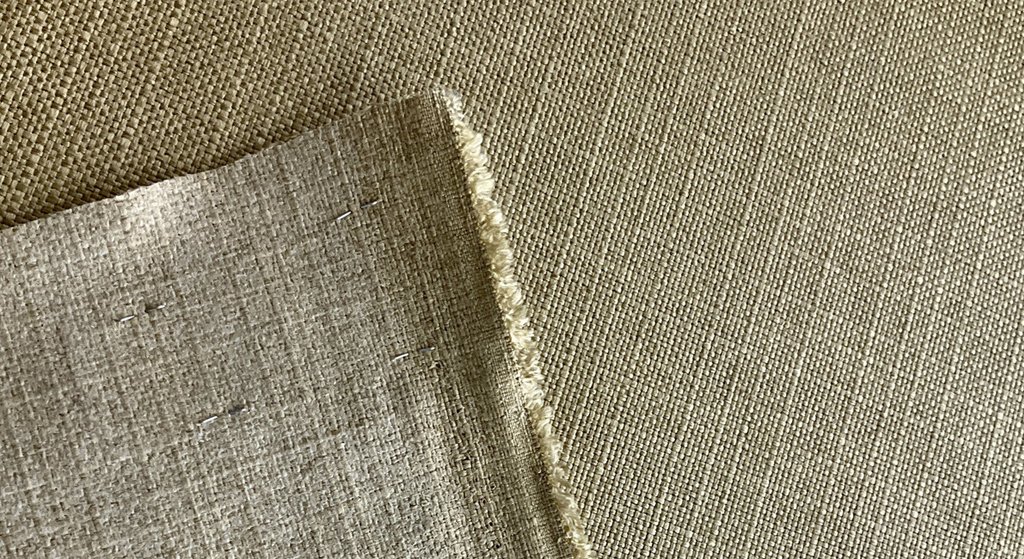
Most procurement managers I talk to think "Oxford" is a specific fiber like Nylon or Cotton. It’s not. In our factory, when we say "Oxford," we are talking about the geometry of the weave, not the chemistry of the yarn.
Oxford fabric is associated with basket or modified basket weaves, which create a characteristic woven texture. Bag suppliers also use “Oxford” as a broad commercial description, so the name should not replace a detailed material specification.
Polyester and nylon are common fibers in synthetic Oxford bag fabrics. Cotton Oxford also exists, particularly in apparel, but a cotton shirting fabric should not be assumed to perform like a coated synthetic bag fabric.
What makes Oxford the "Factory Favorite"?
- Abrasion Armor: The "basket" pattern prevents minor scuffs from turning into major rips.
- Structural Memory: It holds the bag’s shape even when empty—no "sad, saggy bag" syndrome on the retail shelf.
- Coating Adhesion: The textured back gives our PU (Polyurethane) coatings more surface area to grip, significantly reducing the risk of delamination.
- Water Resistance: When we pair it with a 0.5mm PU coating, it’s practically a shield.
- Aesthetic "Heft": It looks expensive. A 600D Oxford bag always fetches a higher retail price than a 600D plain polyester one.
Separate these parts of a fabric description:
| Specification | What it tells you | What it does not tell you |
|---|---|---|
| Polyester or nylon | Fiber composition | Finished fabric strength or water resistance |
| Oxford | Weave or commercial fabric construction | A guaranteed performance grade |
| 600D, 900D or 1680D | Yarn linear density | Finished fabric weight, weave density or lifespan |
| PU coating or PVC backing | Type of applied layer | Its thickness, adhesion, aging performance or chemical compliance |
| Finished weight in g/m² | Mass per unit area of the supplied fabric | How much of that weight comes from yarn versus coating |
For example, “600D polyester Oxford with PU coating” is a useful starting description. It still leaves the fabric density, finished weight, coating specification and required performance to be confirmed.
Is Oxford Fabric Better Than Standard Polyester?
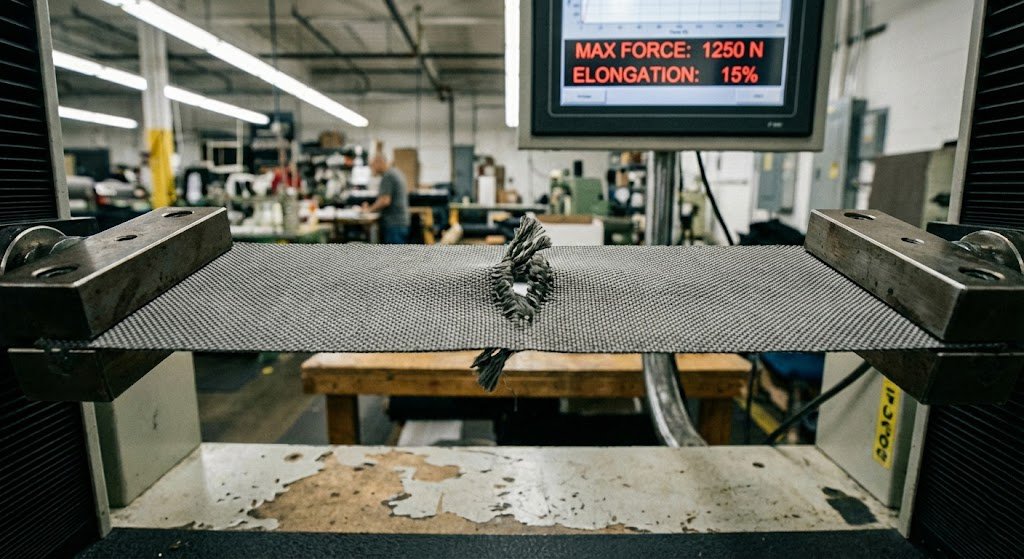
Oxford fabric is not automatically better than standard polyester because the two terms describe different things: polyester is a fiber, while Oxford refers to a weave construction. In most bag projects, the actual comparison is between polyester Oxford fabric and plain-weave polyester fabric.
Polyester Oxford often has a more textured appearance and a stable construction, making it a common choice for backpacks, travel bags, tool bags and other products exposed to regular wear. However, the word “Oxford” alone does not guarantee greater strength, water resistance or durability.
Two fabrics both described as 600D polyester can perform very differently depending on:
- Yarn quality and construction
- Fabric weight in GSM
- Weave density
- PU, PVC or other backing
- Coating thickness and adhesion
- Tear and abrasion test results
- Finishing treatment
- Recycled or virgin material content
Oxford Polyester vs Plain-Weave Polyester
| Comparison point | Polyester Oxford | Plain-weave polyester |
|---|---|---|
| Weave construction | Basket or modified basket weave | Conventional one-over-one plain weave |
| Appearance | Usually more visibly textured | Usually flatter and more uniform |
| Hand feel | Depends on yarn, density, coating and finish | Depends on yarn, density, coating and finish |
| Tear resistance | Can perform well with suitable yarn and weave density | Can also perform well when densely woven and correctly specified |
| Abrasion resistance | Depends on the complete fabric specification | Depends on the complete fabric specification |
| Water resistance | Mainly determined by coating, lamination and finished-bag construction | Also mainly determined by coating, lamination and construction |
| Breathability | Usually limited when PU- or PVC-coated | Also limited when coated |
| Cost | May cost more when heavier, denser or more highly finished | May be lower or higher depending on the actual specification |
| Typical bag applications | Backpacks, travel bags, tool bags and outdoor gear | Drawstring bags, shopping bags, linings and lightweight packs |
Does Oxford Fabric Have Better Tear Strength?
Oxford polyester may provide good tear strength and dimensional stability, but it should not be confused with ripstop fabric. Ripstop contains visible reinforcement yarns designed specifically to help limit the spread of a tear. An Oxford weave does not automatically provide the same tear-stopping function.
We therefore do not approve a bag fabric based only on the terms “Oxford” or “600D.” For load-bearing products, we compare actual samples and review the fabric weight, yarn construction, weave density, coating and relevant test results.
Where tear resistance is critical, testing can be carried out using an applicable method such as ISO 13937-2, with both proposed fabrics tested under the same conditions.
Factory sourcing tip: Do not write only “600D Oxford polyester” on the purchase order. Confirm the approved fabric swatch, color, GSM, yarn construction, weave density, coating type and performance requirements. Two suppliers can use the same fabric name while supplying noticeably different materials.
Ultimately, a well-specified polyester Oxford fabric may be more suitable for demanding bags, but it is not universally superior to plain-weave polyester. The correct decision should be based on the complete material specification and the performance required from the finished bag.
If you are choosing between polyester Oxford and nylon Oxford, our guide to nylon vs polyester for backpacks explores the fiber differences to consider alongside the finished fabric specification.
What Denier Is Right for Your Bag: 210D, 420D, 600D or 1680D?
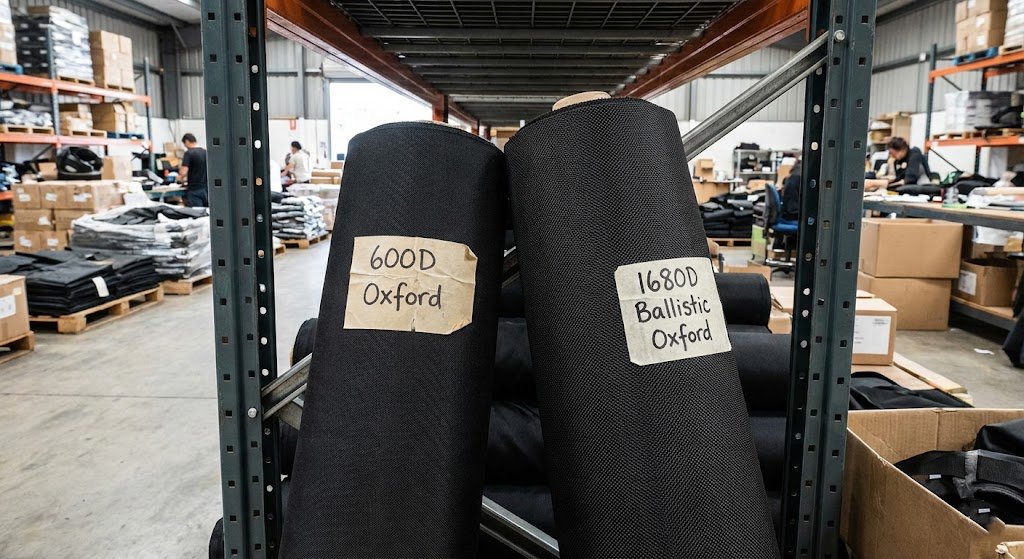
Denier measures yarn linear density: one denier equals one gram per 9,000 meters of yarn. It does not measure fabric density, coating thickness or finished bag strength.
Higher-denier yarn is heavier per unit length, but a higher number does not automatically mean a heavier or more durable finished fabric. The weave and backing also matter.
Use the following as starting points for sample selection, not universal performance ratings.
| Fabric description | Applications to evaluate | Main development check |
|---|---|---|
| 210D Oxford | Linings, lightweight pouches and selected packable bag shells | Seam behavior, tear resistance and support at loaded attachments |
| 420D Oxford | Lightweight backpacks, organizers and bag shells | Balance of weight, durability and coating performance |
| 600D Oxford | Daily backpacks, school bags, gym bags and duffels | Actual density, backing, hand-feel and finished weight |
| 900D–1200D Oxford | Structured bags or panels requiring a heavier texture | Whether added weight and stiffness benefit the product |
| 1680D Oxford | Luggage, tool bags and selected reinforcement panels | Thickness at folded seams, corner construction and sewing access |
Is 1680D Oxford better than 600D?
Not necessarily. A suitable 1680D fabric may provide the texture or wear performance needed for a luggage panel, while being unnecessarily bulky for a small curved pocket.
At a bound edge, several layers of fabric, lining, webbing and binding may meet. A heavier shell can make that junction harder to feed and finish neatly. Review a representative corner or attachment sample before approving it across the entire bag.
Likewise, do not reject every 210D fabric as unsuitable for an outer shell. Some lightweight bags use lower-denier fabrics successfully, with material selection and reinforcement matched to the intended load.
Why can two 600D Oxford fabrics feel so different?
They may differ in yarn construction, weave density, finishing or backing weight. A thick backing can make a fabric feel substantial without proving that the woven base has better tear or seam performance.
Compare the finished weight and backing specification alongside the fabric itself. Hand-feel is useful for appearance approval, but it is not a strength test.
How Do PU Coatings and PVC Backings Affect Oxford Bags?
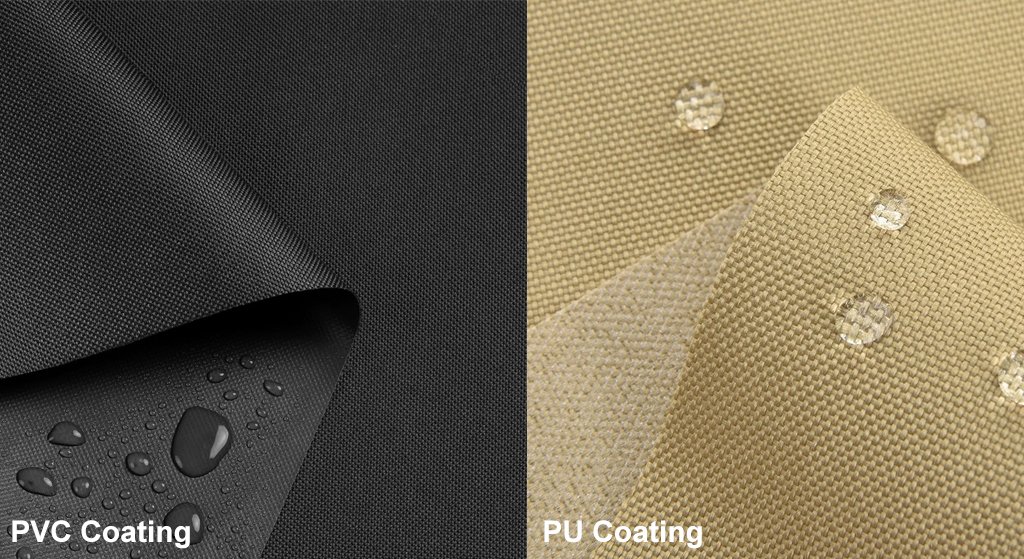
The fabric on the roll isn’t just fabric. It has a chemical backing glue applied to the back. This is what makes the bag waterproof and gives it shape. Without it, Oxford fabric is just a limp rag.
The coating or backing changes how an Oxford fabric handles, resists water penetration and behaves during sewing. Its effect depends on the formulation and amount applied.
| Option | Potential reason to consider it | What to verify |
|---|---|---|
| PU-coated Oxford | A construction that provides the required barrier and flexibility | Coating coverage, adhesion, aging behavior and finished weight |
| PVC-backed Oxford | A construction offering the required body, surface or barrier properties | Backing weight, flexibility at the intended temperature, adhesion and restricted substances |
| Water-repellent face finish | Reduced wetting of the outer surface | Initial repellency and retention after relevant wear or cleaning |
A water-repellent finish and a waterproof backing serve different purposes. Water forming droplets on the face does not prove that the material—or the finished bag—will prevent leakage.
Is Oxford fabric waterproof?
The Oxford weave itself does not guarantee waterproofing. A coated fabric may resist water penetration, but seams, zipper openings and attachment points can still admit water.
For a commuter bag, specify the expected rain exposure. For a bag intended for more demanding water protection, evaluate the closure and seam system as well as the fabric.
Ask for the applicable fabric water-penetration test and a finished-bag check suited to the intended use. Do not turn a fabric test result into an immersion claim for the whole product.
Is PU safer than PVC?
Neither “PU” nor “PVC” is proof of chemical compliance. The formulation, additives, colors and applicable requirements matter. Odor alone cannot establish whether a material passes a restricted-substance requirement.
Provide the destination market and product requirements before material approval. Request documentation or testing that covers the proposed material rather than assuming one coating type automatically passes.
If an OEKO-TEX STANDARD 100 certificate is supplied, verify the covered article and certificate scope. A certificate for one fabric does not automatically cover the finished bag.
If your project also involves TPU-coated or laminated Oxford fabric, see our comparison of TPU vs PU coatings for bags for material selection, seam construction and testing considerations.
Why Does Some Oxford Fabric Peel?
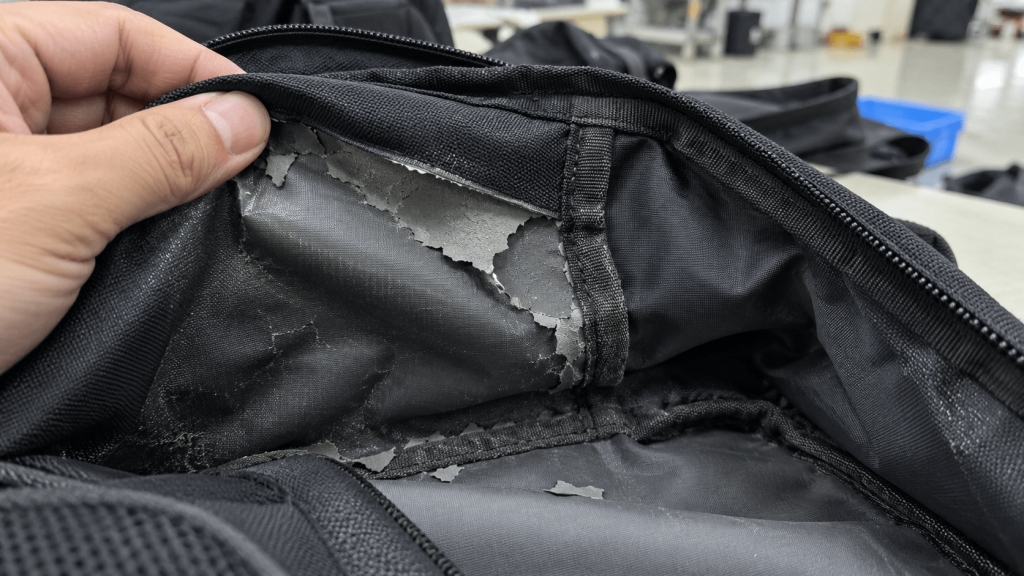
When an Oxford bag flakes or becomes sticky inside, the problem may involve its coating, backing or a bonded layer rather than the woven face. It is the "dirty secret" of budget bag manufacturing.
Oxford fabric itself does not peel; the backing does. If a bag is "peeling" inside, it is a sign of low-quality recycled PVC coating degrading due to hydrolysis or UV exposure, not a failure of the polyester Oxford weave itself.
I remember a German client who moved their production to a "cheaper" shop. Six months later, they came back because their bags were delaminating in the winter. The other factory used a low-grade PVC backing. At our facility, we use a REACH-compliant PU or a cold-resistant PVC that stays flexible down to -20°C.
What Causes Oxford Fabric Coatings to Peel?
Possible causes include:
- Loss of adhesion between the backing and face fabric
- Repeated bending or abrasion at folds and contact points
- Hydrolysis of susceptible polyurethane formulations
- Unsuitable cleaning, prolonged heat exposure or other aging conditions
PVC-backed materials can also crack or change with age. However, peeling alone does not confirm that the backing is PVC—or prove that recycled material caused the failure.
How Can Buyers Investigate and Prevent Peeling?
For a production investigation, first identify the exact material article and affected batch. Then examine where and how the damage occurs. Broad tackiness, peeling along a fold and localized surface rubbing may indicate different causes.
For new orders, agree on tests relevant to the product’s intended use and environment. These may include:
- Coating or backing adhesion
- Repeated flexing
- Heat-and-humidity aging
- Abrasion resistance
- Low-temperature performance
The acceptance criteria should define what must remain satisfactory after testing. Accelerated aging results should not be converted directly into a guaranteed number of service years.
Scratching, flexing and holding a swatch up to the light can help identify questions during an initial material review. However, these checks cannot authenticate the fiber composition, establish chemical safety or replace appropriate laboratory testing.
How to Specify Oxford Fabric for a Custom Bag Order?
A complete material description reduces ambiguity between quotation, sampling and bulk production.
| Item to confirm | Information to include |
|---|---|
| Intended use | Bag type, expected contents, carrying load and use environment |
| Base fabric | Fiber composition, supplier article and weave description |
| Yarn specification | Denier and relevant warp/weft details |
| Finished construction | Fabric weight, usable width, coating or backing and coated side |
| Appearance | Color reference, texture, hand-feel and logo method |
| Performance | Relevant tests, conditioning and acceptance criteria |
| Purchasing | Quantity per color, material availability and any custom-color minimum |
| Approval | Approved swatch, sample reference and procedure for substitutions |
Compare cost per bag, not only cost per meter
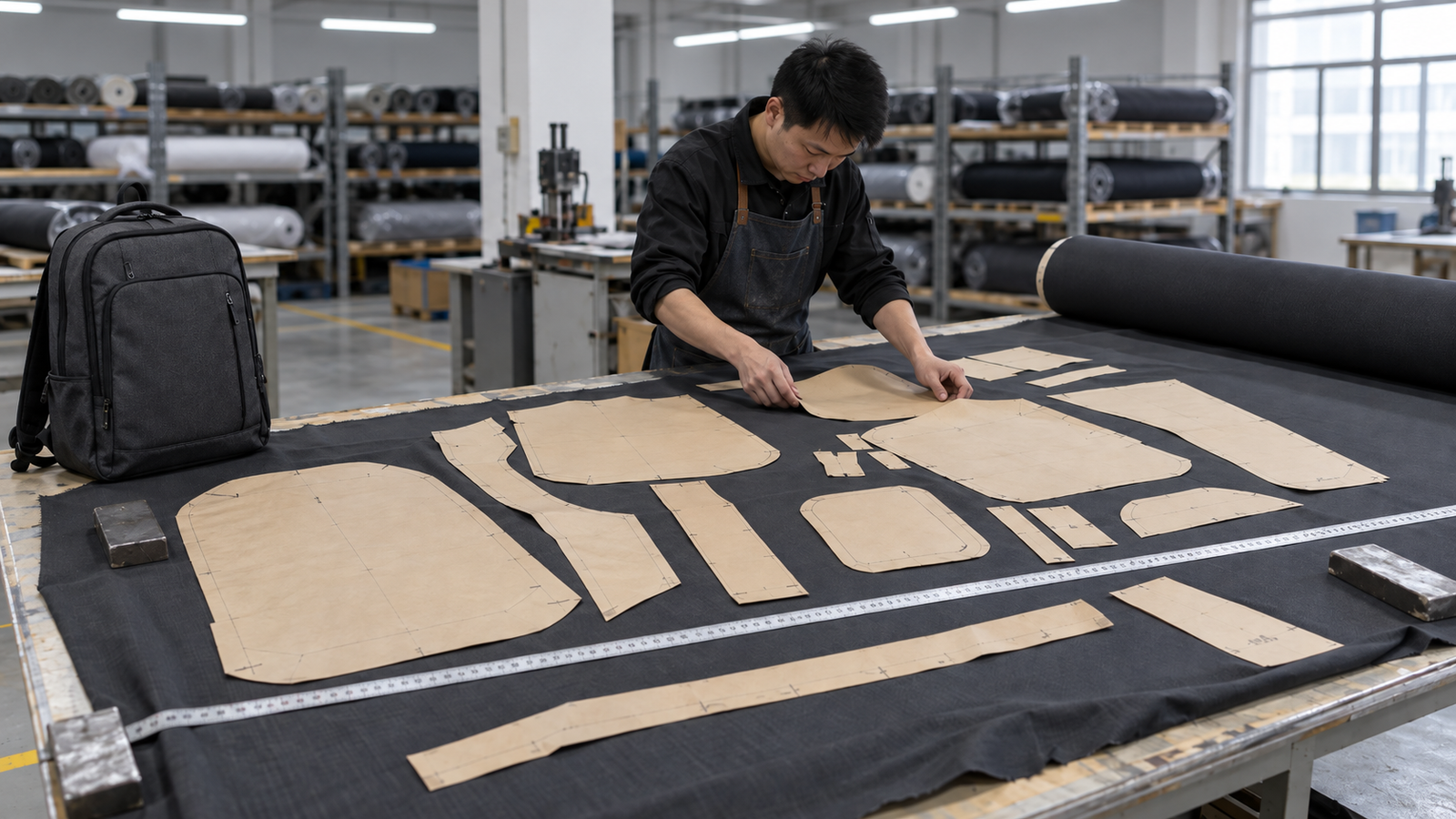
Usable width and pattern layout affect fabric consumption. A lower-priced fabric can require more material per bag or introduce a separate color minimum.
Using a heavier fabric only at the base may be worth evaluating, but adding a second material also adds sourcing and assembly considerations. Confirm that the reinforcement addresses the wear or load problem and that the total saving remains worthwhile.
For a broader purchasing discussion, see our guide to balancing quality and cost when sourcing backpacks.
Approve the material in a representative sample
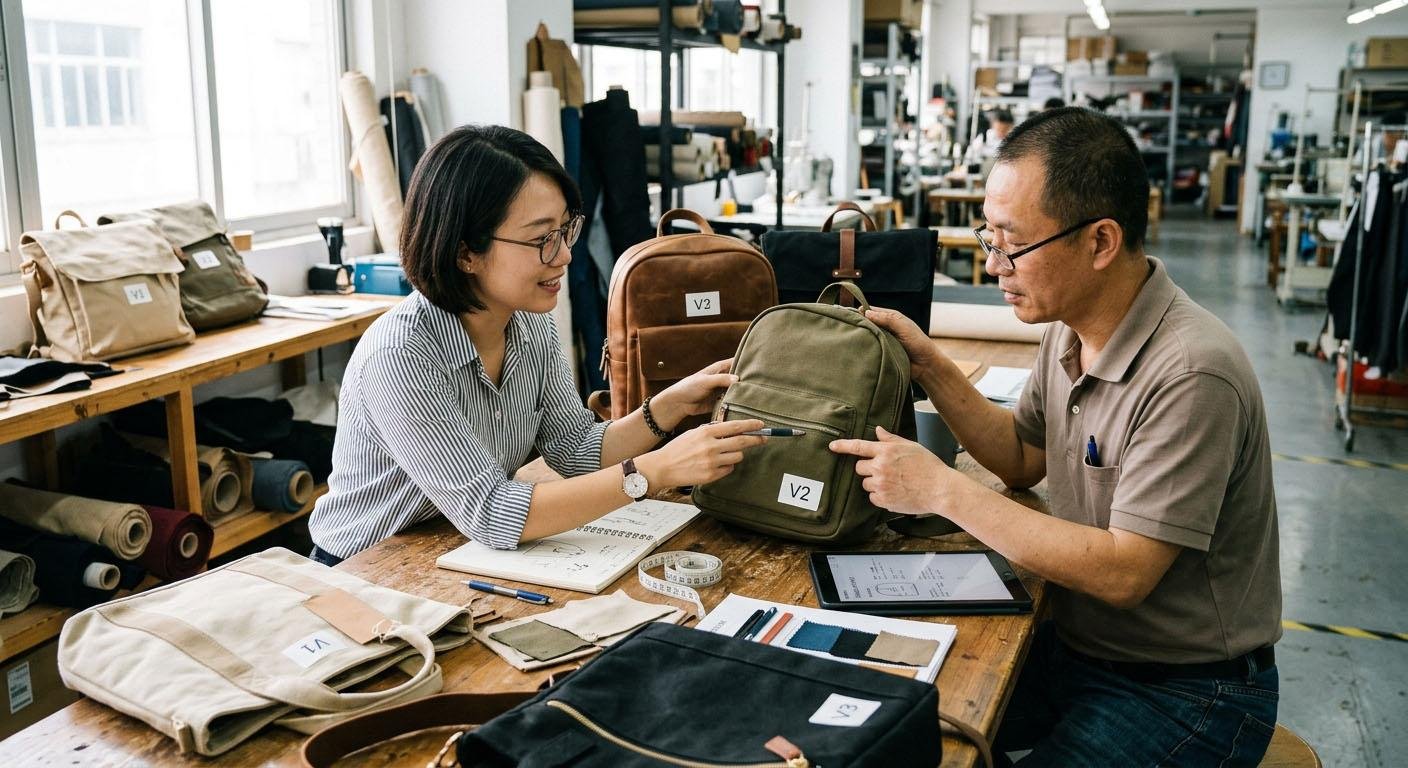
A flat swatch cannot show how the fabric behaves around a zipper curve, gathered opening or thick strap attachment.
Use the proposed production material for relevant sample checks. If a temporary substitute is used during early development, record the difference and approve the actual material before bulk production.
For repeat orders, keep the approved supplier article and swatch reference. A replacement described only as “the same 600D Oxford” may still differ in backing, feel or performance.
Frequently Asked Questions
Can Oxford fabric be used for drawstring bags?
Yes, provided the fabric is flexible enough for the opening and suitable for the intended contents. A heavy backing can make gathering difficult or leave a bulky opening. Test the drawcord channel and lower attachment points on the assembled sample.
Can you print a logo on Oxford fabric?
Often, yes. Screen printing and transfers are options to evaluate, but texture, surface finishes and heat sensitivity affect the result. Approve the actual artwork on the selected fabric, including fine text, adhesion and any effect on the backing. Denier alone does not determine print quality.
How should an Oxford fabric bag be cleaned?
Follow the finished bag’s care instructions. Coatings, foam, boards and trims may limit washing even when the outer textile tolerates it. For routine cleaning, gentle spot cleaning with mild soap may be suitable; test an inconspicuous area and dry thoroughly. Avoid assuming all Oxford bags can—or cannot—be machine washed.
Choosing Oxford Fabric for Your Bag Project
Oxford can be a practical bag fabric, but a useful specification goes beyond its name. Choose the fiber, yarn, backing and construction together, then confirm the result in a sample that reflects the intended use.
For a planned OEM/ODM bag order, send Osgoodway your project details, including drawings or reference photos, bag dimensions, intended use, quantity per color, target FOB price and delivery requirement.
If you already have a preferred fabric, include its specification or a swatch. This helps us review material and construction options for the planned sampling and bulk order.