Last Updated: April 10, 2026
Quick Answer: What Is a Backpack?
A backpack is a fabric bag carried on the back and secured with two shoulder straps, designed to transport items hands-free. The modern backpack originated in the late 1870s when U.S. Army officer Henry Clay Merriam patented the first external-frame knapsack. Today, backpacks come in over 30 specialized types — from 15L daily commuters to 80L expedition packs — and serve students, professionals, travelers, athletes, and outdoor enthusiasts worldwide.
Key facts at a glance:
| Attribute | Detail |
|---|---|
| Also known as | Knapsack, rucksack, packsack, book bag, haversack |
| First modern patent | Late 1870s (Henry Clay Merriam, USA) |
| First zipper backpack | 1938 (Gerry Cunningham) |
| First internal frame pack | 1967 (Greg Lowe) |
| Typical capacity range | 10L – 80L+ |
| Most common material | 600D Polyester, 1000D Nylon, Cordura® |
| Primary function | Hands-free transport of goods with weight distributed across the back |
A backpack (also known as a knapsack, rucksack, or packsack) is a type of bag that is carried on a person’s back and secured with two straps that go over the shoulders, allowing the wearer to transport items hands-free. It is a highly versatile item used for a wide range of activities, from carrying school books and commuting essentials to transporting camping gear and supplies for long-distance hiking.
Whether you are sourcing 10,000 units for a brand or buying one for your commute, understanding the anatomy, materials, size, carry way and specific types of backpacks is essential for making a high-quality choice.
Is It a Backpack, Rucksack, or Knapsack? (What’s the Real Difference?)

While often used interchangeably by consumers, “Backpack” is the modern industry standard term. “Rucksack” specifically refers to rugged, top-loading bags with flap closures (military style), and “Knapsack” is an archaic term rarely used in modern production.
To help clear the confusion, here is the technical breakdown used in the bag industry:
Key Terminology Breakdown
| Term | Origin / Context | Key Identifying Feature | Modern Usage |
|---|---|---|---|
| Backpack | Modern Standard | Two shoulder straps; frameless or internal frame. | The universal term for school, work, travel, and hiking bags. |
| Rucksack | German / Military | Top-loading entry with a flap cover and drawstring. | Specific to bushcraft, military surplus, or heritage fashion. |
| Knapsack | Archaic / Old English | Canvas or leather sack; often single compartment. | Rarely used in specs; mostly found in historical contexts. |
For a deeper comparison of these terms, including etymology and regional usage differences, see our dedicated guide on the difference between a backpack and a rucksack.
A Brief History of the Backpack: From Military Gear to Daily Essential
The modern backpack is younger than most people think. While humans have carried items on their backs since prehistory, the backpack as an engineered product — with structured frames, shoulder straps, and specialized compartments — only emerged in the late 19th century. Its evolution from military equipment to the universal daily accessory we know today took just over a century.
Here’s how it happened.
The Pre-1870s Era: Sacks, Not Backpacks
Before the 1870s, people used simple cloth or leather sacks with single straps, bedroll-style bundles, or wooden-frame carriers to transport goods. None of these had the two-strap, structured design we now call a “backpack.” The word “back-pack” itself did not enter the English language until around 1904, meaning for the first three decades of modern backpack history, the product existed without a name.
Indigenous peoples in Arctic regions, Scandinavia, and the Americas had already developed sophisticated wood-frame carriers for hunting and trade — designs that would later inspire the breakthroughs of the 20th century.
The Late 1870s: Henry Clay Merriam and the First Patent
The first officially patented external-frame rucksack is credited to Henry Clay Merriam, a U.S. Army officer, with his patent issued in the late 1870s (sources cite 1877–1878). Merriam’s design was radical for its time: it used a sheet-metal external frame that held the pack away from the soldier’s back, transferring weight to the hips through hardwood rods connected to a half-belt.
Merriam’s intent was to free infantrymen from the burden of chest and shoulder straps common in existing military bags. However, the design was uncomfortable in practice and never gained widespread adoption by the U.S. Army. He sold a small number to the New York National Guard and to the French and Austrian armies, but the invention faded into obscurity.
Still, Merriam had established a crucial principle: a backpack’s frame could and should transfer load to the hips, not the shoulders. Every modern hiking pack still follows this insight.
1908: Ole Bergan and the Ergonomic Revolution
Three decades later, Norwegian inventor Ole Bergan returned from a hunting trip with sore shoulders and decided there had to be a better way. Drawing on traditional Scandinavian wooden-frame carriers, Bergan bent a piece of juniper wood to follow the natural contours of his back, then hung a soft cloth bag on the frame.
Bergan later replaced the juniper with lightweight tubular steel, creating what became the first commercially successful external-frame backpack. His patent lasted 25 years, and Bergan’s packs were used on expeditions across the globe. His company, Bergans of Norway, still exists today — making it the oldest continuous backpack brand in the world.
1920: Lloyd Nelson and the Trapper Nelson Pack
In 1920, outdoorsman Lloyd Nelson visited Alaska and saw indigenous people carrying loads in wood-and-sealskin packs. Inspired, he designed the Trapper Nelson Pack: a wooden frame with canvas bands for cushioning, and a detachable canvas bag held on with steel pins. It was one of the first mass-produced backpacks in America and appeared in the very first REI catalog in 1939.
The Trapper Nelson was so durable and practical that it remained in production for decades, becoming a staple for hunters, foresters, and early recreational hikers.
1938: Gerry Cunningham Adds the Zipper
For the first 60 years of backpack history, packs closed with straps, buckles, and drawstrings — never zippers. In 1938, Gerry Cunningham, an outdoor enthusiast and later founder of Gerry Outdoors, added the first zippered closure to a backpack. It was a simple innovation but a practical revolution: hikers could now access their gear without unbuckling the entire pack.
Cunningham went on to pioneer the use of nylon in backpacks in the 1960s, setting the stage for the lightweight revolution that followed.
1947: Jack Abert and the Aluminum Frame
Jack Abert, a Boy Scout counselor from Phoenix, Arizona, saw firsthand how uncomfortable existing packs were for young hikers. In 1947, he designed a contoured aluminum external frame — strong, lightweight, and shaped to distribute weight off the shoulders and onto the hips. By 1950, his design had received official Boy Scouts of America approval, and by 1967, he was the largest manufacturer of backpacking frames in the world.
Abert’s aluminum frame set the template for the classic external-frame backpack that dominated outdoor recreation through the 1970s.

1967: The Year Backpacks Went Modern
1967 was the single most important year in backpack history. Three things happened simultaneously:
- Greg Lowe invented the first internal-frame backpack — a design with the frame built inside the pack body, allowing closer fit and better balance on rough terrain. Lowe also introduced the first side compression straps, modern sternum strap, and load stabilizer straps in the same design. He later founded Lowe Alpine and Lowepro, brands still leading the industry.
- Gerry Outdoors launched the first modern nylon backpack, dramatically reducing weight while increasing durability over canvas.
- JanSport was founded in Seattle by Murray Pletz, his future wife Jan Lewis (the “Jan” in JanSport), and his cousin Skip Yowell. Pletz had designed an aluminum flexible-frame backpack that won a design contest sponsored by the Aluminum Company of America. They used the prize money to launch the company.
JanSport’s aluminum-frame pack was originally designed for mountaineering, but by 1970 the “Ski N’ Hike” daypack had become wildly popular with students at the University of Washington — not for hiking, but for carrying books. This was the moment backpacks crossed over from outdoor gear into everyday student life.
1970s–1980s: Backpacks Enter the Classroom
Through the 1970s, JanSport’s student-friendly daypacks spread from Seattle to college campuses across the United States. By the 1980s, the backpack had fully replaced the leather satchel and book strap as the default way American students carried schoolwork. Other brands joined the movement: Fjällräven (Sweden, 1960s), The North Face (USA, 1966), and Kelty (USA, 1952) all helped shape what modern students still carry today.
In 1984, Deuter (Germany) patented the first ventilated mesh back panel, creating an air gap between the wearer’s back and the pack body — solving the sweat problem that had plagued hikers for decades. This “trampoline-style” design is now standard on virtually every premium outdoor pack.
1990s–2000s: The Laptop Era
As personal computers shrank into portable laptops through the 1990s, backpack brands rushed to add padded laptop sleeves. By the early 2000s, the business laptop backpack was a distinct category — no longer an outdoor product, but an essential tool for knowledge workers. Brands like Targus, Tumi, and eventually Peak Design built entire businesses around this single use case.
2010s–Present: Specialization Explosion
Since 2010, the backpack market has fragmented into dozens of specialized categories — anti-theft urban packs, USB-charging commuter bags, drone carriers, parent-focused diaper backpacks, ultralight Dyneema trekking packs, and more. Today, a modern consumer can buy a backpack engineered for virtually any activity, from photography to pickleball.
Key 2020s trends:
- Sustainability: Recycled polyester (rPET) and recycled nylon becoming industry standard
- Tech integration: USB ports, RFID-blocking pockets, wireless charging
- Hybrid designs: Convertible backpack-duffels, modular travel packs
- Premium materials: X-Pac, Dyneema, ECOPAK replacing traditional nylon at the high end
What started in 1870s as a uncomfortable military experiment has become a $20+ billion global industry, with backpacks now serving as the default daily carry for students, professionals, athletes, travelers, and parents worldwide.
If you’d like to dive deeper into specific backpack categories and how modern manufacturing has evolved to serve them, our complete guide to all 33 types of backpacks breaks down every category in use today — with sourcing, material, and design notes from a working OEM factory.
Who Invented the Backpack?

No single person “invented” the backpack — it evolved through contributions from several pioneers over nearly a century. However, if the question is specifically “Who invented the modern, structured backpack?”, the answer is Henry Clay Merriam, a U.S. Army officer who received the first patent for an external-frame rucksack in the late 1870s.
Here are the five most important names in backpack invention history:
| Inventor | Year | Contribution | Why It Matters |
|---|---|---|---|
| Henry Clay Merriam (USA) | ~1878 | First patented external-frame rucksack | Established that packs should transfer load to hips |
| Ole Bergan (Norway) | 1908 | First ergonomic contoured frame | Started the modern backpack industry (Bergans still exists) |
| Lloyd Nelson (USA) | 1920 | Trapper Nelson Pack — first mass-produced backpack | Brought backpacks to recreational hiking |
| Gerry Cunningham (USA) | 1938 | First zippered closure + nylon adoption | Enabled modern compartment organization |
| Greg Lowe (USA) | 1967 | First internal-frame pack, sternum strap, compression straps, load stabilizers | Invented virtually every feature on a modern hiking pack |
The “invention” of the backpack is really the story of these five breakthroughs stacked on top of each other. Merriam proved the concept, Bergan made it comfortable, Nelson made it affordable, Cunningham made it accessible, and Lowe made it modern.
Why Are Backpacks So Popular Today?
Walk down any city street, school campus, or airport terminal, and you’ll see more backpacks than any other type of bag. The global backpack market reached over $20 billion in annual revenue by 2024, and continues to grow faster than any other bag category. Why?
There are five reasons, each rooted in a different aspect of modern life.
1. Ergonomics: It’s Simply Better for Your Body
A backpack distributes weight symmetrically across both shoulders (and, ideally, the hips). Shoulder bags, briefcases, and messenger bags all create asymmetrical loads that force the spine to curve laterally to compensate — leading to muscle imbalances, neck strain, and chronic back pain over time.
Ergonomic studies consistently show that, for loads over 3kg, a properly-fitted backpack is the only bag style that doesn’t cause long-term skeletal stress. This is why medical professionals universally recommend backpacks for students, commuters, and anyone carrying more than a few kilos daily.
2. Hands-Free Convenience Matches Modern Life
Modern life is full of moments that require both hands: holding a phone, carrying coffee, boarding a train, pushing a stroller, checking an airline ticket. A backpack is the only bag style that leaves both hands completely free, which is why it has quietly replaced shoulder bags and briefcases for millions of daily commuters.
The rise of smartphones accelerated this shift — the more time people spent holding a device, the more they needed a bag that freed both hands.
3. Versatility Across Life Stages
A single backpack design can serve a student at age 15, a college kid at 20, a young professional at 25, a traveler at 30, and a parent at 35. No other bag category spans so many life stages with minimal redesign. Brands like JanSport and Herschel have built billion-dollar businesses on this cross-generational versatility.
Compare this to a briefcase (only for office workers) or a handbag (primarily for women, primarily for non-carrying-heavy-stuff contexts) — neither has the breadth of use cases that a backpack offers.
4. The Laptop and Remote Work Shift
The laptop backpack category alone is worth over $5 billion annually. When workplaces went hybrid after 2020, millions of professionals started carrying their laptops daily between home and office. A padded laptop backpack became as essential as shoes — and often just as expensive.
This shift elevated the backpack from “student gear” to “business essential,” allowing premium brands like Tumi, Peak Design, and Away to charge $200–$400 for well-designed work backpacks.
5. Economic Scalability and Design Democracy
Unlike leather handbags (which require hide yield management) or rigid luggage (which requires mold tooling), a backpack can be mass-produced with simple cut-and-sew operations. This makes backpacks one of the most economically scalable bag categories:
- Entry-level backpack: $3–$5 factory cost, $15–$30 retail
- Premium backpack: $15–$40 factory cost, $80–$250 retail
- Luxury backpack: $40–$150 factory cost, $300–$1,500 retail
This broad price accessibility means backpacks serve every income bracket from promotional giveaways to luxury fashion — a range no other bag category can match. For brand owners, this is exactly why backpacks are one of the best categories to launch a product line.
Factory Insight: If you’re curious about how backpack manufacturing costs actually break down — from fabric to labor to hardware — our complete guide to backpack manufacturing cost walks through real 2026 factory pricing.
What Are the Key Parts of a Backpack Anatomy?
The anatomy of a backpack consists of three critical systems: the Suspension (straps/padding), the Chassis (storage compartments), and the Hardware (zippers/buckles).
Understanding these parts allows you to judge durability and comfort before buying. For example, a bag might look good, but if the “Suspension System” lacks high-density foam, it will become painful under load.
- Shoulder Straps: The primary load bearers. Look for Dual-Density EVA Foam padding, which resists compression over time compared to cheap open-cell sponge.
- Back Panel: The interface between the bag and your body. Modern panels use 3D Air Mesh or molded foam channels to promote airflow and reduce sweat.
- Sternum Strap: A small horizontal strap connecting the shoulder straps. Its function is to disperse pressure from the armpits and keep the pack stable during movement.
- Hip Belt: Critical for heavy loads (hiking/travel). It transfers up to 80% of the weight from the shoulders to the hips (iliac crest), preventing back fatigue.
- Main Chassis: The storage area. Durability here depends on the Denier (D) of the fabric (e.g., 600D Polyester vs 1680D Nylon).
Understanding Fabric Strength
| Fabric Rating | Durability Level | Best Application |
|---|---|---|
| 300D – 600D | Standard | School bags, promotional gifts, light daily use. |
| 840D – 1000D | Heavy Duty | Tactical gear, high-end travel packs. |
| 1680D (Ballistic) | Industrial Grade | “Buy it for Life” durability, luggage, tool bags. |
📘 Want to go deeper? This section is a summary. For a complete component-by-component breakdown of every strap, buckle, zipper, and foam type — with engineering specifications — see our Manufacturer’s Guide to Backpack Anatomy.
How Many Types of Backpacks Are There?

Backpacks are categorized by Capacity (Liters) and Activity. Choosing the wrong type (e.g., using a bulky 60L hiking pack for a business meeting) results in poor ergonomics and unprofessional aesthetics.
Backpacks fall into four primary categories: Daypacks (Everyday Carry), Tech/Laptop Packs, Travel Packs, and Hiking/Trekking Packs.
How Do You Categorize Backpacks by Use Case?
The most effective way to categorize backpacks is by volume (Liters) and intended activity, ranging from small 15L commuter bags to massive 80L trekking haulers.
| Backpack Type | Typical Capacity | Key Features | Best Use Case |
|---|---|---|---|
| Daypack | 15L – 25L | Lightweight, simple organization, water bottle pockets. | Daily commute, school, short trips. |
| Tech / Laptop Backpack | 20L – 30L | Suspended laptop sleeve, cable organizers, water-resistant coating. | Office workers, IT professionals. |
| Travel Backpack | 35L – 45L | Clamshell opening (opens like a suitcase), hide-away straps, lockable zippers. | One-bag travel, weekend getaways. |
| Hiking / Trekking | 50L – 80L+ | Internal Frame (aluminum/plastic), heavy-duty hip belt, hydration bladder port. | Camping, multi-day hiking. |
| Tactical / Military | 25L – 40L | MOLLE webbing system (for attaching gear), high-denier Nylon (1000D+). | Outdoor rugged use, field work. |
📘 Looking for more types? The 5 categories above cover the major functional groups. For a comprehensive breakdown of all 33 specialized backpack types — including drone backpacks, diaper backpacks, USB charging packs, anti-theft urban bags, and more — see our ultimate reference guide: 33 Types of Backpacks: The Complete Guide (2026).
What Is the Difference Between a Daypack and a Travel Pack?
The main difference lies in the opening style and harness system: Daypacks typically use “Top-Loading” or “Half-Zip” designs for quick access, while Travel Packs use “Clamshell” (full perimeter zipper) openings for packing clothes like a suitcase.
- Opening Style: Travel packs open flat (180 degrees) to allow for organized packing of packing cubes and clothes.
- Harness: Travel packs often feature “stowable” straps that zip away so they don’t get caught in airport conveyor belts.
- Security: Travel packs prioritize lockable zipper sliders, whereas daypacks prioritize quick-access magnetic or buckle closures.
What Are the Different Sizes of Backpacks?
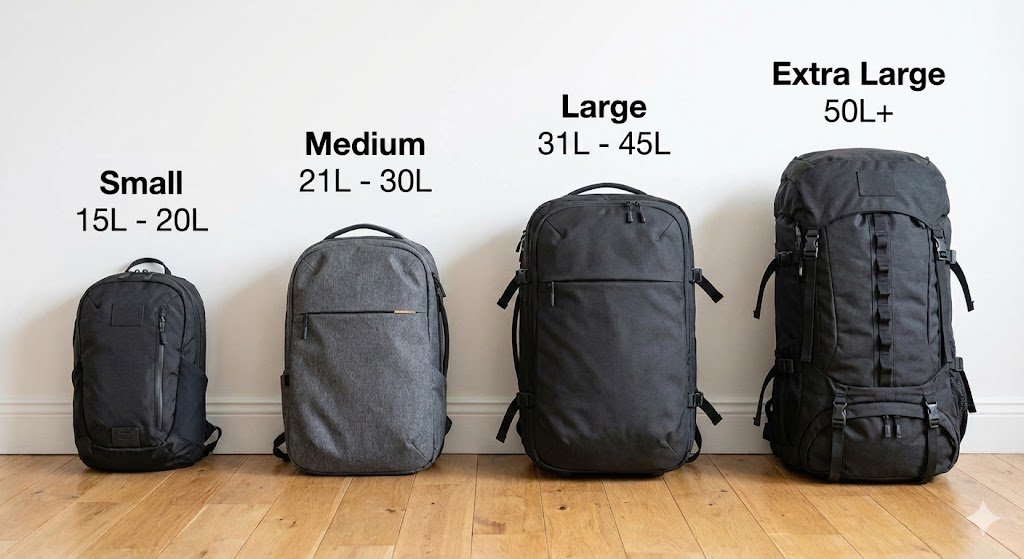
Backpack sizes are measured in Volume (Liters), representing the total internal space of the bag, rather than its external dimensions. Sizes typically range from Small (15-20L) for daily essentials to Extra Large (50L+) for multi-day trekking.
Understanding “Liters” can be confusing because it measures liquid volume, not shape. A 30L bag might be tall and thin (hiking) or short and wide (travel). To choose the right size, you must match the volume to your specific load-out requirements.
Use this size guide to determine exactly how much capacity you need:
Table: Backpack Size Guide by Volume
| Size Category | Capacity (Liters) | Common Load-Out | Best For |
|---|---|---|---|
| Small | 15L – 20L | 13″ Laptop, Jacket, Water Bottle, Wallet. | Minimalist commute, sightseeing, concerts. |
| Medium | 21L – 30L | 15″ Laptop, Gym Clothes, Lunch, Notebooks. | The “Sweet Spot” for school, work, and gym. |
| Large | 31L – 45L | Clothes for 3-5 days, Toiletry Bag, Tech Pouch. | One-bag travel, weekend road trips. |
| Extra Large | 50L+ | Tent, Sleeping Bag, Cooking Gear, Food. | Hiking, camping, military deployment. |
Pro Tip: For daily use, do not exceed 30 Liters. A bag larger than 30L often becomes too bulky for crowded trains and under-desk storage, and the extra space encourages overpacking which leads to back strain.
How Do You Choose the Right Backpack Material?
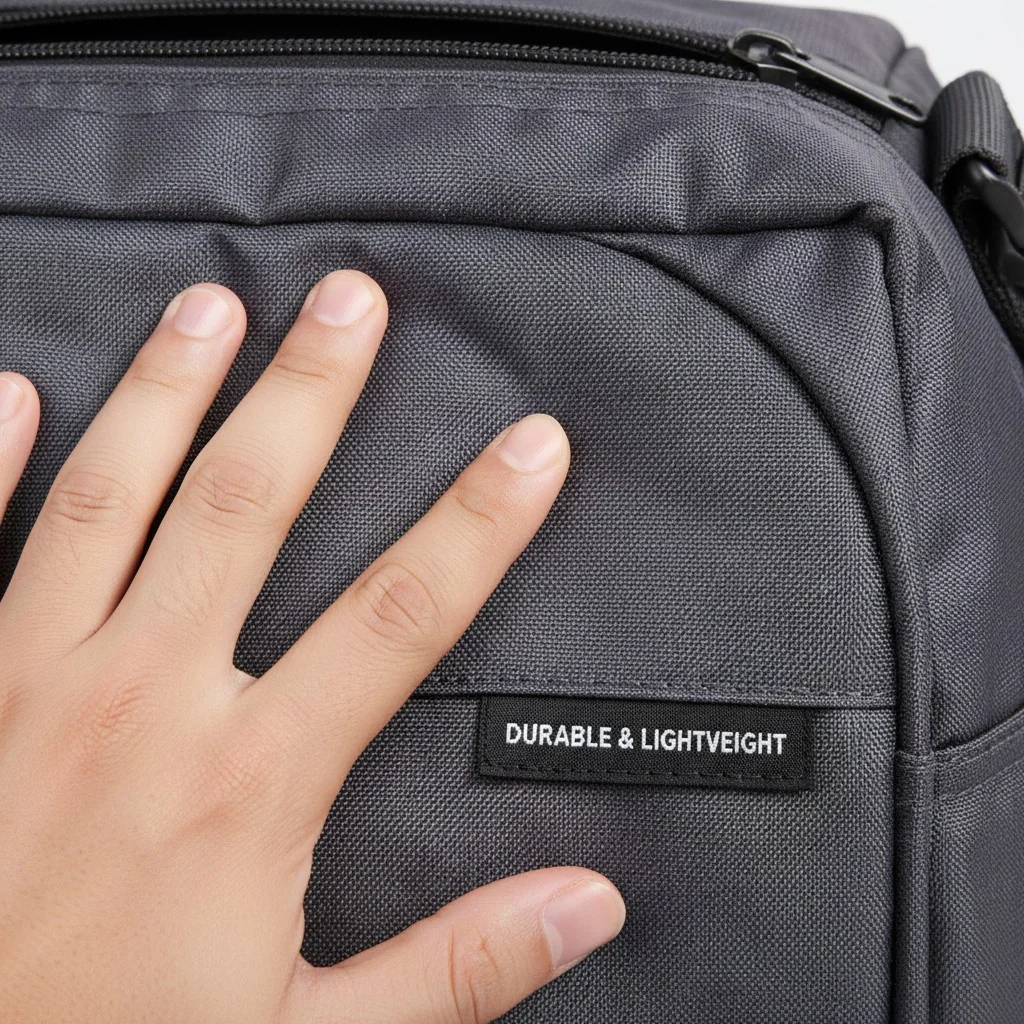
The durability of a backpack is strictly determined by its fabric Denier (D) and coating. For heavy-duty use, manufacturers recommend 1680D Ballistic Nylon; for general use, 600D Polyester is standard.
In backpack manufacturing, the “Bill of Materials” (BOM) dictates performance. You can use this decision matrix to select the right material for your needs.
Fabric Selection Guide (Decision Matrix)
| Priority | Recommended Material | Technical Reason |
|---|---|---|
| Maximum Durability | 1680D Ballistic Nylon | Developed for military armor; offers highest abrasion resistance. |
| Water Resistance | TPU Coated Polyester | Rubberized coating sheds water completely (ideal for cycling/swimming). |
| Budget / Lightweight | 600D Polyester | Good balance of cost and weight; holds dye/colors well. |
| Vintage Aesthetic | Waxed Canvas | Develops a patina over time but is heavier and requires maintenance. |
- Nylon (Ballistic/Ripstop): The strongest option. It has high tensile strength and abrasion resistance. 1680D Ballistic Nylon is the gold standard for premium bags.
- Polyester: A cost-effective alternative. While slightly weaker than Nylon, it holds color well and resists UV fading. Look for 600D or higher.
- Canvas: Used for “Heritage” style bags. It is heavy and absorbs water unless waxed.
- Waterproofing: Check if the fabric has a PU (Polyurethane) Backing or a DWR (Durable Water Repellent) face coating. This keeps your gear dry in light rain.
📘 Deep dive into backpack fabrics: This table covers the essentials. For a full comparison of all 12 common backpack materials — with pros/cons, real sourcing prices, and brand supplier information — see our complete guide to 12 common backpack materials. For nylon specifically, our nylon fabrics guide breaks down 420D through 1680D in detail.
How to Choose the Right Backpack? (3-Step Guide)
To ensure a perfect fit and long-term durability, buyers should focus on three technical specifications: Torso Length (not total height), Volume in Liters, and Hardware Brand (specifically YKK zippers).
When buying a backpack, ignore the color for a moment and focus on the mechanics. Finding the right pack is a balance between your body mechanics and your daily workflow requirements.
Which Technical Specifications Matter Most?
To guarantee longevity and comfort, you should prioritize 1680D Ballistic Nylon for durability, YKK zippers for reliability, and a suspended laptop sleeve for device protection.
- Torso Fit: The bag should sit between your C7 vertebrae (base of neck) and your iliac crest (top of hips). If it hangs below your glutes, it will cause back pain.
- Volume (Liters):
- 15L-20L: Minimalist (Laptop + Jacket).
- 25L-30L: Hybrid (Laptop + Gym Shoes + Lunch).
- 40L+: Travel Only (Too bulky for daily use).
- Hardware: Check the zippers. If they aren’t YKK or SBS, they are likely the first component to fail.
Actionable Tip: The “Laptop Drop” Test
Before keeping a new backpack, perform the “Laptop Drop Test” (gently). Feel the bottom of the laptop compartment.
- The Fail: If the padding goes all the way to the bottom seam, the bag is poorly designed.
- The Win: You want a “Suspended Sleeve”—where the pocket ends 1-2 inches above the bottom of the bag. This ensures that when you set your bag down on a concrete floor, your expensive device hits a cushion of air, not the ground.
What Is the Proper Way to Wear a Backpack?
To properly wear a backpack, adjust the straps so it rests snugly against your back, with the hip belt supporting the majority of the weight on your hips. Use both padded shoulder straps to keep the pack high on your back, roughly between your neck and waist, and adjust the load lifters to prevent the pack from sagging backward.
Adjusting the straps
- Tighten the hip belt: Adjust the hip belt so it rests on your hip bones (iliac crest) and carries about 80% of the weight.
- Tighten the shoulder straps: Pull the shoulder straps down and back to a snug, comfortable fit, but ensure they are not bearing the majority of the weight. The anchor points of the shoulder straps should be 1 to 2 inches below your shoulders, near the top of your shoulder blades.
- Adjust the load lifters: Gently pull on the load lifter straps (if your pack has them) to bring the pack closer to your body and prevent it from pulling backward.
- Connect the sternum strap: Fasten the sternum strap across your chest to help keep the shoulder straps in place and stable.
How Do You Clean and Maintain a Backpack?

Never put a technical backpack in a washing machine or dryer, as heat and agitation will destroy the waterproof PU coating and degrade the foam padding. The industry-standard method is a lukewarm hand wash.
Follow these steps to extend the life of your bag:
- Empty & Shake: Remove all debris and turn the bag inside out if possible.
- Spot Clean: Use a soft brush (like a toothbrush) and mild soap (non-detergent) on stains.
- Rinse: Use a showerhead or bathtub to rinse thoroughly with cool water.
- Air Dry: Hang upside down in a shaded, ventilated area. Avoid direct sunlight, which accelerates UV fading.
Also read:
The Ultimate Guide to Backpack Care and Repair – 2025
A Definitive Guide-Can You Put a Backpack in the Washing Machine?
Looking for OEM/ODM Backpack Solutions?
At Osgoodway, we manufacture high-quality backpacks for brands and retailers worldwide. Whether you need 500 pieces for your shop or 5,000 for your brand, Contact Us for a free quote today.
Learn our customization process and how we control quality for your bags.
Frequently Asked Questions (FAQ)
Yes. Ergonomic studies confirm that backpacks distribute weight symmetrically across the body. Shoulder bags (messengers) create an asymmetrical load, forcing the spine to curve laterally to compensate, which can lead to muscle imbalances and chronic pain.
Generally, No. Agitators can delaminate the PU (Polyurethane) waterproof coating inside the fabric and degrade the foam padding. The industry-recommended method is hand washing in a bathtub with mild soap and air drying.
The modern backpack — meaning a structured bag with frame, shoulder straps, and designed for load distribution — was first patented in the late 1870s by U.S. Army officer Henry Clay Merriam. However, the word “back-pack” itself didn’t enter the English language until around 1904, and what we now consider a “modern” backpack (with zippers, nylon, and internal frame) really emerged in 1967, when Greg Lowe invented the internal-frame pack and JanSport was founded.
Backpack is the modern universal term for any two-strap bag carried on the back. Rucksack specifically refers to top-loading bags with flap closures and drawstring openings, typically military or bushcraft style. Knapsack is an archaic term (from Dutch “knappen” meaning “to eat”) rarely used in modern production — you’ll mostly find it in historical or literary contexts. All three words describe overlapping products, but in the bag industry today, “backpack” is the standard term.
By production volume and market share, JanSport (founded 1967, owned by VF Corporation) remains the largest backpack maker in the world. Together with its sister brand The North Face, JanSport produces nearly half of all small backpacks sold in the United States. Other major global backpack brands include Herschel (Canada), Fjällräven (Sweden), Deuter (Germany), Osprey (USA, outdoor), and Samsonite/Tumi (premium business).
A loaded backpack should never exceed 10-15% of your body weight for daily use, or 20% for hiking. For a 70kg adult, that’s 7-10kg for daily commute, up to 14kg for multi-day hiking. Exceeding these limits regularly causes muscle strain, poor posture, and long-term back problems. For children, the recommendation is even stricter: a loaded school backpack should not exceed 10% of the child’s body weight.
For most use cases, 600D polyester offers the best balance of cost, durability, and weight. For heavy-duty outdoor or tactical use, 1000D Cordura nylon is the industry standard. For “buy it for life” durability, 1680D ballistic nylon is the ultimate. For eco-friendly options, recycled polyester (rPET) offers comparable durability to standard polyester with a lower environmental footprint. There is no single “best” material — it depends on your use case, budget, and priorities.
For daily commuting, school, or office use, 20L–25L is the sweet spot. This size fits a 15″ laptop, water bottle, lunch, notebook, and a light jacket without becoming bulky. Avoid going larger than 30L for daily use — the extra space encourages overpacking, and the bigger profile becomes awkward on crowded trains, in narrow office corridors, or under desks. For weekend travel, step up to 35L–45L. For multi-day hiking, 50L+.